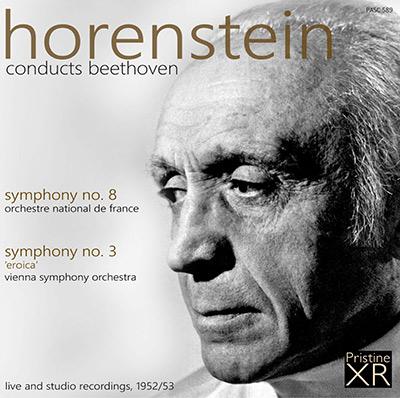
BEETHOVEN: Symphony No. 8 in F Major, Op. 93; Symphony No. 3 in E-flat Major, Op. 55 “Eroica” – Orchestre National de France (Op. 93)/ Vienna Symphony Orchestra (Op. 55)/ Jascha Horenstein – Pristine Audio PASC 589, 78:38 [www.pristineclassical.com] ****:
Collectors of the distinguished conductor Jascha Horenstein (1898-1973) will receive this latest entry from Pristine Audio with mixed feelings, given that the volatile, volcanic performance of the Beethoven Eighth Symphony (11 February 1952) has already had a solid restoration by way of the 2004 Music&Arts set (CD-1146, 9 CDs) devoted to Horenstein’s broadcasts from Paris, 1952-1966. The XR remastering from Andrew Rose casts a slightly brighter sheen on what had already been a fiercely driven, crisply etched realization of Beethoven’s favorite among his symphonies. The Paris woodwinds and strings appear particularly alert and responsive to the various shades of color in metronome-parody Allegretto scherzando. The obvious love of detail and the sense that the work bears many of the contrapuntal hallmarks of the Eroica and rhythmic strategies from the Fifth– but in compressed form – informs Horenstein’s account with an intelligent musculature impossible to deny in its infectious, often singing, grandeur. Commentator Mischa Horenstein characterizes the last movement, Allegro vivace, as “ebullient,” and aficianados of this robust score will note how Horenstein’s propulsive brio well matches the kind of witty energy accomplished just across the English Channel, with Beecham and his Royal Philharmonic.
Jascha Horenstein recorded Beethoven’s Eroica twice for the same Vox label, this from February 1953 Vienna and a second reading from Baden-Baden in May 1957. Jascha Horenstein called the 1953 recording the “one I conducted from my heart,” as opposed to the more cerebral conception of 1957, conducted “with my head.” The “heartfelt” version we have before us testifies to the tremendous influence of Horenstein’s post-Romantic apprenticeship in thought and style under Wilhelm Furtwaengler, whose own, titanic reading of 1944 Vienna likely stands as a humanistic testament without peer. But this performance comes mighty close: driven, inward, often surging in temperament and fully conscious of Beethoven’s struggle in agogic articulation and asymmetry in the opening movement, the impact proves entirely gripping and compelling. The balance of phraseology, each with its poised sense of closure, the periodic landings – and perhaps most eloquent – the breathed silences within the ongoing tumult of musical lines, become a haunting, haunted lesson in aesthetic architecture. Some may feel that the tympanist of the Vienna Symphony deserves a credit entirely his own.
Horenstein’s Marcia funebre: Adagio assai (in C minor) proves no less monumental: in point of fact, this reading may endure as among the most grueling and compelling – especially for its length and maintenance of dramatic tension – on record. The brass work from the VSO has my unqualified admiration, as do the oboe, flute, and French horn. The palpable presence of fate, doom, Moira – call tragic destiny what you will – rises before us as a commentary on post-WW II Europe, if not on what Mahler called the 20th Century, “the century of Death.” The Scherzo, then, emerges, phoenix-like, from the emotional ashes, yet no less studied in tis rhythmic suasion and potent, often explosive, ostinatos. Here, we feel something of the Toscanini economy of means, the incisive leanness of attack. The vibrant Trio has the “hunt” sensibility, but the manic directness subverts whatever bucolic repose might have assuaged our sense of tragedy. Horenstein opens the huge last movement, Finale: Allegro molto, relatively marcato, restrained, gradually allowing the theme – drawn originally from a contredanse and then applied to the Prometheus ballet and the Op. 35 Variations for piano – to evolve in the course of ten variations that indulge, along the way, in counterpoint set in the second movement’s key of C minor. The G minor Variation 6 has Horenstein’s urging the string and wind rocket figures upward with a potent elan. The interplay between brass and tympani assumes a truly thunderous dimension. The oboe Variation 8 (Poco Andante) enjoys a rare moment of repose, an enchanted lyricism undergirded by pizzicatos and the low woodwinds. The last variation exults in the power of the tutti as well in selective silences, often creating a mesmerizing pulse and layered stretto. The surging energy of the Presto coda embodies the very core of “heroism” as we might construe its having to do with self-overcoming.
—Gary Lemco