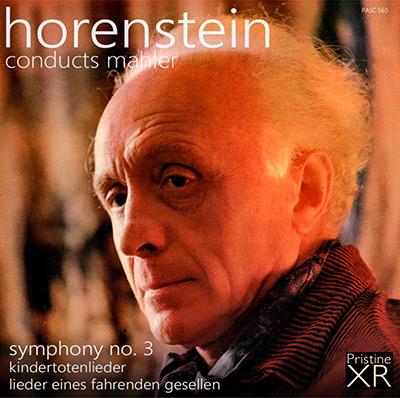
Horenstein conducts MAHLER = Symphony No. 3 in D minor; Kindertotenleider; Lieder eines fahrenden Gesellen – Norman Foster, baritone/ Bamber Symphony Orchestra/ Helen Watts, contralto/ Highgate School Choir/ Orpington Junior Singers, London/ London Symphony Orchestra – Pristine Audio PASC 565 (2 CDs) TT: 2 hr 10:39 [www.pristineclassical.com] *****:
Despite a virtually life-long commitment to the music of Gustav Mahler, conductor Jascha Horenstein (1898-1973) embraced the challenges of the composer’s massive Symphony No. 3 (1902) late in his career, 1953, leading Italy’s first performance in Rome. The performance presented here by Pristine, under the supervision of Mischa Horenstein, derives from a concert of 16 November 1961 from Royal Festival Hall, London and captures the LSO (and contralto Helen Watts) in their respective debuts in this work.
The set, however, opens with Mahler’s settings of 1901 and 1904 of five of the poet Rueckert’s Kindertotenlieder, recorded for Vox in September 1954 with baritone Norman Foster. Foster’s voice projects a deeply somber and resonant sense of loss, given that the cycle utilizes a relatively small orchestra – consisting of strings, winds, two horns, a kettledrum and gong – and the connecting motif appears to be a yearning for light. “Nature,” as such, absents itself from the texts, unlike both his First and Third Symphony, rife with pantheistic declamations. The harmonic movement of the five songs remains deliberately restrained, gravitating generally from D minor to D Major – especially in the fourth song in E-flat Major, coming after the dire C minor of “Wenn dein Muetterlein.” The E-flat tonality, underlined by the appearance of the harp’s arpeggios, signifies for Mahler that “primal light” for which his heavy determinism seeks succor. That Foster’s opening notes in the song relay a minor third adds to the tragic irony of the sentiment of denial, that the children will eventually return. Given the grim descent of the last song, “In diesem Wetter,” whose mortal storm proves entirely parallel to that in Nature, the appearance of light soothes the narrator’s temptations for recrimination and assigning blame. “Sie ruh’n,” they rest, he grants, as the flute line resolves into D Major. Collectors of the Horenstein recorded legacy know well that the conductor leads an equally resonant version from Paris with Marian Anderson.
Mahler’s 1885 Songs of a Wayfarer owe their melancholy creation to an unhappy love affair between the composer and soprano Johanna Richter. The journeyman seeks to escape the “chagrins” of love by seeking out Nature, a theme close to Schubert. The folk style of The Youth’s Magic Horn permeates the setting, which opens with the beloved’s marriage to another, the grim thoughts of which collide with the rhythms of a wedding dance. The immediacy of natural sounds infiltrates the first two songs, although the pipings, chirps, and twitterings may also reflect Nature’s indifference. Mahler’s most “operatic” moment occurs in the third song, in which a glowing knife cuts into the heart of the narrator, a bitter pulse to mark his dejected state. While we might note the limits of Foster’s upper register, his rendering of the lover’s anguish, buttressed by an incensed Bamberg orchestra, could hardly bear more catastrophic emphasis. A funeral march begins the last of the cycle, as the blue eyes of the beloved haunt the plodding steps of the narrator as he proceeds toward eternity. With the appearance of the linden tree the music assumes a consolatory tone in major, and the narrator may find acceptance of life’s cruel mixture of pleasure and pain.

Gustav Mahler,
by Moritz Nähr
Mahler insisted that his Third Symphony embraced “a world, a personal universe” of experience. Mahler at first provided a detailed program for his epic, a pantheistic “rejection” of that irreverent part of Nietzsche, that “God is dead,” but rather exists – a la Spinoza – in the fusion of all matter and spirit. The first movement, “Pan Awakes. Summer Comes Marching In,” invokes a thoroughly contradictory series of shifting effects, rendered in a hugely inflated sonata-form. The brass section of the LSO – Barry Tuckwell’s French horn, especially – invokes a clarion gesture of a cosmic will to paradoxical, organic life. Crisp attacks, pungent clarity of lines, a slow and inexorable rise of temper and tempest, a vaulting, tensely unified energy – characterize the colossal movement, expansive in its own right as any complete Classical symphony.
Horenstein invests the idiosyncratic Tempo di Menuetto with alternately requisite swagger, cynicism, and tender lyricism. Frequently, the music gathers a sentimental urgency as well as a sinister element in this flower-piece, with its allusions both to Schubertian laendler and to Wagner’s Parsifal. For his third movement, a scherzo entitled “What the animals in the Forest Tell Me,” Mahler employs his own lied Abloesung im Sommer, rife with woodwind twitters and pizzicato strings. Trumpet, posthorn, flutes, and diviso strings contribute to a dazzling effect, given the LSO’s acerbic attacks that pungently, even drunkenly, resonate with Nature’s kindness and mischief, at once. The melody line traces out La Folia. Nietzsche’s Also Sprach Zarathustra then provides the eleven lines set in frozen motion to low strings and harps, the “chimes” of the Midnight Song, each line of the cosmic message sung by Helen Watts set between two of the twelve peals of midnight. “What Humanity Tells Me” sings of a “Joy deeper still than heartache,” perhaps catapulting Beethoven’s “Ode to Joy” to a higher plane. “All joy seeks eternity.” The sublimity of thought segues to an intermezzo fifth movement of bells and chimes, “What the Angels Tell Me,” the ingenuous gestures taken from Des Knaben Wunderhorn. The children’s voices enter into dialogue with a voice of sinful Humanity, who needs only repent and love God to receive Heaven’s balm. “And a child shall lead them.”
At the beginning of the final Adagio, “What Love Tells Me,” Mahler wrote, “Father, behold my wounds, do not let any creature be lost.” We recognize immediately that Mahler’s Fourth Symphony has in fact been written in reverse. We hear reminiscences of the first and fourth movements as the music proceeds confidently and serenely within the “transcendent,” emotional parameters of Beethoven’s last, F Major Quartet, Op. 135. A deep faith and overpowering feeling of love pervade the finale, where the world’s anguish and perversities find resolution. And in what does Mahler’s potent faith base itself upon, if not the depth and power of his doubts?
A towering performance, this, in its own time and hereby granted us for posterity.
—Gary Lemco
More Information at Pristine Classical Website: