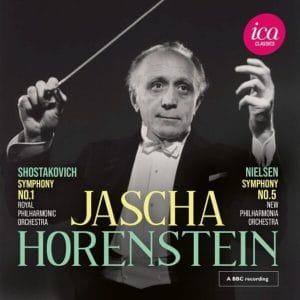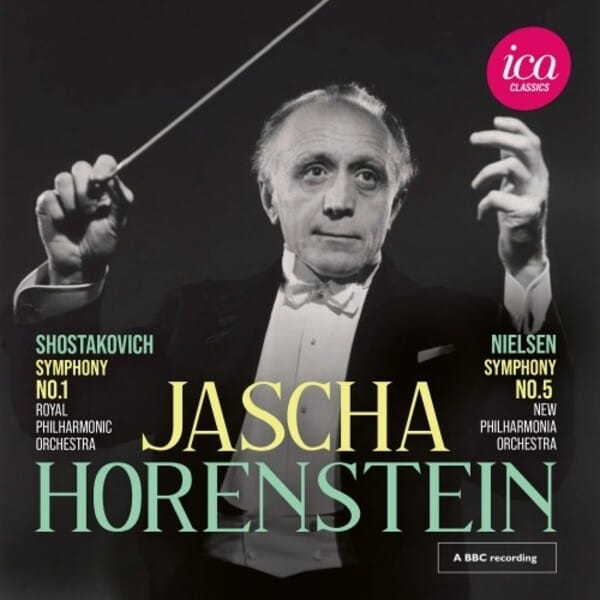
NIELSEN: Symphony No. 5, Op. 50, New Philharmonia Orchestra; SHOSTAKOVICH: Symphony No. 1 in F Minor, Op. 10, Royal Philharmonia Orchestra; Horenstein in conversation with Deryck Cooke – Jascha Horenstein – ICA Classics ICAC 584 (72:50) (4/16/25) [Distr. by Naxos] ****
Conductor Jascha Horenstein (1898-1973) continues to gather a more expansive discography as new releases feature his outstanding concert and studio performances. The live 1970 Shostakovich First reading came to the BBC for a 12 April 1971 broadcast. The Nielsen Fifth Symphony was recorded at the BBC Maida Vale Studios on 26 February 1971.
The six-minute conversation with Deryck Cooke reveals Horenstein, though born in Russia, to be a musical product of the Austro-German school. His having absorbed the Dane Carl Nielsen into his repertory came about because of a direct assignment from Wilhelm Furtwaengler to prepare the score for the SCM Festival in Frankfurt. Also on the program was the Bartok Piano Concerto No. 1 with the composer at the keyboard. Horenstein rehearsed the Nielsen Fifth and then took a decided interest in Nielsen’s work as a whole. The Fifth, for Horenstein, projects originality from the first, a similarity with the work of Janacek. Horenstein mentions that pianist Artur Schnabel held Nielsen’s music in respect. Nelisen came to the Frankfurt Festival, an old-fashioned gentleman, genial, polite, and very sensitive to the demands of orchestra conducting.
The Shostakovich Symphony No. 1 of 1924 served as Dmitri Shostakovich’s graduation project, and it received its 1925 premiere in Leningrad from conductor Nikolai Malko. Deft and witty in its scoring, the piece conveys the capacities of the composer for irony and sarcasm, given the politics of the relatively new Soviet Union and its transformation from a workers’ state to a punishing dictatorship. The young composer eschews ceremonial bombast in his first movement, Allegretto – Allegro non troppo, opting for dialogues between muted trumpet and bassoon, assisted by winds and pizzicato strings. Clarinet and flute, respectively, introduce major themes, but Shostakovich often interrupts the flow with shifts in rhythm and texture that leave us off-kilter and bewildered.
The second movement Allegro serves up a bravura scherzo, most demanding on the RPO but tossed off with Horenstein’s characteristic panache. With the addition of an obbligato piano, the score resembles a jazzily zany concerto just before an eruption, fff, that smacks of the composer’s earlier avocation, playing silent movie accompaniments. Malko had to repeat this movement at the world premiere. The RPO oboe assumes much control in the slow movement, Lento, an expressive alteration of the martial theme in the first movement. Minor mode chords and a funereal tone mark the secondary theme in dotted rhythm, almost a Baroque progression. A collision of themes ensues, and brass fanfares announce what might have proved a serene coda, but the snare drum, attacca, moves us to the final movement, Allegro molto. A grinding texture motif erupts, supported by a manic piano. Emotional conflict seems the order of the day; but suddenly, a consoling solo violin appears over a wind and chime pedal, and a horn extends the moody theme. The RPO strings surge in pain, but the woodwinds, strings, brass, and tympany assault us the circus or battle music sustained in harsh tone colors. A full stop: then the tympany tattoos a funereal motif answered by the cello and oboe over the fateful drumbeat. Mournful, wistful, the music allows some brighter colors to invade the dungeon premises in rising figures, erupting yet one final time, an assertion of will in the midst of emotional havoc. Huge applause from the audience in Nottingham.
A spirit of rebellion seems to motivate Carl Nielsen’s 1922 Symphony No. 5, especially given the snare drum’s role as an instigator of musical and dramatically disruptive shifts. Often, the first movement, Tempo giusto – Adagio no troppo, has individual instruments playing ostinato, repeated notes percussively, having arisen from a dreamy surface, with shards of melodies rather than extended, flowing themes. We feel the influence of Sibelius, pastoral but unnerving, at once. The emergent string line feels promising, but a tension soon arises, and harmonic, chromatic instability takes its toll. The martial appearance of the snare, with its clanging accompaniments, urges us to menace, and the snaky figures from woodwinds only confuse us. An Adagio replaces the furor, but the snare does his obsessive best to unsettle the mood. These huge periods of competitive activity suggest the influence of Mahler more than that of Sibelius, a world of conflicting and conflated impulses. Horenstein has revealed his own, authoritative command of Nielsen’s unique orchestral syntax, indicative of a long association with this particular score; and we may well imagine that the over-taxed Wilhelm Furtwaengler of 1927 had been well pleased by his assistant’s preparations, forty-four years later, here brought to a convincing fulfillment.
—Gary Lemco
More information through Amazon