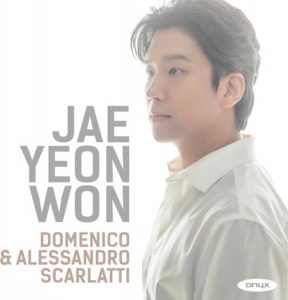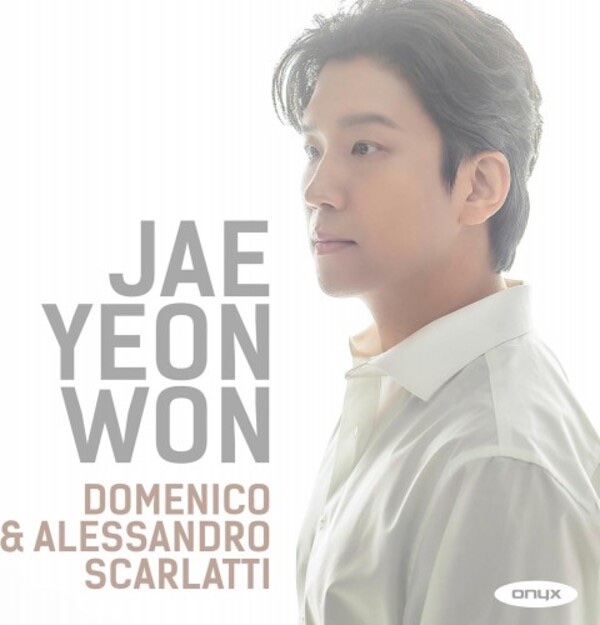
A & D SCARLATTI: Sonatas and Toccatas – Jae-Yeon Won, piano – Onyx 4267 (6/27/25) (78:44) [Distr. By PIAS] *****:
South Korean pianist Jae Yeon Won (b. 1988), second-prize winner of the 2017 Ferruccio Busoni Piano Competition, explores Italian father and son Alessandro Scarlatti (1660-1725) and Domenico Scarlatti (1685-1757), both of whom contributed to the Baroque keyboard tradition. Father Alessandro, however, enjoys his repute in the opera medium, while Domenico, by way of 550 sonatas, proved himself a brilliant innovator of expressive, colorful works that blend vital, Spanish and Italian impulses.
A. Scarlatti: Toccata VI in D minor typifies his designation for a touch-piece, often in several sections, marked by contrasted tempo indications. Virtuosic, they feature frequent arpeggio and acciaccatura accents to create strong dissonances. Originally conceived for harpsichord or clavichord, that Won plays them on the modern piano gives them a fluid luster. This piece’s second movement expresses a desire for a light, French vocal style.
 D. Scarlatti: Sonata in G Kk 427 The “Kk” stands for the Kirkpatrick chronological listing. This piece features a flurry of 16th notes and potent cadences. Sonata in E, Kk 380, one of his most popular, has a prancing, martial gait, ending with delicate trills. Set in binary form, its second half continues the rhythm in a quieter, reflective mood. Sonata in G minor, Kk. 8 is an expansive, meditative work, built on short, drooping phrases that gain lyric power.
A. Scarlatti: Toccata in D Major, in two sections, projects a ceremonial jubilation, ornamental and brilliant in the high registers. The second movement Allegro plays like a Gigue, an energetic, contrapuntal dance in perpetual motion.
D. Scarlatti: Sonata in D minor, Kk 141 brilliantly imitates Spanish guitar figures in relentless, bravura style. The demands for repeated notes require an adept virtuoso. Sonata in D Minor, Kk 22 is marked “Aria” and projects lyrical intimacy. It easily suggests a Spanish sarabande. Sonata in A Kk 208 proceeds in stately, processional tones. The parlando (“spoken”) melody enjoys a series of nuances in tone and gesture. Sonata in F# Minor Kk 25 proceeds in colored, chromatic phrases, often sounded in bell tones. Won uses his pedal to bring out the rich layers of tone, especially in smooth legato. Sonata in A Minor Kk 175 aggressively darts forward, then assumes a dance style in syncopated accents. We hear imitations of guitar style, especially the sound of strumming in keyboard terms, bouncing in flamenco rhythms.
A. Scarlatti: Toccata in A Minor in five movements resembles a suite or partita. The Grave sets a deliberate, melancholy tone in echo effects. The Balletto exerts energy, with brisk attacks and staccato motion. The brief Allegro playfully exploits counterpoints. Presto in C treats the right hand to bravura figuration, quite Italianate in repeated notes in dancing motion. Tempo di Menuetto concludes the suite in courtly style, a galant exercise with quick, sliding gestures
D. Scarlatti: Sonata in C Kk 255 presents an extended, colorful Allegro, shifting registers and textures in a prancing rhythm. The music becomes haunting in its procession, the hands in dialogue. Sonata in F Kk 17 plays like a staccato étude, no less exploiting ornamental runs. Sharp accents mark the various points of entry. Scarlatti diminishes the dynamics and then suddenly catapults forward in swirling turns, like a matador’s cape. Sonata in C Minor Kk 56 is marked con spirito, another speedy étude for color effects. Its syncopated energies bursting with hints of Spanish guitar rhythm. Sonata in C Minor Kk 40, relatively brief, offers a minuet in a dainty, prancingly lilted rhythm, almost a music-box sonority.
A. Scarlatti: Toccata IV in A Minor proceeds in two sections. The first sounds like a romantic fantasia, Allegro, which might be assigned to Sebastian Bach’s sons. It gains acceleration and chromatic color quickly, reminiscent of Bach’s Toccata and Fugue in D Minor, S 565. The ensuing fugue is texturally dense, layered in fast, perpetual motion.
D. Scarlatti: Sonata in D Minor Kk 9 gives us another of his more familiar works, marked Allegro but played moderato in the manner of a lovely, ornamental sarabande. Sonata in E-flat Kk 253, Allegro, tests the coordination of the hands in alternate, staccato figures. A Spanish gallop ensues, repetitive and accented, at once, always exhilarating. Sonata in F minor Kk 466 ends the cycle in haunted tones, darkly romantic in color. Quite extended in the Scarlatti canon, it traverses various shades of color within its repetitive, echoed periods, always moving in persuasive, arioso lines, predicting much in Chopin.
Jae-Yeon Won favors the Steinway instrument, and his exemplary tone projects an elasticity and resonance commensurate with his canny, digital prowess. This album comes highly recommended.
—Gary Lemco