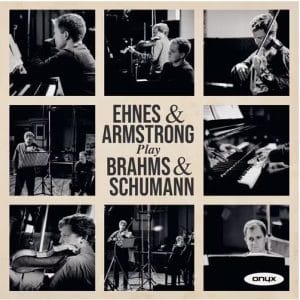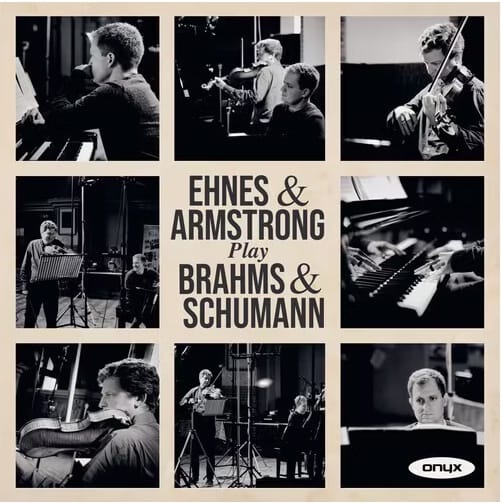
BRAHMS: Viola Sonata No. 1 in F Minor, Op. 120/1; Viola Sonata No. 2 in E-flat Major, Op. 120/2; Wiegenlied, Op. 49/4; SCHUMANN: Märchenbilder, Op. 113 – James Ehnes, viola/ Andrew Armstrong, piano – ONYX 4256 (9/11/24) (61:31) [Distr. by PIAS] ****:
Canadian-American violinist James Ehnes (b. 1976) addresses (9-12 October 2023) the two sonatas Johanns Brahms wrote late in his creative life, 1891, inspired by the clarinetist of the Meiningen Court Orchestra, Richard Mühlfeld (1856-1907, the two sonatas (1894) later arranged for the viola. Robert Schumann composed his sequence of four “Fairy Tale Pictures” in 1851 with violinist and conductor Wilhelm Joseph von Wasielewski in mind. For these recordings of music by Brahms and Schumann, James Ehnes performs on the 1696 ‘Achinto’ Stradivari viola, courtesy of the Royal Academy of Music.
Schumann’s patented melancholy informs the opening of his Op. 113, marked Nicht schnell, D minor, the three minutes of the piece haunted by the close, darkly hued intimacy of the two instruments. Schumann’s template for rondo form dominates the second piece, Lebhaft, F major, an athletic, dotted-rhythm excursion with two intervening episodes. The spirit of the hunt reigns here, the viola’s rich stops and the piano’s sweeping chords affecting a symphonic sonority. The third movement, Rasch, returns to D minor, urgent and restless in buzzing effects, trying to find some respite in the middle section, but the frenzied figures proceed once more. The D major last movement, marked Langsam, mit melancholischem Ausdruck (“Slow, with melancholy expression”), employs a theme found in the slow movement of the Beethoven Ninth Symphony, which no less makes its way into the Adagio of the Brahms Op. 108 D Minor Violin Sonata. Ehnes and Armstrong unite these three grand souls in a mood of quiet, serene reflection.
The darker of the two Brahms sonatas Op. 120, that in F Minor, is marked Allegro appassionato in the first movement, originally meant to glorify the clarinet chalumeau register. Brooding and startlingly impulsive, the music has Ehnes moving in brisk arpeggios and shifting registers. Armstrong opens with a four measure descending phrase that dominates the music, while a spirited, lyrical melody, ben marcato, serves as an emotional foil. The beauty in the late Brahms style emerges fluently in the second movement, Andante un poco adagio, 2/4, led by a descending theme of heartfelt introspection. The piano plays an ostinato, Schumannesque rhythmic figure that segues into its own meditation, much like the late Brahms intermezzos. Brahms opts for a waltz in his third movement, Allegretto grazioso, comprised of a descending motif and its rising inversion. A kind of stomping dance emerges momentarily, only to return to the swaying impulse that has inherited a bit of the rusticity of the second motif. Armstrong’s tender suasion in the middle part suggests what he might effect in the larger Brahms solo piano works. Three ff chords from Armstrong alert us to the Vivace last movement, a sparkling rondo whose theme derives from previous falling figures, interrupted by reflective episodes that define the rondo form. Even in the martial episodes Ehnes’ instrument projects a lovely, burnished tone, grazioso et leggiero, that equals what William Primrose accomplished in his classic collaboration with Willima Kapell.
Emotional restraint marks the E-flat Major Sonata, first revealed to me in the recorded collaboration between Benny Goodman and Nadia Reisenberg. The music, autumnal and essentially lyrical, has a genial mood, amabile, that corresponds to his earlier “Thun” Violin Sonata in A, Op. 100. The wistful temper of the first movement has a turbulent, passing, chromatic interruption early, especially in the audacious piano writing, that Ehnes’ viola assuages with a leisurely songfulness. The same emotional duality permeates the second movement, Allegro appassionato, whose insistent piano part aspires to dark heroism, but must concede to a mood serene and consoling, Sostenuto, ma dolce e ban cantando, spaciously melodic in the manner of a dignified hymn or procession. Brahms opts for a favorite among chosen forms and procedures: a theme-and-variations based on a 14-measure motif that will inspire five variants. Marked Andante con moto – Allegro non troppo, taking a folk-like melody through increasingly florid, even virtuosic, permutations. Variation 3 breaks away from the dreamy, carefree sensibility of the first two, demanding, grazioso, twenty-four notes to the bar, divided neatly between the two principals. A quiet interlude defines Variation 4, a moment approaching stillness; when suddenly, Variation 5 rushes forward in a frenzied gesture, Allegro, rife with cross rhythms and a plaintive, scalar, rising gesture from Ehnes. The music catapults downward, exploiting the richly fertile tones of the low viola register for a conclusive, final note.
The transcription of the ubiquitous Brahms Wiegenlied, Op. 49/4 in its simple brevity and ardent sincerity, makes us believe Ehnes and Armstrong have been playing lullabies all along.
—Gary Lemco
More information through Amazon