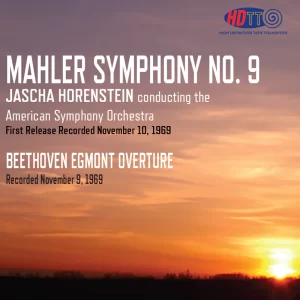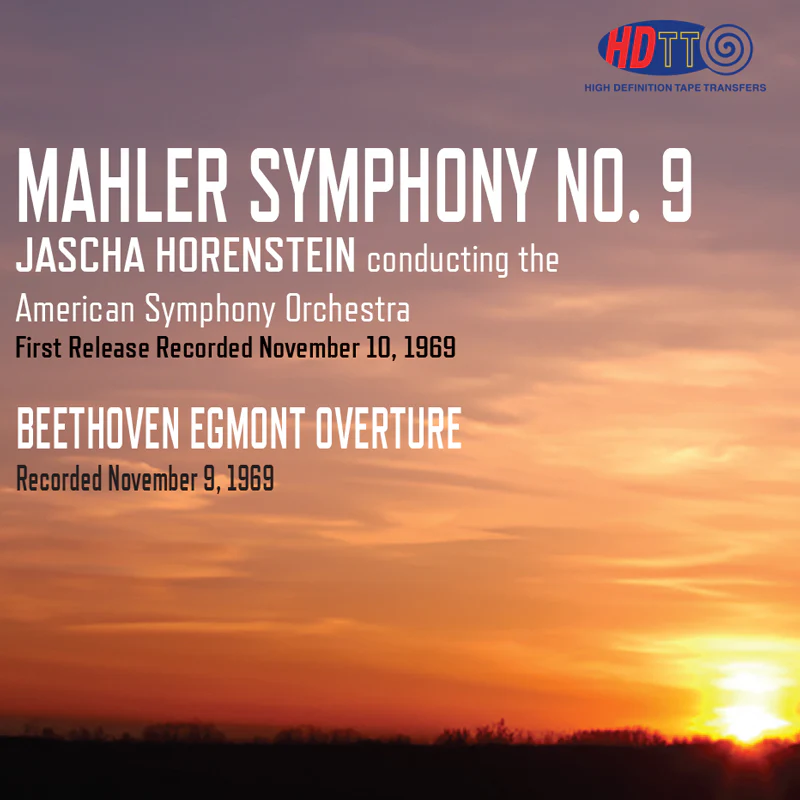
MAHLER: Symphony No. 9 in D Major; BEETHOVEN: Egmont Overture, Op. 84a – American Symphony Orchestra/ Jascha Horenstein – HDTT (2 CDs = 52:39; 39:10) *****:
Ukrainian-American conductor Jascha Horenstein (1898-1973) appeared before Leopold Stokowski’s American Symphony Orchestra but once, 9-10 November 1969, in what would be his last thoughts on Gustav Mahler’s 1909 Ninth Symphony, complemented by the popular, defiant Egmont Overture of Beethoven, programmed as a concession to “late arrivals” at the ensemble’s concerts. As commentator John Haley explains in his excellent program notes, the recording of the Ninth, the product of a hidden, portable tape recorder of an experienced audience member, enjoys a remarkable ambiance and resonance, minus dynamic compression and the removal of audience noise. The American Symphony had not performed the complicated Mahler score prior to Horenstein’s arrival, and the second of the performances – that offered here – benefitted dramatically over their first efforts. Recall that conductor Horenstein served among the primary acolytes of Mahler interpretation, along with Fried, Mengelberg, Klemperer, Szenkar, and Walter, bearing within him the original, spiritual impulses that had suffused the composer’s creative imagination. After their first rehearsal together, Horenstein praised the American Symphony players foremost for their “enormous devotion,” a quality that Mahler (and writer Joseph Conrad) prized beyond all aspects of the human character.
Mahler’s Ninth Symphony contains some of his most paradoxically uplifting, tragic moments in his entire canon. The opening motifs of the first movement, Andante comodo, with their pp cello announcement of a sigh (F-E), answered by a syncopated harp figure, their correspondence to the Lebwohl of Beethoven’s Sonata No. 26, then the climactic utterance of the trombones and timpani and ironic echoes of the Johann Strauss waltz, “Freut euch des Lebens,” resonate with the thought “in the midst of life we are in death.” Whether the irregular rhythms of Mahler’s own failing heart find palpable utterance or Mahler rages against the dying of the light, there persists a singular, tortured anguish to seize all existence, amor fati, forward and backward, in the spirit of Nietzsche’s existential acceptance or Piaf’s Je regret rien! Alternately bucolic with sounds of Nature and dirge-like, funereal processions, the music condenses experience into a ball, later pealing in low bells that sound once only in this laborious trek of the spirit. Horenstein imbues the score with a titanic sense of longing, a yearning to find some meaningful statement in the midst of such a plethora of competing, contrapuntal impressions.
A rustic C major Ländler sets the tone for movement two, but the evolution of the assembled dance music distorts its naiveté into something threatening and sinister. Chromatic harmony has already “progressed” away from D major and employed whole tones to suggest a waltz not far from Berlioz’s ballroom scene in his Fantastic Symphony. The first movement sighing motif appears once more, now a leitmotif or idée fixe, a complement to both Berlioz and Wagner. Playful, flirtatious, even resonant of klezmer sensibility, the sonically lavish music appears to mock its own tragic muse. The piccolo and contrabassoon will pass the final comment upon all that has preceded, acerbic touches of irony that hearken back Mahler’s own Symphony No. 4 and ahead to many sarcastic moments in Shostakovich.
The Rondo: Burlesque third movement, dedicated “to my brothers in Apollo,” may nod both to Nietzsche and Robert Schumann, especially since the contrapuntal antics and often brutal energy of the music may reflect the literary influence of E.T.A. Hoffmann. The indication Sehr trotzig (quite defiant) justifies our feeling that Beethoven and Wagner hover within the intricacies of a double fugue in an antique, whirling Baroque dance impulse. The American Symphony trumpets, winds, and strings inject a feverish vitality into the reading, reveling in dynamic and textural shifts that suddenly collapse into tearful reminiscence. The naughty dissonances that usher forth, accompanied by harp scales, juxtapose tenderness with a savage mockery. A frenetic statement of the thematic jumble occurs late, still insisting on an anguished counterpoint, a manic, grotesque march in ringing colors. The coda becomes even more keen and outrageous, ending as if by duress.
The last movement, a huge sigh of an Adagio, may owe the finale of the Tchaikovsky Pathétique Symphony a debt, but the urgent string line that opens this music plays as an extended, resigned dirge in autumnal, D-flat major colors. Mahler had dubbed the 20th Century “the Century of Death,” and this grimly processional music seems to embody a long farewell, likely personal, to Mahler’s deceased children, his thwarted ambitions for his work in Europe, and to a defunct system of musical tonality. Horenstein constructs a virtual “wailing wall” of sound with his intent ensemble, a haunted layering of various griefs. The urgent theme from the middle of the Rondo: Burlesque appears now somberly dignified, an overflow of sincere, emotive exhaustion. Exactly what does “Nature tell me” at this level of expression? Woodland textures appear late, sadly intimate, laced with the melancholy of the Kindertotenlieder cycle. Dead children will remain forever young. Their passing never gets any better, only different. A sudden desire to rage against the improbabilities of fortune rises up, as rich in polyphonic despair as in future hopes. The harmonic movement slows down to a lamented crawl of a coda, two pages of drawn-out nostalgia, or better, tesknota, recollection infiltrated by regret. The world here does end in a sustained whisper, though it does not emanate from T.S. Eliot, but from the future of music and Mankind.
Kudos to the HDTT team who has released this second performance by Horenstein and the American Symphony in a shattering and uplifted format.
—Gary Lemco
More information through High Definition Tape Transfers