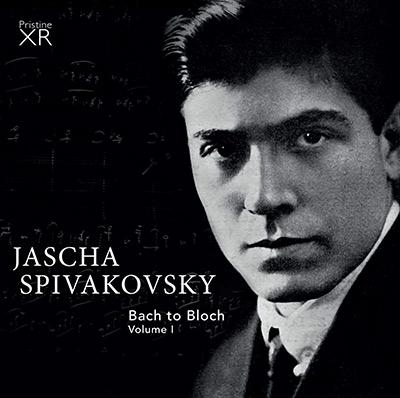
Jascha Spivakovsky, Vol. 9 = Keyboard works by BACHI; BRAHMS; MENDELSSOHN; GLAZUNOV; DEBUSSY; SAEVERUD; KABALEVSKY; LIADOV [full composition list below] – Jascha Spivakovksy, piano – Pristine Audio PAKM081, 78:09 [www.pristineclassical.com] ****:
The ninth installment of the proclaimed “Spivakovsky Jubilee” continues with recordings of the fine pianist in concert, performances selected by Mark Ainley. From the very first measures of the Bach English Suite No. 3 (rec. 1961), the robust vitality of Spivakovsky’s piano tone compels our attention. The two dancing gavottes cavort between major and minor, the latter’s providing he outer structure. Spivakovsky then launches into a monumental reading of the Brahms Sonata No. 3 from Australian Radio archives (1953). This sonata serves as the first potent indication of the young composer’s creative prowess – Brahms was twenty-one in 1854 – heartily combining a prodigious counterpoint with often soaring lyricism. Spivakovsky’s bass line in the opening movement, Allegro maestoso, perforce must span the leaps the define the opening motive, stentorian and declamatory. Spivakovsky’s riveting sense of forward motion carries this sonata-form movement to a towering, ringing sense of closure.
The treasure of this Brahms reading lies in Spivakovasky’s incandescent realization of the Andante espressivo, conceived in the manner of Schumann as a meditation on lines of the poet Sternau, whose nocturne has two hearts embrace, blissfully joined in love. Spivakovsky at key moments, both harmonic and dramatic, slows the rhythm to a kind of enchanted stasis, playing the symmetrical sequences of notes with poignant nuance. The ensuing Scherzo enjoys a whiplash attack, economical of pedal, driving the demonic element while finding that poetic repose in the Trio section that allots to the music a kind of chorale. Spivakovsky finds ominous, nervous energy in the succeeding Intermezzo, which Brahms designates a Rueckblick, a backwards glance that delivers Beethoven’s “fate” motif. Brahms, as Haydn had before him, combines elements of rondo and sonata-form to evolve his Finale. Surprisingly intimate, this last movement, Allegro moderato ma rubato, contrasts a bouncy prime rhythm against two lyrical episodes, dreamy as the musical idol, Schumann, often appears. The second lyric theme achieves the character of an anthem under Spivakovsky; this, despite Mark Ainley’s report that the final movement had gaps in the surviving tape that had to be supplemented by a contemporary student of the master.
The group of keyboard miniatures Pristine restores include a flowing 1830 Venetian Gondola Song from Mendelssohn, set in a seductive F-sharp minor. Add to the innate songfulness of this barcarolle Spivakovsky’s transparent trills. Poise and grace mark the relatively unknown, sprightly Gavotte from Glazunov’s suite of Three Pieces, Op. 49. Claude Debussy has a studied devote in Spivakovsky: The “gradual ascent to perfection” proves an apt rubric for this robust but delicately shaped incursion into chromaticism and whole-tone scales. The Rachmaninoff Prelude in G Major, Op. 32, No. 5 possesses its own allure, gossamer and ethereal, that Moiseiwitsch virtually owns on records by patent. But Spivakovsky realizes its fluid admixture of Thomas Wolfe’s “time and the river” in equally shimmering terms. Harald Saeverud (1897-1992), a Norwegian composer whose pedigree closely attunes itself to Edvard Grieg, has two characteristic pieces of national character: Rondo amoroso and Little-Bird Waltz. The first, a fascinating study in light staccatos and somewhat angular harmony, has Spivakovsky dedicatee. Much in the spirit of a Grieg Lyric Piece, the second twitters and skips in the upper registers.
The last large work in this recital, Kabalevsky’s 1945 Sonata No. 3 in F Major, had a major recording debut in 1948 by Horowitz. The piece addresses the two dominant impulses in the composer: war and the resilience of youth. Spivakovsky’s reading comes to us by virtue of the mid-1950s BBC. The evolution of the first movement development section certainly casts a demonic temper that the pianist’s left hand subsumes in one, unbroken gesture. The coda generates a passing nervousness we recall in the last movement of the Prokofiev Seventh Sonata. The Andante cantabile moves in triple meter, graceful enough at first, but ineluctably yielding to darker impulses. The middle section becomes quite explosive. But in the manner of the Shostakovich Ninth Symphony, the horrors of war transmogrify into insolent humor, Allegro giocoso, a sly one-beat-per-measure waltz that impertinently asserts victory of the spirit over (political) adversity.
The Liadov Musical Snuff-Box (1893) first came to this auditor by way of Alexander Brailowsky. The tiny range of notes captures the toy or gift-box that usually held gold coins for musical luminaries, like Mozart. Liadov designates for the brilliant color miniature to be played “automatically,” but between Spivakovsky’s spoken introduction and his polished upper register, we can only savor the glowing humanity in all them music Spivakovsky surveys.
Compositions:
BACH: English Suite No. 3 in G minor, BWV 808: Gavotte I & II;
BRAHMS: Piano Sonata No. 3 in F minor, Op. 5;
MENDELSSOHN: Venetian Gondola Song, Op. 30, No. 6;
GLAZUNOV: Gavotte, Op. 49, No. 3;
DEBUSSY: Dr. Gradus ad Parnassum from Children’s Corner;
SAEVERUD: Rondo amoroso, Op. 14, No. 7; Little Bird Waltz, Op. 18, No. 2;
KABALEVSKY: Piano Sonata No. 3 in F Major, Op. 46
LIADOV: The Musical Snuff Box, Op. 32
–Gary Lemco