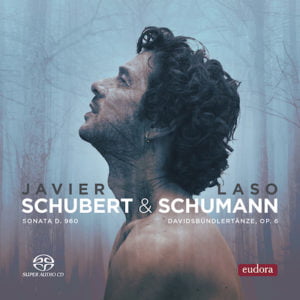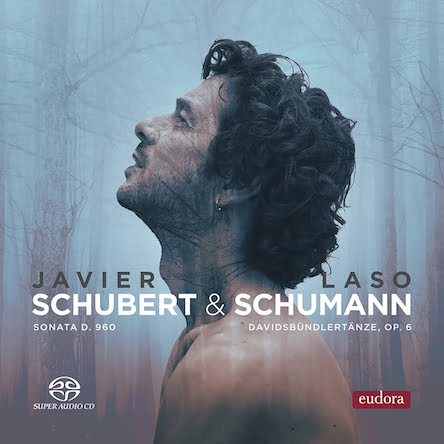
Franz Schubert & Robert Schumann- Sonata D. 960 and Davidsbundlertanze – Javier Laso : Eudora SACD 2113 80:55 *****
When Robert Schumann left home, an orphan at the age of 16, he had a head full of ambitions, most of which were literary. His father had been a book-seller and publisher. Young Robert had enthusiastically consumed all of the heady Romantic literature of his time. His own self- understanding drew heavily on literary references; he was especially attuned to the Romantic era fascination with the shadowy side of things: the Unseen, the Doppelganger, the mask that hides another mask. Indeed, these tropes nourished his melancholy and introspection. But he had another side, possibly a species of mania, that made him intensely creative. Musical improvisation and creation were the most direct outlet for these counteracting spirits.
A number of circumstances tilted him away from literature into music. First, he met a self-made piano teacher (Friedrich Weick) who convinced him that he could make a world-class virtuoso out of the musically talented but untrained Robert. The compelling evidence was manifest in the teacher’s daughter, who was already a piano playing prodigy at the age of 8. Robert more or less joined the household and made astonishing progress while exploring in a more structured way the mechanics of composition.

Clara and Robert Schumann
At some point, and this point was after a series of romantic escapades not without penalty, Robert fell in love with the young girl (say 15 or 16 and Robert 9 years older) and all manner of complications ensued. A much disapproving pater familias, something of a tyrant and spiteful malefactor when crossed, dedicated himself to thwarting their romance over the next four years.
This followed a perfect plot outline from Romantic literature, and the already self-doubting and conflicted Schumann prepared himself to be all at the same time the victim, hero, lover and the artist who turns pain and suffering into beauty. It was no small task, and Robert finally hit on the brilliant idea that he could make more of the situation if he was two people instead of one. Thus arrived his creation of a dual alter ego, Florestan and Eusebius, the names by which he signed both his musical and literary works during this period.
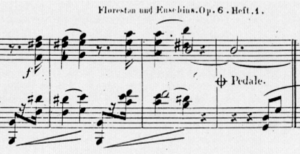
These artistic personae are a well known bit of Schumann biography but I think they are more than just curiosities. They are the key to understanding the very special properties of this bipolar composer. For Schumann felt each as a wind blowing in on his creation. They are an impulse, an aspiration, an orientation towards the past and so much more. He even wrote a note to his future wife in which he dreamed of both figures leading her up to the altar.
It is true that this obsession with his dual genii lasted only through the turbulent phase of his life leading up to his marriage (by which time his music was at last established as a viable life work) In fact, in revised editions of the early piano music, he used his own name. However, I think this music is certainly Schumann’s most original inspiration, and it sets the stage for his later developments which carry on his deeply personal idiom which even in the symphonies (think of the feierlich of the 3rd symphony) veers sharply between moods and expressive sensibilities.
No piece is more important to Schumann’s Florestan and Eusebius period than the Davidsbundlertanze. It is in this piece that the two personalities come on stage unmasked, both speaking for the composer, both addressing the loved one and summoning the great artistic voices of the past that so informed Schumann’s music, specifically Beethoven and Schubert.
It is worth noting the “old saying” that was attached to the original copy dedicated to Clara, his newly affianced lover. “In all times grief and joy are intertwined; be sober in joy and face grief with courage.”
The very first piece has a quote from one of Clara’ own published pieces, a Mazurka. Titled simply Lebhaft and attributed to both Florestan and Eusebius, the piece is wrought with cleverness and perhaps contains some hidden references (according to Uchida there are coded messages in Schumann’s music that would only be understood by Clara). As in earlier works, the Notes E and F have their own special meaning, and their sudden insertion in the pedal will signal the voice of either the impassioned Florestan or the Eusebius speaking simply and from the heart.
It is with the second piece that we feel like we are in new territory. Innig (Eusebius) can mean inward, or tender or even devoted in German. The gentle lyricism of Schumann in his early music is astoundingly beautiful, but it seems here he is pushing towards something beyond that. The feeling evoked from this 2-minute composition is an approach to Schubertian grief and loss. It is not the tenderness of the bridegroom for the bride but rather something closer to a bereavement or a memory of unrecoverable loss. It is remarkable how compressed this is and also how variable it can be in performance. Played with extreme pianissimo and with the gentlest of rubato, it has a devastating impact. The same is true of the penultimate Wie aus der Ferne. The feeling is that of receding, of abandonment.
There is thus some ambiguity in what is supposed to be a collection of “wedding dances.” Meanwhile Florestan is always cheerful and demonstrative. The Florestan pieces have titles like Mit Humor’, Ungeduldig (Impatient) Wild und lustig. Here is the musical representation of the extroverted personality that Schumann aspired towards but never achieved. But within it there is a great deal of well-crafted surprise. As always with early Schumann, there is a feeling of rhythmic high spirits, a trait that was inspired by Beethoven but in his hands is never less than unique. In these very short pieces there is no room for heroic statements. In their brevity, they utterly rivet your attention.
Mitsuku Uchida is one the finest exponents of Schumann (and Schubert for that matter) and revealed much about the nature of these works and the special importance that they have had in her artistic life. In an interview captured in her 2010 release of both the Fantasie op 17 and the Davidsbundlertanze, she expressed that it was here that Schumann showed all the true dimensions of his dual alter egos but that, in the end, it is not so much as a reconciliation of opposites but rather a tilting towards Eusebius as the preferred destination. The final two pieces are as far removed from the ‘wedding dances’ as you can get. It is as if the bridegroom had slunk away from the merrymakers to brood by himself in the forest.
For Uchida and other commentators who try to sort out the many influences on Schumann’s musical mind, these dances represent a moment and maybe the moment when Schumann looked back to Schubert, rather than to Beethoven, for his deepest inspiration. When I learned that, I started to hear a deeper beauty to these works. I had previously thought they were mere sketches, single ideas with a dash of improvisational flair. But in the hands of a genius such as Uchida and the pianist under review, here they are works of real power. If they were any longer, they would break us.
There are two examples of this Schubertian spirit filtered through a (seeming) simplicity and tenderness that must rank among the most perfect pianist utterances of all time. A Schumann skeptic might be profitably directed to these two pieces. The first is the 18th dance zart und singend, which, with its dazzling chromaticism and gorgeous melodic shape, reminds one of Chopin. The other is Wie aus der Ferne. Here the melancholy of the singing top line is undercut by strange left hand musings which add that sense of foreboding and mortality that was a unique feature of so much of Schubert. A final modulation suggests a second person entering who is perhaps the necessary confidante, or the object of either (or both) joy and suffering.
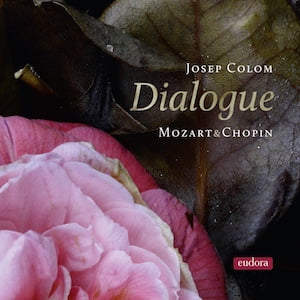 We are lucky to have a 2021 release from Eudora, a small audiophile label in Madrid that allows us to hear Schumann’s finest (at least according to Uchida) set of piano pieces in exactly the context of a “Eusebian” Schumann. Javier Laso is a young Spanish pianist recording for the first time on this label which specializes in solo and chamber music recordings in exquisite 5.0 surround sound, usually in programs that ask the listener to reposition the composer(s) in new and insightful ways. One such artist, Josep Colom has recorded three Chopin recitals that are paired with Mozart, Bach and Liszt. All of these recordings have been reviewed in these pages. For this listener they offered several most interesting revelations and were a supreme pleasure. Josep Colom Dialogue.
In fact, Mr Colom writes the liner notes for this release. He wishes to speak to those who might be coming to the music like this for the first time “Don’t be put off by thinking you don’t understand this kind of music. None of us understands it. Try to open yourself up to the experience; if nothing happens this may not be the right moment. If even the tiniest thing inside you changes, you can try it again.” This is fresh advice and one would hope that it would fall on willing ears.
But the reason that Colom can trust the experience of listening to hit home rather than play the card of cultural prestige is that this music is very immediate in its effects. The part we don’t understand is the power of melody and in this recital we have two of the greatest melodists and each in his finest moment of creation.
The first half of the session is the monumental final sonata of Franz Schubert. Our hypothetical first time listener should not be told ahead of time that the first movement of this work is just over 22 minutes long. The famous Molto Moderato is Schubert’s finest effort at casting a potent spell by way of lyrical power and repetition. The sound of the Eudora Steinway situated in a medium size hall basking in every kind of ambient warmth is an overload on the senses, almost a delirium. But there is a large scale architecture to the piece that builds and directs and finally surprises.
Javier Laso is extraordinarily sensitive to all the nuances of feeling. I would say that he belongs to the Uchida school of playing. He doesn’t throw out any repeats (a recording by Paul Lewis trims the repeats and tempo so as to come in 7 minutes sooner than this recording). And yet we don’t feel anesthetized by the end; rather the opposite, sobered up.
The Andante is the piece to show off how well Eudora does with extreme pianissimo. Josep Colom set a high standard for this on his Chopin recordings, but the reference recordings for this are the several Eudora recordings of solo guitar. Audiophile connoisseurs would do well to check out these recordings, including a remarkable recital of Lute music by Jonas Norberg.
The Scherzo shows off the extraverted Schubert and Laso’s articulation and phrasing are faultless. Finally, the Allegro ma non troppois played just a tick slower than normal but with a lightness and whimsicality that is fresh. When the second theme with its galloping rhythms arrives Laso bridles his horse a bit. (My ears were a little more used to Alfred Brendel’s great interpretations) but in the end, I think these are extremely accomplished readings of what might be the finest Piano Sonata of all time (unless it is one of the other two late Schubert sonatas).
However, what makes this recording special is the juxtaposition of Schumann and Schubert. Of course, Schumann knew of his older contemporary and deeply lamented his untimely demise. He made a pilgrimage to Schubert’s brother and came away with the manuscript of the 9th symphony. But in fact, the gap between them seems large, and the differences are most obvious at first glance. That is why they are not a common pairing. However, this recording makes it seem inevitable and deeply instructive. I have come to hear Schumann in a new way and with a deeper appreciation of the Eusebian side his split personality.
Every single release from this label can be anticipated with great curiosity and pleasure. I hope that they can find the audience they deserve for this enduring, life-changing music.
—Fritz Balwit
For more information, please visit the Eudora Records website: