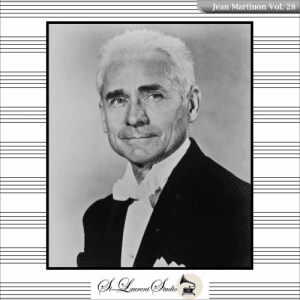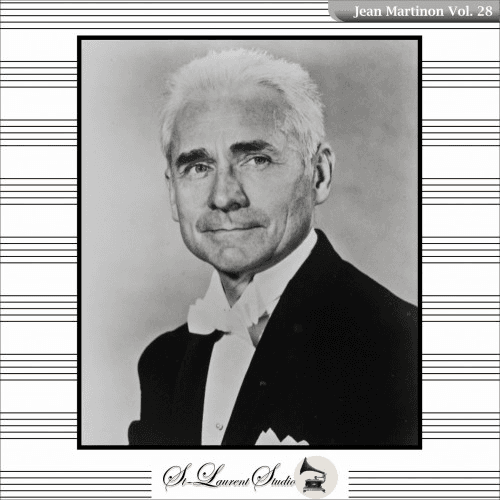
Jean Martinon Vol. 28 = SCHUMANN: Symphony No. 4; PAGANINI: Violin Concerto No. 1; DEBUSSY: La Mer – Yves St-Laurent YSL T-1601 (2 discs = 63:00; 55:04; credits and content details below) *****:
Composer-conductor Jean Martinon (1910-1976), who assumed the directorship of the Chicago Symphony Orchestra after Fritz Reiner, 1963-1968, enjoyed a reputation for directness and clarity of delivery in his diverse, often experimental, repertory. Although many would argue he improved the standard of the already-high quality of the Chicago’s virtuoso powers, he sustained fierce opposition from some players, management, and the notoriously acerbic pen of critic Claudia Cassidy. In spite of a cool and unaffected podium demeanor, Martinon elicited passionate readings from his multifarious ensembles, and the two concerts presented here by Yves St-Laurent, from Carnegie Hall, New York City, and Orchestra Hall, Chicago, respectively, testify to some illumined music-making.
The opening work, the Schumann Fourth Symphony (1841; rev. 1851) from Carnegie Hall, 1 November 1970, features the French National Radio-Symphony in a reading of homogeneous muscularity and driven clarity. The linear propulsion of the first movement Ziemlich langsam – lebhaft fashions tight-knit thematic groups which will claim the remainer of the score in cyclic form. If anyone else’s rendition resembles this propelled account, it would be George Szell’s with the Cleveland Orchestra, though his is perhaps more tonally accurate than this French ensemble. Still, the sympathy of the conception remains sonorously warm and resonant, especially in the winds and brass.harmonies, while the strings soar nostalgically. The D minor Scherzo (Lebhaft) has robust, contrapuntal energy, insistent in martial and dance figures. The lovely Romanze violin figure returns in full bloom, almost a serenade’s serving as the Trio section. The amazing bridge section to the last movement, obviously in imitation of the Beethoven Fifth, projects a sense of dire potency, though not so pregnant as the Furtwaengler version from Berlin, but rivalling Cantelli’s reading in New York. The upward gestures, rife with trumpet interjections, burst forth, Lebhaft, into a marcato version of the introductory theme, now played off antiphonally between strings and winds. Martinon maintains a good sense of Schumann’s singing line, despite the heavy punctuations that travel along. The obligatory fugato section remains steady, insistent, ineluctable, and heraldic in the trumpet work. A performance of warm, sweeping momentum, the impact clearly resonates with the New York audience, as it does with us.
Russian violin virtuoso Viktor Tretyakov joins Martinon for a rousing full (especially in the first movement, Allegro maestoso, orchestral tutti) rendition of Paganini’s D Major Concerto. Tretyakov, winner of the 1966 Tchaikovsky Competition, delivers a consistently suave performance of the concerto, replete with the panoply of Paganini’s violin arsenal of effects and a wonderfully melting singing line, courtesy of his Nicolo Gagliano violin, 1772. The sheer fluidity of line, richly colored in bowing and articulation, quite takes one’s breath away, and the responsive orchestra, quick to catch the infectiousness, projects a soaring, vivacious series of structural periods. For those familiar with the Russian violin pedagogical tradition instilled by the Moscow Conservatory and Yuri Yankelevich, the kindred like of Leonid Kogan and Boris Belkin, the silken virtuosity and breadth of conception come as no surprise. Collectors may well recall Martinon’s equal success on EMI disc of the complete Lalo Symphonie espagnole with David Oistrakh. Meanwhile, Tretyakov has his own ideas about the huge, first movement cadenza, which simmers, slides, and revels luxuriantly across his instrument’s strings. Don’t be shocked that the audience erupts.
After the dramatic, ardently seething and languidly beguiling Adagio, the collaborators embark upon the Rondo – Allegro spirituoso finale, a virtual catalogue of Paganini’s selective pyrotechnics. Sparkle and wit pervade every measure of this rambunctious music, delighting in its own, virtuosic aplomb. Double stops, ricochet bowing, quick alternation of arco and pizzicato passagework, high falsettos, the entire gamut of wizard, circus effects passes by in a mad kaleidoscope of seamless beauty. If buoyancy of effect is contagious, the audience has caught the delirium for which, happily, there exists no cure.
Disc 2 at first extends the Carnegie Hall concert of 1 November 1970, concluding with the Debussy orchestral staple his 1905 La Mer. Debussy the man was no great seafarer, drawing inspiration from art, “preferring the seascapes available in painting and literature” to the physical sea. Yet, the application of his distinctive brand of timbral impressions, the total instrumental security of the score, more than elicits a potent and lasting image of the sea in her various moods, akin to what the poet Shelley does for the West Wind. A slow, leisurely pedal point and shifting colors announce the opening From Dawn till Noon at Sea, soon gaining acceleration with no loss of details, like those 16 cellos diviso. The harp part, prominent while the oboe, brass, and strings weave their own magic, helps construct a voluptuous, even spasmodic, pageant, which the witty Satie sound most effective “at a quarter of eleven.” A palpable, erotic languor inhabits this reading, a love affair for sirens and water sprites that concludes in a burst of passion.
The central movement, Play of the Waves, serves as a scherzo point of departure, again dreamy and blurred in its coloration. Crystalline attacks in winds, strings and horns keep the pulsation active, mercurial, impulsively seductive. The tonguing of the brass emerges distinctly, and the cymbal clashes ring with the water’s hitting coral and rock. The upward gestures delight in air as well as water, the melody surging out of the effervescent foam. The accumulated energy palpably transmits to the whole ensemble, especially the transparent harp. Martinon always had mixed feelings about Debussy’s deletion and re-insertion of the trumpet work of Dialogue of the Wind and the Sea – Mitropoulos kept the effect of “Triton blowing his wreathed horn.” The elastic play of elemental forces under Martinon emerges clearly, articulately, from all principals, often with explosive energy. The fine pedal established by high strings and singing woodwinds evolves sensuously, the harp’s throbbing in the distance. A sudden, convulsive gesture from strings to brass that suddenly dissipates only to dissolve into more brass pomp but lacking the ad lib trumpet heraldry that spoiled me in Mitropoulos’ favor. Still, the final pages resound with primal, unbuttoned momentum, and this New York audience can let their feelings enjoy their own tidal wave.
We then change the venue to Chicago’s Orchestra Hall, 14 April 1966, for an alternative, Chicago Symphony reading of the Schumann Fourth Symphony. The recent release by RCA of The Complete RCA Jean Martinon Chicago Symphony Recordings (nine documents) had done nothing to convince me of any rightness to Claudia Cassidy’s vitriol concerning him (or Rafael Kubelik, for that matter). The Chicago players, even more than his French National Radio personnel, appear responsive, alert, and technically superior to virtually every other classical, American ensemble. More than likely, Martinon’s predilection for contemporary repertory formed the basis of any and all antipathies to his leadership, not the quality of his innate musicianship. Except for the Schumann first movement, which here in Chicago proffers a monumental introduction, a la Furtwaengler and a proportionately broad exposition with extremely active, interior lines – a full minute briefer than in Paris – the tempos for the remaining movements remain within ten to thirty seconds of their counterparts. Martinon also obeys the attacca designation to the slow movement, so often ignored either by the conductor or the recording engineer. The miking of the individual instruments – violin, cello, and viola – proves especially ingratiating. The slightly quicker tempo for the Scherzo produces a playful rather than a martial atmosphere. That haunted transition to the last movement rings with menace and sonic girth, an adumbration of titanic forces. Credit the CSO timpani with his palpable contribution. The finale literally throbs with vitality and elastic motion, exemplary in homogenous, orchestral discipline. Martinon gets the fugato section to sound like a fleet Stokowski transcription of Bach. When the CSO brass make their presence known, the effect resonates with pomp and high circumstance. The coda, an aroused peroration of virtuoso speed and agility, has the Chicago audience out of their collective seats.
—Gary Lemco
Jean Martinon Vol. 28
SCHUMANN: Symphony No. 4 in D Minor, Op. 120 (two versions);
PAGANINI: Violin Concerto No. 1 in D Major, Op. 6;
DEBUSSY: La Mer
Viktor Tretyakov, violin
Orchestre national de l’ORTF
Chicago Symphony Orchestra/
More information through Yves St-Laurent Studios