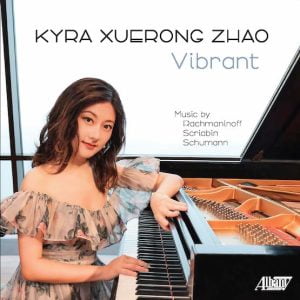
VIBRANT = RACHMANINOFF Études-Tableaux; SCRIABIN Piano Sonata No. 2, 24 Preludes for Piano; RACHMANINOFF Six Moments Musicaux, No. 4; SCHUMANN Carnaval – Kyra Xuerong Zhao, piano – ALBANY TROY1932 (53:16) (10/10/23) [Distr. by Albany] ****
In her introductory remarks to this August 2023 recital, pianist Zhao explains the rubric as “a colorful excursion taking. . .a journey from the dreamy seashore to the roaring thunder and from intimate friendship encounters to triumphant marches.” Zhao’s own, fertile musical imagination has been nurtured by studies with such luminaries as Arkady Aronov, Ju-Ying, Boaz Sharon, and Victor Rosenbaum. Zhao holds a Doctor of Arts degree from Boston University, and she favors the Steinway Grand Piano, Model D.
The allure of Zhao’s piano sound resonates at once, given the 1911 Rachmaninoff Étude-Tableau in g’s cascading arpeggios, over which a brooding melodic line unfolds. Fashioned in the manner of a Chopin nocturne, its elegiac mood finds a bravura disruption in the middle cadenza, powerful, only to relent and return, nostalgically, to the opening, whose figures have been transformed by the impulse to passionate outburst. The Étude-Tableau in C# Minor abandons any sense of reconciliation for an apocalyptic vision, swirling, heaving, and convulsing in leaping chords and bell tones. Something oceanic may be at work in the left hand, as if Debussy’s “dialogue between the wind and the sea” has assumed a darkly prophetic stance.
Scriabin’s 1897 Sonata No. 2, “Sonata-Fantasie,” results from his early encounter with the Baltic Sea, “where everything glowed with magnificent majesty on the horizon.” Already having evolved an idiosyncratic approach to the Classical sonata-structure and investing his work with personal, pantheistic and synaesthetic associations, Scriabin provided a brief description of his intentions for op. 19:
“…the first movement represents the quiet of a southern night on the seashore; the development is the dark agitations of the deep, deep sea. The E major middle section shows caressing moonlight coming after the first darkness of the night. The second movement, Presto, represents the vast expanse of ocean stormily agitated.”
Zhao’s Andante declaims in sturdy chords a menace in Nature veiled by passing illuminations in chromatic harmony. Zhao realizes the movement in improvisatory gestures of flickering light, liquidly and passionately erotic. The dramatic juxtaposition of crescendos and decrescendos in rapid motion defines the Presto movement. The waves’ heavings give rise to a soaring melody, creating a contradictory stasis amidst the active runs. Zhao’s passionate virtuosity embraces Nature’s paradoxical energies with a furious abandon.
Prior to the major work, Schumann’s ubiquitous kaleidoscope of Romantic personae, Carnaval, Zhao provides us two “encores,” each by, respectively, Rachmaninoff and Scriabin. The first, the 1896 Moment musical No. 4 in E Minor, marked Presto, and indebted to Chopin, moving alternately in bravura 16ths and descending thirds. Passionate and melancholy at once, the music remains melodic as well as polyphonic in bold colors, which Zhao renders with swift, if percussive, aplomb. From the same year, 1896, we have Scriabin’s B Major Prelude, Op. 11/11, a delicate nocturne, Allegro assai but liquidly rendered in the Chopin sensibility it follows.
Robert Schumann’s 1834-35 suite Carnaval requires little more introduction to its musical and literary obligations, those having been Franz Schubert’s Sehnsuchtswalzer and the masquerade scene from Jean-Paul’s 1805 novel Flegeljahre. The evolution of “little scenes on four notes” becomes explicit when Zhao uncharacteristically includes, among the 21 character pieces, No. 8 “Sphinxes,” the three measures of which embody (in compressed form, as breves) the permutations of the notes: E♭-C, B, A and A-E♭-C-B, variations on the town of Asch and an anagram for letters in Schumann’s name. In Presto No. 10, “Lettres Dansantes,” the anagrams collide playfully in the spirit of the masked ball and excerpts from the commedia dell’arte in which the assemblage performs.
A resonantly bright Préambule in A♭ sets the optimistic tone for the occasion, and so the suite begins, often in a resolute mode. The impish character of Arlequin makes a good contrast with the prior melancholy of Pierrot. The aristocratic sweep of the Valse noble, Un poco maestoso, communicates the just combination of poise and delicacy. Introvert Eusebius and extrovert Florestan appear, Schumann’s eternal alter-egos, rife with Jungian rhetoric. Moments of Schumann’s earlier suite, Papillons, remind us that musical larvae may bloom into aerial butterflies, implicitly in Florestan and explicitly in No. 9, a bold response to the previous “Sphinxes.” At No. 11 “Chiarina,” Clara Wieck enters the ball, and her Passionato C minor resonates with an especial affect. “Chopin,” no great admirer of the Schumann suite but himself admired, makes an affected, rubato-laden smile at the proceedings.
The sense of play then invests the sequence of characters: “Estrella,” the mutual acknowledgement of “Reconnaissance,” and scurrying dialogue of “Pantalon et Columbine,” the latter agogically alert. Zhao proves sumptuous but literal in her approach to the “Valse Allemande” but ferociously visceral in her rendering of the bariolage of “Paganini.” With the “Aveu” in F minor we have an open confession of love that leads to a waltzing “Promenade,” here played in some muted dynamics by Zhao, quite touching. Of course, the ironical “Pause” achieves a manic velocity to seque into Schumann’s shaking fist, his “Marche des Davidsbündler contre les Philistins,” with its cornucopia of dotted-rhythm reminders of a “grandfather’s dance” blended with recollections from Beethoven’s Emperor Concerto. The point has been to declare war on mediocrity, musical and cultural, and Dr. Zhao has proved herself an ardent acolyte for the initiated.
—Gary Lemco
Kyra Xuerong Zhao – VIBRANT:
RACHMANINOFF Études-Tableaux, Op. 33: No. 7 in g; No. 8 in c#;
SCRIABIN Piano Sonata No. 2 in g#, Op. 19;
RACHMANINOFF Six Moments Musicaux, Op. 16: No. 4 in e;
SCRIABIN 24 Preludes for Piano, Op. 11: No. 11 in B.
SCHUMANN Carnaval, Op. 9
More information available through Amazon