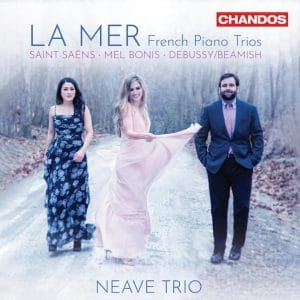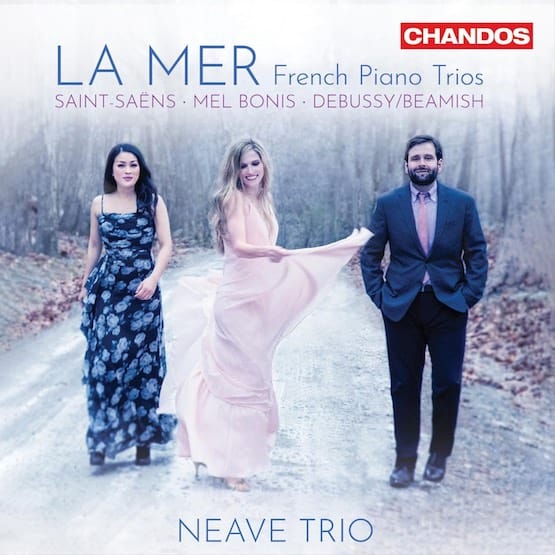
La Mer: French Works for Piano Trio = SAINT-SAENS: Piano Trio No. 2 in E Minor, Op. 92; MEL BONIS: Soir-Matin, Op. 76; DEBUSSY: La Mer (arr. Sally Beamish) – Neave Trio – Chandos CHAN 20337 (65:05) (6/20/25) [Distr. by Naxos] *****:
Fin de siècle France warrants the attentions of the Neave Trio, whose ensemble members – Anna Williams, violin; Mikhail Veselov, cello; Eri Nakamura, piano – recorded the triptych 23-25 July 2024 at Potton Hall, Dunwich Suffolk. The selected works span the era 1882-1905, thus inviting impulses from late Romanticism, early Impressionism, and Symbolism. Besides the novel input of music by Mel (Mélanie Hélène “Mel” Bonis (21 January 1858 – 18 March 1937), we have the 2015 piano trio arrangement by Sally Beamish (b. 1956) of Debussy’s 1905 three-movement tone-poem La Mer, what the composer termed Three Symphonic Sketches. Beamish rises to the challenge of a chamber music reduction of an eminently orchestral color-piece to the piano trio medium, first performed at the 2013 Lincoln Festival by Trio Apaches.
Atypical of Saint-Saens’ speed of composition, his Piano Trio No. 2 in E Minor (1892) had a six-year gestation, his having promised the work to his publisher Durand in 1886. Conceived in five movements, its grand scheme compelled one encyclopedia chronicler to remark “that the five movements hardly suffice to contain. . .vast scale.” Despite some intrinsic beauties, Saint-Saens called it “black with notes and black in mood.” The opening, sonata-form Allegro non troppo. does indeed project a symphonic dimension, especially given the composer’s application of quick turns in uneven rhythms, 5/8 and 5/4. When the lyric E major melody arises, it finds an immediate contrast in the more agitated B major episode. The two themes in dramatic dialogue provide the extended development section. A special, nocturnal moment pairs the violin and cello in exalted colloquy.
The composer’s innate wit shines in the second movement Allegretto, a sectionalized rondo set as a scherzo in 5/8 that spins out a dainty, two-measure motif in a series of contrasts: major and minor, fast and slow, and perpetual shifts in registration. The Trio section asserts a veritable, glittering étude for the keyboard. The third movement, a lament marked Andante con moto, employs a sighing motif that dominates the whole, The violin and cello explore the diapason of tonal range available to the respective instruments, the dynamic expression appassionato insisted upon. An aerial, waltzing movement, Grazioso, follows, lyrically establishing the sense of the French salon. Saint-Saens’ natural capacity for contrapuntal lines, a product of his extensive organ training, manifests itself in the dark, last movement, Allegro – Allegro moderato, including a four-part, double-fugue grand finale. We might speculate the Saint-Saens’ virtuoso model here is Mendelssohn or even Schumann, whose Piano Quintet, Op. 44 proceeds along similar lines. A tender moment of respite evolves into a massive force, a chromatic, unison structure whose weighty urgency to the last page cannot be denied.
The two-movement Soir-Matin, Op. 76 (1907) of Mel makes a charming piano-trio discovery. Soir. Andante cantabile opens with a series of swaying, lulling motifs that pay homage to Franck or Fauré. The ensuing Matin clearly has impressionistic impulses close to Ravel and Debussy. The syntax, gently pentatonic, moves in a light, breezy tracery, the violin’s top line a singing arioso. Both movements pojor ssess a naturally genial disposition that makes us wish these complementary movements were longer.
In approaching the Sally Beamish 1956 arrangement of Debussy’s “kaleidoscope of surprising harmony,” his 1905 La Mer, I had to ask myself, “Did the piano trio medium suffer such a dearth of compositions as to require this treatment?” The demands of Debussy’s orchestral palette and syntax, their deliberate inconstancy of tonality, relying on ninth chords (G-B, F-A) and a perpetual modification of the major tones B, C#, F#, and G#, and whole-tone scales, set a considerable challenge for pianist Nakamura, who must attempt, more than her colleagues, to assert a symphonic presence. Beamish conceives her arrangement particularly with the keyboard in mind, the instrument’s appoggiaturas and modal scales providing a lush and transparent surface, while Williams’ violin extends Debussy’s melodic arch, and Veselov’s cello suggests the dark undercurrents of the sea’s voluptuous fatality.
The opening piano tones capture the sound of the orchestra’s harp, while the two strings shimmer in response, the awakening of the colossus, “From Dawn to Noon at Sea.” Ostensibly in D-flat major, the first movement moves in “supple” variations of 6/8, in half-step shifts, often avoiding traditional cadences. After a brief pause, the music proceeds in fragmented melodic kernels that compete for attention. The second movement, “Play of the Waves,” insists on more refined nuances and coloristic tracery. Glissandos, pizzicatos, trills, and buzzing ostinatos fill the string voices while the piano has legato, parlando, and bright scalar passages. The violin and cello carry a serpentine melody that nods to Berlioz. The motion becomes hectic, momentarily contrapuntal and modal, with the cello’s leaning into the alto register. The mesmeric effect sparkles with light, and we recall how much Debussy admired J.W.N. Turner’s pictorial work. A grand unisono climax vibrates with unleashed, kinetic energy, and the keyboard virtually dissolves the texture into the horizon.
Low tones in piano and cello, almost Mussorgsky, invite the “Dialogue of the Wind and the Sea,” a study in vertical vibrations. A kind of polyrhythmic savagery sets in, with the double stops of the violin and the rasping cello glissandos assuming a volatile, aggressive posture against the assaults of the keyboard. A chorale theme appears in fragmented form, set against a parlando motif in minor mode. The string inverted pedal is maintained as the piano discourses over tremolo violin. The Sea gathers her accumulated energies for a final eruption, an ecstatic delirium of sound. Gradually and irrevocably, a gallop establishes itself, a Ride to the Abyss, culminated by the glorious appearance of “Triton’s wreathed horn.” At the very least, a musical and instrumental tour-de-force!
—Gary Lemco