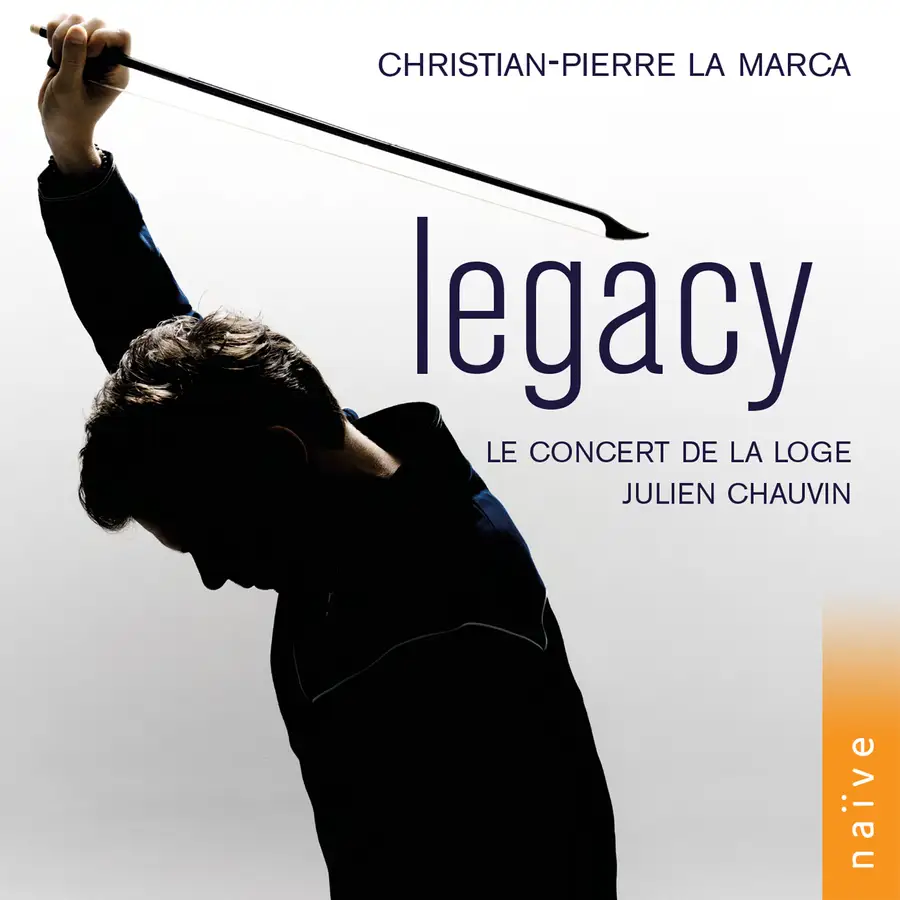
Joseph HAYDN: Concertos, Hob. VIIB:1, VIIB:2; Nicola PORPORA: Concerto in G, largo; W.A. MOZART: Sinfonia Concertante in A; C.W. GLUCK: Danse des ombres heureuses; N. POPORA: Giusto amor tu che m’accendi — Legacy — Le Concert de la Loge (dir. Julien Chauvin), Christian-Pierre la Marca (cello) soloist with Philippe Jaroussky (voice) and Adiren la Marca (viola) — Naïve V7259 — 66:00 — *****
Le Concert de la Loge, directed by violinist Julien Chauvin, tackles a program focused on Haydn’s cello concertos with cellist Christian-Pierre la Marca in Legacy. The idea was to explore some of the influencers around Haydn and to present these alongside performances of his first and second concertos for cello.
Born in 1732 in Rohrau, Austria, Haydn spent much of his career as a court musician for the wealthy Esterházy family, where he composed a vast array of works, including 104 symphonies, 83 string quartets, and numerous operas, piano sonatas, and concertos. His music is known for its clarity, balance, and form, exemplifying the ideals of the Classical style. Haydn’s influence extended to his contemporaries and successors, including Wolfgang Amadeus Mozart and Ludwig van Beethoven. But who influenced Haydn?
Naples-born Nicola Porpora (b. 1686) was an eminent Italian composer and vocal teacher, renowned for his significant contributions to the world of opera and his role in shaping the careers of some of the 18th century’s most celebrated singers. He had an influence on Haydn, who in addition to composing music in his official capacity, was involved in performing Italian music for the Esterházy family. Porpora’s experience extended beyond vocal music, and is seen as a source for Haydn’s knowledge of the cello.
Included on this album are both an aria by Porpora, sung by countertenor Philippe Jaroussky and slow movement of a Porpora cello concerto. Music by Mozart and Gluck are also featured in this recording.
Haydn’s first concerto for cello, only came to light after a discovery in the early 1960s. As one might expect, it blends virtuosic passages for the cello with the orchestral forces. La Marca reveals himself to be a master interpreter early-on; his style flirts with what I might call a chiaroscuro effect. At the phrase level, but even on longer, extended notes, everything sounds sculpted, rendering sound with amazing dynamic depth. Chauvin does something similar to the shaping of his orchestral sound in the concerto’s opening, but it’s echoed in la Marca’s own playing.
La Marca contributes his own cadenza in the first concerto. The virtuoso presents the full gamut of his instrument’s range, focusing upon the concerto’s dig into the cello’s deep register as a trademark theme. As far as cadenzas go, it’s not overly long, and seems to my ears to be well-woven into Haydn’s style.
The 9.5 minute work by Mozart presented here—thought to be a fragment of an otherwise abandoned commission—is the A major Sinfonia concertante for violin, viola, and cello K320e Anh 104. The piece opens with quite a substantial opening before the trio of instruments takes on the theme themselves, which of course could have been a triple-concerto. La Marca’s brother joins the album’s cast to perform this piece alongside director Chauvin on violin. The cello part is not given priority over the other instruments, but plays duty in support of the violin and viola parts.
As the liner notes agree, it’s a well-wrought piece and is an interesting piece for how clearly it pits Mozart’s own style against that of Haydn. The Danse des ombres heureuses from Gluck’s Ophrée et Eurydice puts the cello back in the starlight. The style of writing is a far departure from the Mozart. La Marca uses vibrato to perhaps imitate the voice; despite it lending the gloss of romanticism to playing style, the result is musically satisfying.
It is difficult not to hear the influences of the music presented before Haydn’s second concerto in D, even in the opening fast movement. It’s unmistakable to not hear the heavy echo of baroque style against the emerging melodic focus introduced by the galant style that replaced the overly contrapuntal and dance-oriented cello sonatas in the baroque period. The work featuring Jaroussky also includes obbligato cello and the pairing here on this album was smart. It helps us see the Italian connection and Porpora’s influence on young Haydn.
La Marca’s balance in this concerto is interesting—and well done—he allows himself to be absorbed in parts by the shadows of the orchestral forces around him—weaving in and out. This integration for me is more natural sounding and demonstrates the tight cooperation of the orchestra, it’s director, and the soloist to be focused on the overall effect for the audience. For an easy way to hear this, listen to the start of the slow movement; the opening of the third movement is another opportunity. The feeling that la Marca is integrated with the ensemble rather than being ten feet out front is sonically satisfying.
I auditioned this album in both near-field and more typical listening position with my two-channel system using full-range loudspeakers. Ken Yoshida is responsible for the album’s sound, made at the Temple du Saint Esprit in Paris. The album first smacked me with its ample reverb and a large soundstage. When enjoyed sitting at a normal distance from speakers, the sound ideally captured the instruments and singer in detail against the orchestral forces located further afield. The sound is generous and does not capture the impression of a concert stage; it might be closer to a palace performance, imitating the environment where at least some of these works may have first been enjoyed. While I am perhaps more accustomed to classical works performed with close-miking and a drier sound, as has come with many historically-informed recordings, the sound signature on this album helps amplify the dynamic contrasts lending the orchestral forces a shiny gleam while still providing an intimacy with the solos. The tell for me is how the harpsichord—when used—cuts through the texture crisply. It’s a beautiful result.
As a program, I think these musicians did well to provide context to Haydn’s two concertos for cello. La Marca is a sensitive player whose style remains fairly consistent across the album. His use of vibrato is a little shocking for those immersed in period style, but at the same time, he’s not constantly vibrating. I like his approach and think he and Chauvin both are sensitive to the historical practice while also attempting to engage with a contemporary audience. As seems Naïve’s practice of late, the liner notes include interview questions with the musicians. Combined with historical notes, I much enjoy getting the mini-history lesson alongside the perspectives of the musicians. It’s a high-mark in how to prepare liner notes!
—John Hendron
For more of John Hendron’s reviews, please visit his website at Biberfan.org