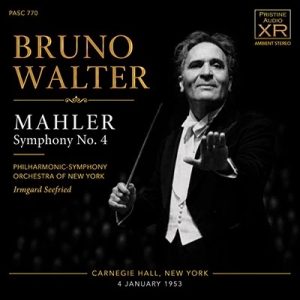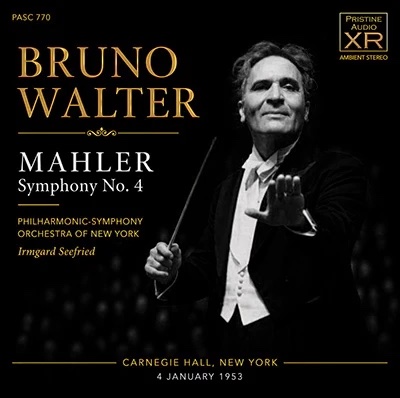
MAHLER: Symphony No. 4 in G Major – New York Philharmonic Orchestra/ Bruno Walter – Pristine Audio PASC 729 (53:14) [www.pristineclassical.com] *****:
I well recall my LP version of Bruno Walter’s 1945 reading of the 1900 `Mahler Fourth Symphony on CBS (ML 4031) with Viennese soprano Desi Halban (1912-1996), and my appreciation of Walter’s realization of this music’s songful sympathy both with Nature and childhood, dependent upon the collection Des Knaben Wunderhorn, the “folk” hybrid collection of poems substantially invented by Arnim and Brentano. Given that Mahler’s score had been conceived “in reverse,” with the original “Das himmlische Leben” omitted from the 1898 Third Symphony, so that Mahler had to create a new three movements to precede it, the work depends upon the sustaining of Wordsworth’s “childlike wonder” at the joys and Heaven in their often contradictory impulses. Frankly, my real quibble with Bruno Walter’s reading lay with Halban, whose voice I found unsympathetic to the moment, while I found in Teresa Stich-Randall (1927-2007), the so-called “white soprano,” a perfect vehicle for Mahler’s phantasmic vision, though her conductor in the Epic recording, Willem van Otterloo, lacked the immense, poetical monumentality Walter accords the third movement Ruhevoll. So this 4 January 1953 radio broadcast with lyric soprano Irmgard Seefried (1919-1998) proves most ingratiating, a collaboration transparent, mystical, and wise, at once.
Walter compared Mahler’s Fourth Symphony to a “Fairy tale. . .weightless and unburdened,” an epithet that does not quite accommodate the occasional shadows that appear in this score. The first movement Bedachtig (well considered) offers a festival journey, beset with sleigh bells, Nature calls, and mountain-train whistles, that proceeds with fervor and insistence, rife with visionary passion. The New York Philharmonic trumpets and battery inject an alert, vivid presence to the occasion, the music’s often capturing the sense of maerchen, musical fairytales or allegories that marked the musical excursions of Ribert Schumann. Played without exaggerated sentimentality, the performance enjoys a sober relish of Mahler’s inspirational forces, realized in that liberal, Viennese style endemic to his musical identity.
The juxtaposition of life and death becomes immediate via the second movement, in which the principal violin scordatura (“mis-pitched”) initiates a scherzo in which insinuates Death’s fiddle as dominant in a rustic, country dance shared by horns, winds, strings, and timpani. A breezy secondar motif embraces the dance to give it an unearthly, vaporous quality. A (Schubert-like) laendler in the winds imposes a graceful pulse; so, if Death hovers, he makes a casual, gracious presence. Mahler intentionally submits the genial, gemütlich quality as the rule. Suddenly, the expansive, luminous character of the occasion erupts, only to retreat into the quirky scherzo motif in the winds and solo violin. Pizzicato strokes and timpani herald a distorted vision and dissonant component to the music, compressed into in the winds’ aerial coda.
The New York Philharmonic cellos have rarely shone with the radiance they project for Mahler’s third movement, a gorgeous adagio suffused with an anguish quite ineffable. The horns presage the later explosion in E major that separates the Walter molds this music with ardent care, allotting it the same breadth Beethoven achieves in his slow movement to the Ninth Symphony, though without the double-theme-and-variation procedure. We hear the first violin amongst the interwoven patterns, intimations of mortality. The urgent pulse of the scherzo returns, voluptuous and nostalgic at once, but the momentum fails, turning the music into a darkly moody, polyphonic serenade with klezmer elements. These impish riffs dissipate into a cosmic ether that literally holds its breath in awe of some Eternal Truth. The E major unveiling occurs, in hammer blows to be revealed again later, in Symphony No. 6. Harp and strings insinuate the “heavenly” vision that initially impelled this music out of the Third Symphony.
We will eventually bask in the key of E major, where in Irmgard Seefried has depicted the child’s naïve configuration of a Heaven feast, wherein blessed events converge with animals’ slaughter. Saints and martyrs somehow attend the festivities, the dancing and playful cavorting among the incongruous amalgam of chefs. Saint Martha, patron saint of cooks, presides over this grand grotesquerie, almost a forecast of one of Gatsby’s summer parties. The Pristine note mentions to the “decorative innocence” of the extended scene, enunciated with fervent clarity by Irmgard Seefried. The ravishing invocation of Des Knaben Wunderhorn could scarcely find more suitable collaborators, and Seefried and Walter invoke a storm of grateful applause.
—Gary Lemco