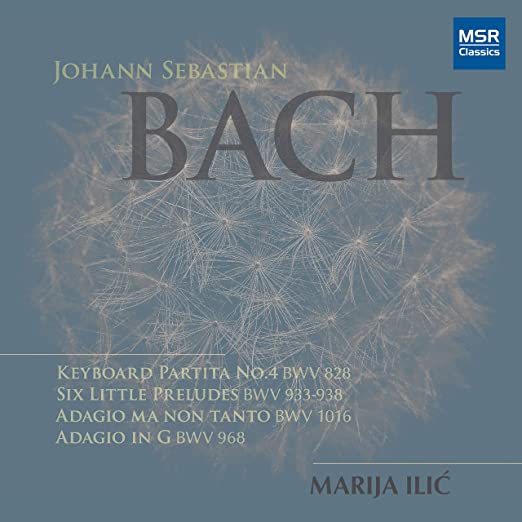
BACH: Adagio ma non tanto from Violin Sonata No. 3 in E Major, BWV 1016 (arr. Ilic); Six Little Preludes, BWV 933-938; Adagio in G Major from Violin Sonata No. 3 in C Major, BWV 1005 (arr. J.S. Bach); Partita No. 4 in D Major, BWV 828 – Marija Ilic, piano – MSR Classics MS 1724, 55:32 (12/16/19) [www.msrcd.com] ****:
Serbian pianist Marija Ilic recorded her homage to Bach 11-17 July 2015. A faculty member at Vassar, Ms. Ilic earned her doctorate at Rutgers via her study of Bach’s The Art of Fugue. Somewhat in the manner of Sergio Fiorentino, Ms. Ilic derives pleasure in transcribing Bach’s alternative, instrumental works to the keyboard, as she does in opening piece, the Adagio ma non tanto from the Violin Sonata No. 3 in E Major, BWV 1016. The piercing clarity of the fluid, melodic line resonates in a particularly luminous effect, almost over-ripe. But she holds the melismatic aria in taut suspension, the C-sharp minor affect spinning out in the manner of a chaconne with a fluid, moving bass line’s setting the harmony for the five-minute meditation.
I first heard Bach’s Six Little Preludes (c. 1717-1720) courtesy of harpsichord virtuoso Fernando Valenti. The pieces assume the character of didactic studies or inventions, moving from C Major and its tonic minor and then repeating the pattern for D Major and E Major. Often, the dance-like affect finds a foil either in polyphony or in the shifts of register. The demands for the hands include light and brilliant figures, often quick, as well as expressive dialogues between the voices. The agogic shifts of rhythm in the E Major piece – juxtaposing 16ths against 8ths – concentrates virtuosity into a small space. If the opening C Major piece serves as an overture, the last piece in E minor brings down the curtain on a lachrymose minuet that leaves us rather haunted by its sensibility.

Johann Sebastian Bach
Whether or not Bach himself transcribed the Adagio in G Major from his BWV 1005 Solo Violin Sonata No. 3 in C Major remains apocryphal, but the BWV 968 stands as an independent composition. In a slow triple meter in dotted rhythm, the work suddenly achieves a rich texture from the added bass line of piano, an angular and chromatic progression that resonates with a tragic sense of power. Not all auditors will sympathize with the highly romantic treatment the Adagio receives, but few can deny its drama.
From Bach’s Leipzig period (c. 1726-1730) we have the most expansive of his six keyboard partitas, the No. 4 in D Major, BWV 828, which Ilic realizes with repeats. I first heard this astonishing and brilliant work in a performance by Joerg Demus. Grandly operatic, the opening Ouverture cedes its broad energy to the succeeding, lithely muscular triple meter dance that becomes increasingly complex by way of polyphonic and imitative devices and glittering duets and trios. The expansive Allemande subdues that former, explosive energy into a series of expressive and intimate gestures, vocal in the manner of a cantata aria that moves in dramatic periods. At times, the music achieves a stasis of motion, serene and spiritually comforted. The happy Courante provides an immediate, emotional contrast: a light and good-natured dance. The Aria presents us a moment of courtly dance, but no less robust in its counterpoint in duple meter. The Sarabande – taken from a Spanish model – proceeds slowly and passionately, and Ilic delivers its caresses in an intimate manner, a lyric in the romantic manner. Rather a duet in style, the music might suggest a garden tryst that stars Rose Hobart and Fredric March. A leisurely Minuet follows, and its first tune repeat occurs in a higher register. Ilic’s studies with harpsichord master Kenneth Cooper make their influence known here, providing a French character to the daintier textures. In the style of a double fugue, the closing Gigue bears a contrapuntal weight its virtuosic elan belies. Upward and downward motions compete for dominance in a spirit of glee and wit, executed with aplomb and secure finesse by Ms. Ilic.
–Gary Lemco