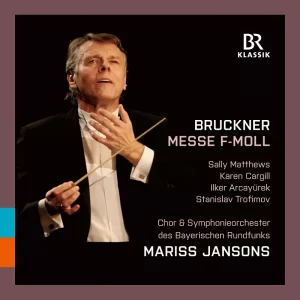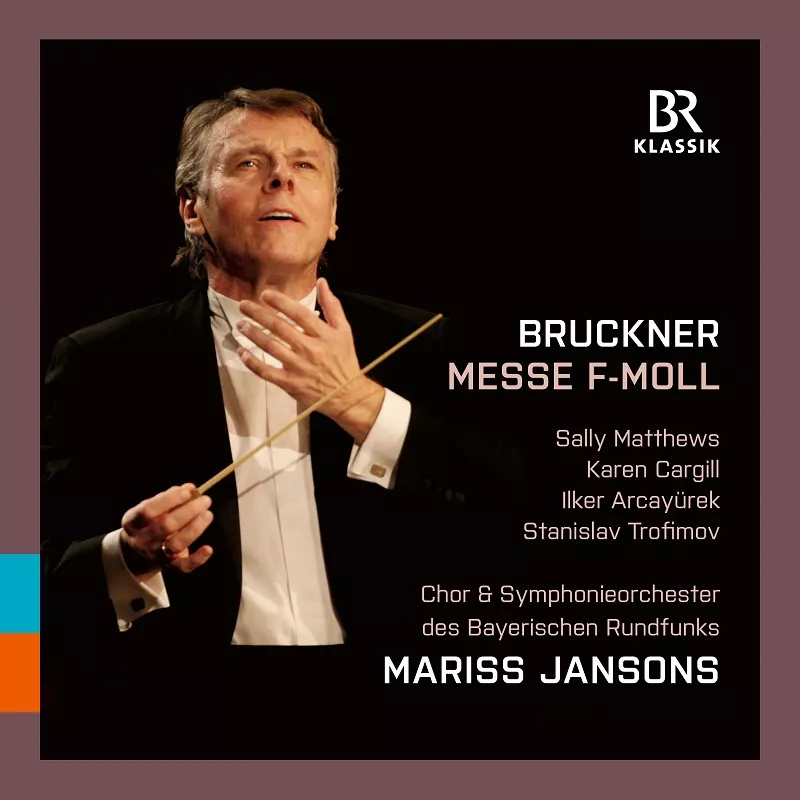
BRUCKNER: Mass in F Minor for Soloists, Choir, Organ, and Orchestra, WAB 28 – Sally Matthews, soprano/ Karen Cargill, mezzo-soprano/ Ilker Arcayuerek, tenor/ Stanislav Trofimov, bass/ Choir of the Bavarian Radio/ Bavarian Radio Symphony Orchestra/ Mariss Jansons, cond. – BR KLASSIK 900017 (58:47) (6/7/24) [Distr. by Naxos] ****:
Bruckner in 1864 saw his fortunes and musical repute rise with the publication of his D Minor Mass, and the resultant euphoria carried into his Mass in E Minor of 1866. The following year, however, saw Bruckner in a depressed state about his mental health and individual insecurities; and a real blow came in the form of the death of his trusted musical mentor, Simon Sechter. On September 14, 1867, Bruckner began to compose his Mass in F Minor, and he completed the work in Linz just in time for him to move to Vienna in October, to assume the very appointment occupied by the late Sechter, as Professor of Basso Continuo and Counterpoint at the Conservatory of the Society of the Friends of Music.
The F Minor Mass conforms much to a style established by Mozart, since Bruckner took the Mozart Requiem as his model, excising passages with parallel fifths, a perpetual temptation. In the large, massively contrapuntal periods, we hear the influence of Beethoven’s epic Missa Solemnis. Audience and critical reception proved favorable; even the irascible Bruckner critic Eduard Hanslick remarked that “the composition caused a sensation among music lovers with its artful counterpoint and fugue work.” In six traditional movements, Bruckner demonstrates his capacity to command both hefty and intimate forces, balancing his exalted sense of piety with a sensitivity for the intimacy of his Lord’s sacrifice.
Mariss Jansons (1943-2019) leads a performance taped 21-25 January 2019, so the document serves no less as a momento mori for the gifted conductor. We feel the warmth of ensemble from the very opening of the Kyrie, with the violin’s weaving a the pervasive four-note pattern between the vocal elements. Soprano Sally Matthews has a good projection, though her top can be piercing, I found the bass Stanislav Trofimov most consistently engaging, especially in those colossal moments of devotion, as in the Gloria’s qui tollis. Girth and clarity, difficult to balance, mark the big choral fugues and chorale-episodes, ultimately leading to the massive double fugue of the Credo’s last page. In the animated rhythms of dramatic sections, we feel the Bruckner of the Eighth Symphony having been anticipated for cosmic, dare I say, Wagnerian, canvas.
While we might easily dwell on the sonic impact of rousing, devotional moments like the Tu solus dominus of the Kyrie, we ought not ignore Janson’s intense quietude, in, for example, the Benedictus, suffused with a restrained, romantic fervor. The Sanctus, though brief, communicates a serene, spiritual repose, permitting its only moment of ecstasy at the last, Hosanna. But the heart of the Mass, and of Janson’s depth of expression, lies in the expansive Credo, with its rapturous moment in C major. As it had with Beethoven, the declaration of faith, the colloquy of bass voice and chorus, the Crucifixus etiam pro nobis, exalts the ultimate sacrifice to redeem Mankind. The Agnus Dei, delicate and demonstrative at once, comes full circle, having returned to F minor, and invoking phrases from the Kyrie. The repeated miserere and the final prayer, Dona nobis pacem, confirm Bruckner’s musical and symbolic mastery of his medium, a hard-won guarantee of his spiritual security, despite his ever-present demons of self-doubt.
—Gary Lemco