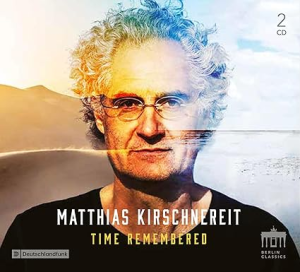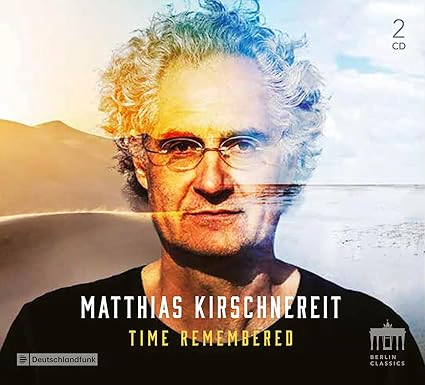
Matthias Kirschnereit, Time Remembered – A Suite of 32 Piano Miniatures – Berlin Classics 0302966BC (2CDs: 116:20; complete track listing below) (8/24/23) [Distr. by Naxos] *****:
German classical pianist Matthias Kirschnereit (b. 1962) assembles what he calls “a playlist of my life,” a “personal musical diary” in the form of a collection of 32 short pieces recorded in Cologne, Germany, February 23-26, 2023 on a Steinway Model D. The selections cover some 400 years in music history, each piece significant, a la Proust, to a time period or rite of passage for Kirschnereit. A pianist who prides himself on having effectively united analysis and intuition, Kirschnereit claims these works embrace nostalgia, retrospection, the present; and, in the two cycles of variations, the “metamorphosis of musical momentum” into the transcendent and visionary, as glimpses into the future.
The rubric “Time Remembered” for this assemblage comes from the great Bill Evans (1929 –1980), the master of modal, richly harmonized and impressionistic, jazz style. Kirschnereit plays the 1964 Time Remembered in a salon, ballad mode, lyrically nostalgic. The Renaissance, 4-part, polyphonic style Girolamo Frescobaldi’s 1635 Canzona takes Kirshneriet to his student days of choir singing. An elongated trill ends the first part, the music commences in martial gaiety. Mozart was likely in a satiric mood when he penned his Funeral March for Signor Meastro Contrapunto in c, a brief farewell to a bygone age. Among the longest pieces in the collection, C.P.E. Bach’s sectionalized Fantasie erupts with imaginative improvisation, the chromatic line in rich harmony and deft articulation, even beyond his esteemed father’s “learned style.” Kirschnereit feels the piece’s kinship with the opening of Beethoven’s Emperor Concerto. Gershwin wrote Who Cares? for the 1931 musical Of Thee I Sing. The music’s easy and persuasive nonchalance becomes an emblem of our contemporary informality.
Kirshnereit proceeds with Debussy’s perpetuum mobile in C, his Mouvement from the First Book of Images, 1905. The exercise in motoric energies reveals at moments hints of the Dies Irae sequence, but the tone remains optimistic and playful, the piano tone via Producer Stephan Reh luminous. Toru Takemitsu’s 1992 Rain Tree Sketch II has the subtitle “In Memoriam Olivier Messiaen.” The very last composition by Takemitsu, it directs the performer to play spatial, modal intervals in a mode Celestially Light, much akin with the Russian mystic Scriabin.
Music lovers of the Beatles’ generation well recall the 1969 album Abbey Road and its iconic cover art. The glorious song in A, “Here Comes the Sun,” is a product of George Harrison’s friendship with Eric Clapton. The version played by Kirschnereit derives from his own collaboration with Benjamin Köthe, in which the pentatonic theme achieves a heartily warm, epic grandeur. Bedrich Smetana’s 1848 bagatelle Sehnsucht (Longing), from his op. 1, is set in E minor. Its restless impulses conclude in limpid recollection of Chopin’s Étude in f, Op. 10/9. Franz Liszt’s Schlaflos! Frage und Antwort, S. 203 dates from 1883, only three years prior to his death, an example of the composer’s late experiments in modality and polyrhythm. Purportedly a “nocturne” in E minor after a poem by Toni Raab, the music exudes little that feels nocturnal or consoling, only a bitter angst followed by a melancholy musing in parlando recitative that descends into tragic thoughts. Perhaps included immediately as an existential anodyne, Janacek’s “Gute Nacht!” from the cycle On an Overgrown Path, meant to be a lament for deceased daughter Olga Janáčková (1882-1903). The simple, chant-like melody over a softly throbbing bass shimmers with tesknota, tearful nostalgia.
A simple, innocent form of nostalgia emanates from Robert Schumann’s “Child Falling Asleep”” from the 1838 suite Kinderszenen. op. 15. Yet another piece set in E Minor, it gravitates in dreamy luxury to the tonic major. Clara Schumann commented, “One cannot close one’s eyes more beautifully!” Helmut Lachenmann (b. 1935), in his 1956 Fünf Variationen über ein Thema von Franz Schubert (German Dance in c#, D. 643) for piano, provides Kirschnereit with an idiosyncratic metamorphosis that traverses into stylistic hints of Shostakovich, Berg, and Webern, especially in the final pulverizing of Schubert’s tune. The composer bemusedly called the piece “a youthful sin.”
The death by execution of King Charles I seriously affected composer Thomas Tomkins, who wrote his Pavane for these distracted tymes on February 14, 1649, whose slow progress in pointillistic style by Kirschnerit may remind some listeners of Glenn Gould. The extended Elegie Meine Seele bangt und hofft zu Dir by Ferruccio Busoni from 1908 is one of seven he composed as a set, this the No. 3, which later became the “Preludio corale” of the Fantasia contrappunstica. The thickly dissonant opening textures attain some transparency, only to resume in mixed counterpoint and an askew, modal lyricism. This piece has reminiscences for Kirschnereit’s participation in the Busoni Competition in Balzano, where he earned elimination in the first round. The first disc ends with the familiar Bach chorale Jesu bleibet meine Freude, as arranged by Myra Hess, and herein delivered much in the same style and spirit of the great Romanian pianist Dinu Lipatti.
Disc 2 opens with Handel’s 1733 Chaconne in G with 21 Variations, a marvelous example of unity-in-variety. The attractive theme, ¾, rife with ornaments, becomes increasingly figurative, moving to the beloved Minore middle section before exploding in spiritual aspiration to the heights that Kirschnereit realizes, much in the excited style of Edwin Fischer. Ravel’s enchanting Pavane for a Dead Princess (1899) results from his studies with Gabriel Fauré. Its archaic evocation of the Spanish court proffers a magical melody in crystalline harmonies that Kirschreneit claims possesses “a cool, refined nostalgia.”
Russia’s first, official composer, Mikhail Glinka, appears in his fluent, multifariously rhythmic Memories of the Mazurka, a reminder that his pedagogy embraced Polish as well as Italian sources. Anton Bruckner’s keyboard music seems to enjoy a resurgence; here, Kirchnereit plays the 1868 Remembrance, a narrative piece that proceeds “slowly and intimately,” reaches a potent fff in the manner of Liszt, especially one his “songs of love.” Schubert’s Hungarian Melody shares, in abridged form, motifs with his four-hand Divertissement a la Hongroise, Op. 54 of 1824, its sprightly impulses spirited reminders of the attractions of the Eszterhazy environs.
The music of Hungarian composer Ligeti poses numerous challenges both to dexterity and temperament: the seventh of his Musica Ricercata (1951-1953) has Kirschnereit’s having to maintain ongoing septuplets in his left hand, while his right negotiates a strophic melody. The dual time signatures create a kind of musical duality, if not schizoid, sensibility that challenges the hand and the mind, functioning as a direct heir to the Debussy Études.
Kirschnereit’s most autobiographical piece, Namibia (1976), portrays in a folk-jazz fusion, the pianist’s teenage roots in southern Africa, where he planned to form an ensemble, the Namibia Trio. The arrangement for piano and percussion, by Benjamin Köthe, has the spunky appeal of syncopated jazz from the old Half Note in SoHo, New York City. Yet another personal moment communicates through William Bolcom’s Graceful Ghost Rag of 1971. Inspired by examples from Scott Joplin, Balcom’s piece was conceived in memory of his father. Kirschnereit learned the piece while living in Japan. The insistent, forward motion in jabbed accents assumes a nostalgic lyricism that defies the natural, two-step percussion in the plays throughout. Conductor-composer Ettore Prandhi contributes to this collection regarding Time with his two-minute, minimalist Bagatelle on Lost Time, a delicate, mostly high-register meditation a la Proust. Kirschnereit calls Chopin’s slow Mazurka in c# (1847), in kujawiak style, yearning, melancholy, and proud.” A glory from the composer’s late evolution, its sotto voce melody and inflected accents fuse Polish nationalism with an idiosyncratic polyphony that now owes only a few debts to Bach. A more askew notion of national, fairy-tale pride arises in Sergei Prokofiev’s March of an Old Grandmother (1918), here in the sustained, animated style akin to the later Peter and the Wolf.
Painter Arnold Böcklin‘s “Die Heimkehr” (The Return) inspired Rachmaninoff’s favorite among his own piano preludes, this in B minor from 1910. The piece has its demands, mostly in deciding upon “the degree of rubato allotted to the page 3 L’istesso tempo,” with its delayed 16th note. The marking pesante Kirschnereit deftly softens throughout but not at the expense of his fortes; and the cadenza, rife with grace notes, flows in the course of the chorale processional, resonant with Russian bells. Much in the manner of the classic rendition by Benno Moiseiwitsch, Kirschnereit gives us a prelude-become-ballade in epic gestures. In Detmold, Kirschnereit saw the movie Diva, in which Satie’s 1888 Gymnopédie No. 1 appears. It’s been a long time since Aldo Ciccolini first impressed this epigram in D in my memory, but Kirshnereit effectively restores its icy, detached nonchalance. From the diversely rich collection of Mikrokosmos of Bela Bartók, Kischnereit selects No. 142, From the Diary of a Fly, a real test in étude style of tempo shifts in divided arpeggios, minor seconds, and major sevenths. For the fly, time runs out at the climax, where the composer writes, with all credit to Albert Roussel, “Oh woe, a spider’s web!!!” The song “Just the Two of Us,” by Bill Withers and Grover Washington, as arranged by Mario Stallbaumer, allots us salon moment prior to the grand finale on the subject of Time: Herman Hupfeld’s 1931 song (arr. Benjamin Köthe), “As Time Goes By” made epic in the 1942 film Casablanca. A pity Ilse Lund (Ingrid Bergman) never said, “Play it, Matt,” the way she does say, “Play it Sam” to Dooley Wilson. One of the great gestures to Romance, the film and the music tenderly remind us, “the fundamental things apply.”
—Gary Lemco
Matthias Kirschnereit – TIME REMEMBERED
EVANS: Time Remembered.
FRESCOBALDI: Canzona, Op. 12/16.
MOZART: Marche funèbre del Signor Maestro Contrapunto, K. 453a;
C.P.E. BACH: Fantasie in E♭, Wtq 58;
GERSHWIN: Who Cares?
DEBUSSY: Mouvement from Images I;
TAKEMITSU: Raftree Sketch II;
HARRISON: Here Comes the Sun;
SMETANA: Sehnsucht from op. 11;
LISZT: Schlaflos!
JANACEK: Gute Nacht!
SCHUMANN: Kind im Einschlummern from Kinderszenen, Op. 15;
LACHENMANN: Fünf Variationen über ein Thema von Franz Schubert.
TOMKINS: A Sad Pavan for These Distracted Tymes, MB 53.
BUSONI: Meine seele bangt hofft Zu Dir, BV 249;
J.S. BACH: Jesu bleibet meine Freude, from Cantata 147 (arr. Hess);
HANDEL: Chaconne in G Major, HWV 435;
RAVEL: Pavane pour une infante défunte, M. 19;
GLINKA: Erinnerung an eine Mazurka B-Dur.
BRUCKNER: Erinnerung, WAB 117;
SCHUBERT: Ungarische Melodie, D. 817.
LIGETI: Musica Ricercata Nr. 7;
LIBERATION GROUP: 1Namibia;
BALCOM: Graceful Ghost Rag.
PRANDI: Bagatelle “An die verlorene Zeit“.
CHOPIN: Mazurka in c#, Op. 63/3;
PROKOFIEW: Märchen der Alten Grossmutter, Op. 31/4.
RACHMANINOW: Prelude in B Minor, Op. 32/10;
SATIE: Gymnopédie Nr. 1;
BARTÓK: Aus Tagebuch einer Fliege;
WITHERS: Just the Two of Us.
HUPFELD: As Time Goes By
1Keylipp Dallmann, Lukas Gesien, Anton Thelemann (perc)
More information through Amazon