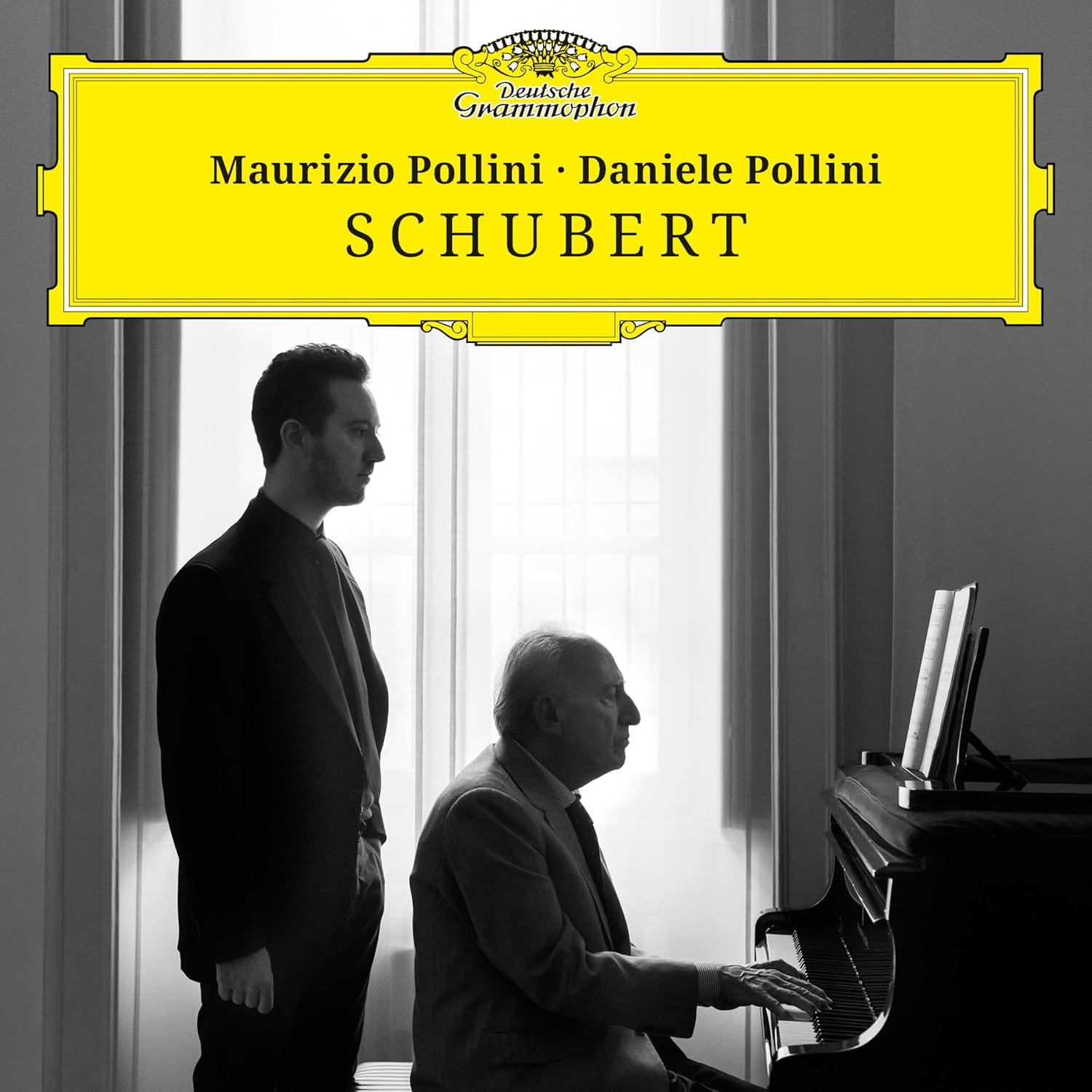
SCHUBERT: 1Piano Sonata No. 16 in G Major, D. 894 “Fantasie”; 26 Moments musicaux, D. 780; Fantasie in F Minor for Piano, four hands, D. 940 – 1Maurizio Pollini. Piano/ 2Daniele Pollini, piano – DG 486 6398 (1025/24) (80:13) [Distr. by Universal] *****:
We have Italian piano virtuoso Maurizio Pollini’s (1942-2024) last recording of June 2022, the swan-song music of Schubert played in collaboration with Pollini’s son, Daniele, in Munich, Germany. The pianism of Maurizio Pollini has consistently raised mixed reactions: his technique, considered flawless, became identified with a cool, hammered detachment that some auditors found austere and indicative of the “new emotional restraint.” Others saw Pollini as both an ardent Chopin specialist and a champion of modern, often highly intellectualized, scores that eschewed affective involvement and rather addressed philosophical curiosity, in the manner of enigmas and musical labyrinths.
The intrinsic warmth and personal serenity imbued in Schubert’s 1826 Sonata in G Major happily evokes from Pollini a corresponding geniality in spirit, the august opening of the first movement, Molto moderato e contabile, slowly evolving into a diaphanous trail of dancing and dramatic motives in loose sonata-form. Later, the initial theme modulates into a boldly unique, fff statement in the minor mode that indicates Schubert’s capacity for the tragic vision has not diminished. Pollini’s surface patina remains hard, percussive but tempered by long affection for his musical subject. Pollini lulls us to beauty instead of insisting we attend to the musical figures at hand. Color concerns from long studies in the music of Debussy seem to have had their nobler influence as the music cascades and sings, alternately, in its chains like the sea.
The second movement, the D major Andante, calls on Pollini’s placid establishment of an extended arioso melody, soon to be interrupted by tumultuous minor-key trio sections, respectively in B minor and D minor. The color panoply Pollini invests into the first trio enjoys a remarkably seductive patina, before a variant of the opening tune asserts itself. The second outburst seems to dwarf the first, especially given its unstable bass currents, capped by a true descent into the maelstrom. Some consolation arises from the treble and middle registers, though the menace only dissipates with a third recurrence of the opening tune, the coda ppp. Pollini projects a decided menace into the third movement, Menuetto. Allegro moderato, with its stern declamations in B minor. The B major trio interlude injects charm near to a musette’s sensibility, gently alluding to the Austrian folk sensibility. The da capo, however, insists upon the harsh inquietude that will not allow the scene to remain entirely placid. The G major finale, Allegretto bubbles forth as a rondo – especially later, in the E-flat major theme – much in the manner of Schubert’s chains of connected waltzes, German dances, and laendler, indulging in musical puns on the “circle of sixths.” Pollini’s execution of the quick runs and adroit changes of register testify to his mastery of Schubert’s essential pulse in the midst of the dancing modulations. Pollini, here much in the same spirit of mastery as had been achieved by Wilhelm Kempff in this sonata, justifies Schumann’s verdict that the G major remains “the most perfect in form and conception” of all the Schubert’s opera in this genre.
Daniele Pollini (b. 1978) makes his own claims as a Schubert colorist in the Six Moments musicaux (c. 1823-28), whose No. 3 in F minor often appears independently, despite Schubert’s intent that the set be played in its entirety. Pollini offers No. 1 in C with spare pedal effects while caressing the emergent melodic line that appears in various, staccato guises. The martial tone eases into a lovely nocturne laden with nostalgia. Daniele Pollini’s palette generally proffers a softer palette than his esteemed father, and his phrasing reminds this auditor of that of Paul Badura-Skoda. The second, in A-fat major, Andantino, opens cautiously then expands into five sections, some of extraordinary, introspectively mysterious beauty. A cry of pain arises, almost bitter in tone but immediately resolved in consolation in order to return to the thoughtful, opening measures. The jaunty No. 3 in F minor passes us in breezy, light touches. The C# minor No. 4, Moderato, reveals a strong, motoric J.S. Bach influence, which Pollini performs rather metronomically and aggressively, a la Rudolf Serkin. The cantabile trio section assumes a nuanced, dark coloration. The second F minor Moment, Allegro vivace, explodes on us in a torrent of potent octaves and then fluttering staccatos, building to an abrupt climax in repeated fortissimos, unrelenting to an equally abrupt coda. The last of the set, A-flat major, Allegretto, proves the most expansive, dramatic and wistful, at once. Between the sudden changes of key – A-flat and E major – and gradations of dynamics, increasing from pp and p to mf and f, the use of poetic anaphora, deliberate phrase repetition, ties the piece together nostalgically, an aching farewell, perhaps apt at this valedictory recital.
The four-hand Fantasie in F minor from 1828 appeared posthumously in 1829, dedicated to Countess Caroline Esterházy, one of Schubert’s royal pupils. This piece, like the Wanderer Fantasie, adheres to Schubert’s patented one-movement structure that subdivides into specific sonata movements, a template for Liszt, Berg, and Schoenberg. I recall first hearing the haunting piece with Robert and Gaby Casadesus; when I spoke of the work to Emanuel Winternitz, he remarked that he had only just introduced the piece to pianist Ralph Kirkpatrick.
The unearthly character of the opening measures, Allegro molto moderato, mesmerizes us immediately; soon, the music becomes martial and dramatic, involving some degree of polyphony. A pass through the major leads to a solemn, dotted rhythm Largo in F# minor, rife with menace and poised delicacy at once. Despite the onrush of vigor of the ensuing Allegro vivace, a manic scherzo, Schubert wants it played con delicatezza, an indication not necessary obeyed by our participants. The Pollinis hustle through the section with brilliant mirth, a feeling of an animated, even dizzily contrapuntal, music-box. The tempo slows down, the atmosphere having become heavy, in anticipation of the return of the lugubrious, haunted opening figures, the bass line especially earthbound. The canonic echo effects ring in the manner of a sad orison, intimations of mortality. After Bach, these polyphonic tones from Schubert utter some tragic thoughts of utmost, dire intensity, breaking off with the initial impulse, now in desolate harmony.
—Gary Lemco
More information through Amazon

From Deutsche Grammophon, Maurizio Pollini and Daniele Pollini on pianos, playing Schubert. Classical Music Review by Gary Lemco.