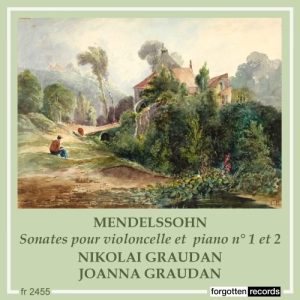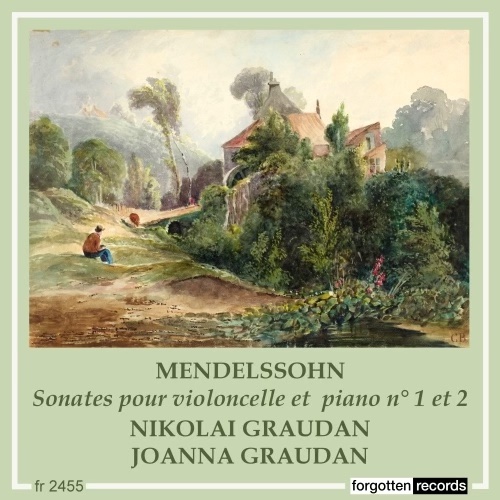
MENDELSSOHN: Cello Sonata No. 1 in B-flat Major, Op. 45; Cello Sonata No. 2 in D Major, Op. 58 – Nikolai Graudan, cello/ Joanna Graudan, piano – Forgotten Records FR 2455 (47:05) [www.forgottenrecords.com] ****:
Forgotten Records revives the 1949 performances (on Vox) of the two Mendelssohn cello sonatas, as performed by Nikolai Graudan (1896-1964) and his wife Joanna Graudan (1905-1993), a couple whose musicianship has been credited with “probity” by Harold C. Schonberg of The New York Times in 1951. Both husband and wife enjoyed the support of conductor Dimitri Mitropoulos: Nikolaus, as principal cellist of the Minneapolis Symphony Orchestra, and Joanna as the soloist for the MSO recording of Mendelssohn’s Capriccio brillant.
The program opens with Mendelssohn’s 1838 Cello Sonata in B-flat Major, originally conceived for the composer’s younger brother Paul, a banker and amateur cellist. The Allegro vivace theme appears divided into octaves between the participants and projects an austerely heavy tread, with Nikolai Graudan “as steady as a blockhouse,” to quote Schonberg’s 1951 assessment. The mood of this big first movement lightens though with fierce energy, much of the piano arpeggios quite voluptuous. The tune in dotted rhythm has Mendelssohn’s characteristic martial attractiveness. Mendelssohn’s model remains clearly Beethoven, who virtually invented the cello sonata genre. Nikolai Graudan’ tone, thin and piercing at times, becomes more sensuous when he allows the bow a long cantilena. The coda cascades with warm authority.
Dotted rhythm dictates the course of the second movement Andante, a delicate dance set in the minor mode. The atmosphere, courtly in character, has the keyboard proceed in canon over a drawn pedal. The secondary melody shows Nikolai Graudan to more lyrical, songful effect. A gently martial development places the piano against the cello’s pizzicato before the roles reverse, sending the cello into lower, throaty register. The march eventually slows its momentum, ending quietly in a manner reminiscent of Beethoven.
The last movement, Allegro assai, returns to the solemn opening of the sonata, but with new harmonization it becomes a lively, ardent romance in rondo form. Now we hear Joanna Graudan’s contribution to the Capriccio brillant in lithe colors. Mendelssohn has saved his virtuoso potential for this last movement, and the gruff exclamations from Nikolai play against the quicksilver runs of Joanna. Having achieved considerable sweep, the music accumulates a symphonic girth that gently cedes to quietly liquid motion from the keyboard. A bit of graininess of the original Vox LP is audible.
The more familiar Cello Sonata No. 2 in D Major (1842) results from Mendelssohn’s association with Count Mateusz Wielhorski, a Polish-Russian nobleman and accomplished amateur cellist who owned a Stradivarius instrument. Commentators note that the opening movement, Allegro assai vivace derives from an unpublished piano sonata in G major, but the musical material owes more to the Italian Symphony and its boisterous, spontaneous energy. Joanna Graudan’s repeated notes carry the sunny impulse while Niklai’s cello adds a dark color to the broad contour of the melody. Joanna’s percussive notes ring with clear authority, while Nikolai’s bass tones and pedal effects shimmer resonantly. A symphonic explosiveness characterizes their recap of the music in sonata form, vehement and ardently articulate.
No coincidence informs the second movement, Allegretto scherzando, conceived at the same time Mendelssohn worked on his amazing, elfin, incidental music for A Midsummer Night’s Dream. Set in B minor, the virtuosic caprice opens to a more lyrical melody in the middle section, another of the composer’s “songs without words.” The da capo proves a mite more incisive than it had at first, especially given Joanna speed of execution.
The Adagio in G major pays homage to Mendelssohn’s deep, abiding veneration of J.S. Bach. Starting with hymnal, organ riffs from the keyboard, Mendelssohn alludes to “Es ist vollbracht” from Bach’s St. John Passion. The cello carries the melodic urgency of the movement in recitative marked appassionato ed animato. The keyboard shares the sweetness of the melodic occasion before the consoling coda that openly quotes the recitative from Bach’s Chromatic Fantasy and Fugue in D minor, BWV 903.
The last movement, Allegro assai, capitalizes on the equality of instrumental parts: we encounter a bustling tour de force virtuosic and restless whose intensity heightens with each passing repetition of the main theme. Joanna Graudan’ s runs and staccato notes resonate, even as her husband sings in a most declamatory fashion.
–Gary Lemco