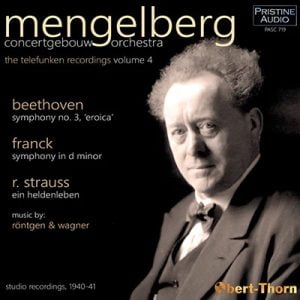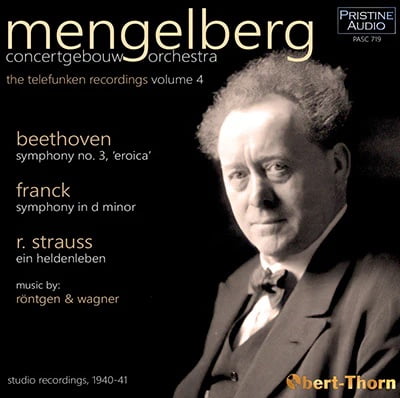
MENGELBERG Concertgebouw Telefunken Recordings, Vol. 4 = Works by BEETHOVEN; RÖNTGEN; WAGNER; FRANCK; R. STRAUSS – Concertgebouw Orchestra of Amsterdam/ Willem Mengelberg – Pristine Audio PASC 719 (2 CDs: 59:31; 76:18; complete content list below) [www.pristineclassical.com] *****:
Producer and Recording Engineer Mark Obert-Thorn, for his latest installment of the Telefunken legacy of conductor Willem Mengelberg, assembles the studio recordings, 1940-1941, which include several prior incarnations issued on the Pristine label.* Mengelberg (1871-1951) earned world renown for his tenure and discipline with the Concertgebouw Orchestra of Amsterdam, which he led from 1895-1945, the end of which occurred ignominiously, with Mengelberg’s dismissal and banishment from conducting activities (for seven years) because of his association with National Socialism.
The Eroica Symphony (11 November 1940) proceeds in the “typical,” flamboyant Mengelberg fashion, even without the first movement repeat, in large periods, the strings, winds, and horns buoyant as Beethoven explores asymmetries in rhythm and meter to arrive finally at a formidable sense of resolve. The heart of the music seems to lie in the second movement, Marcia funebre, which establishes a deep intimacy, the metric distortions and romantic slides notwithstanding, moving to a lyrically clear realization of Beethoven’s counterpoints. After a flippant Scherzo, which virtually breezes along in bravura execution, the finale, utilizing the notes “Prometheus” motif, rather thrives on the homogeneous discipline of ensemble, projecting an infectious brio throughout. The warm acoustic of the Great Hall of the Concertgebouw imparts to the flute ‘variant’ a special flavor, even as it soon competes with in extreme registers. The clarity of the deep bass tones as they play again the woodwind choir enjoys a smooth resonance that belies the age of the shellacs. The brass choir emerges as the pride of Amsterdam, virile, resonant, and focused. Each of the variations Mengelberg imbues with a distinct character, moving to a colossal series of perorations that literally hustle us to triumph.
The two 1904 Old Netherlands Dances from the same session as the Beethoven represent Mengelberg’s last documentation of native Dutch music. The music by Julius Röntgen transcribes court dances in galant style, a stately, “dolorous” Bergerette and a lively Pavane, rambunctiously athletic. Its central section, more contemplative, sounds like a garden-scene entr’acte to a romantic interlude.
Disc 1 concludes with 11 November 1940 performance of the well-familiar Overture to Wagner’s Die Meistersinger, originally released by Telefunken as part of the Franck Symphony issue. Robust and lyrical at once, the reading captures the sense of the musical occasion, realizing that Wagner’s drama – his most successful libretto – concerns the art of musicianship itself. The concentrated polyphony of the piece does not feel intrusive as Mengelberg urges the motion forward in suave strokes. The rapport between the brass and low strings remains fiercely pungent, with the timpani’s injecting a dutiful sense of moral purpose to the whole.
Disc 2 opens with the 12-13 November reading of the 1889 Franck Symphony in D Minor, a performance to which one reviewer responded, “You can feel the incense burning.” From the outset, the Mengelberg patented rubato and portamento are already at work, stretching or softening the linear tension. The cyclical nature of the propulsive thematic structure soon becomes, as detractors put it, “dogmatically evident,” but the force and sincerity of the execution – as it does in the reading by Furtwaengler – dispel academic criticism. In its more rapid periods, the music achieves a breezy, brash fluency under Mengelberg, who luxuriates in the collision of his various orchestral choirs, treating them as cooperating, virtuoso ensembles.
The second movement, Allegretto, famous for its English horn intertwined with plucked strings, begins hauntingly, some of the most warmly refined sonority in the Mengelberg discography. The scoring on several occasions imitates Wagner’s chromatic harmony, touched perhaps by the diaphanous moments in the Ring Cycle. A scherzando element manifests itself, the contrapuntal filigree of which must succumb to Mengelberg’s proclivities for melodic distortion, but the effect remains articulately driven. The coda could well be construed as “passion music.”
The last movement, Allegro non troppo, extends the aura of a church chorale that has lain within the original four-bar context that permeates the entire score. Elements from the Allegretto, superimposed upon the procession, now proceed in sonata form, eventually inverting the low-string somberness of the occasion into a potent, spiritual victory, especially given the Concertgebouw brass players. Kudos to Mark Obert-Thorn for a spectacular, vivid restoration of a performance that virtually “seethes” with idiosyncratic style.
On 21 April 1941, Mengelberg returned to the recording studio to address once more – having done so in New York in 1928 – the score by Richard Strauss dedicated to Mengelberg and his Concertgebouw Orchestra, the 1898 symphonic poem, Ein Heldenleben, a reading that features the ensemble’s new concertmaster, violinist Ferdinand Helman. Broad tempos girded by improved sonics make this interpretation particularly compelling, rife as the music proceeds with the hyperbolic ego of self-reference. Helman realizes the solo part, attributed to Pauline de Ahna, Strauss’s wife, in all her contradictory, whimsical, and seductive moods. Including huge cadenza part, the section, “The Hero’s Companion,” proves a self-contained structure in sonata form. Once Strauss engages and overcomes his critics in an epic (Roman) onslaught in brass punctuations and woodwind twitterings, his “Works of Peace” will evoke some twenty references to the Stauss opera, vocal and symphonic. That the work’s initial, pervasive theme is in E-flat major and later quotes Beethoven’s Eroica directly cannot be dismissed as coincidence. As Obert-Thorn asserts in his accompanying notes, the performance “scores in its superior sonics and in the equal [to the 1928 rendition] commitment and dedication of both conductor and orchestra.”
–Gary Lemco
*Obert-Thorn explains the Pristine arrangement of performances:
“Those prior issues were transferred by Andrew Rose. I’ve done my own transfers as part of my ongoing Mengelberg/Telefunkens series. The performances themselves of the Beethoven and Strauss should be the same (both from studio recordings), while Andrew previously issued Mengelberg’s live performance of the Franck, not the studio recording that I did.”
MENGELBERG Concertgebouw Telefunken Recordings, Vol. 4 =
BEETHOVEN: Symphony No. 3 in E-flat Major, Op. 55 “Eroica”;
RÖNTGEN: Netherlands Dances, Op. 46;
WAGNER: Die Meistersinger – Overture;
FRANCK: Symphony in D Minor;
R. STRAUSS: Ein Heldenleben, Op. 40
Ferdinand Heller, violin