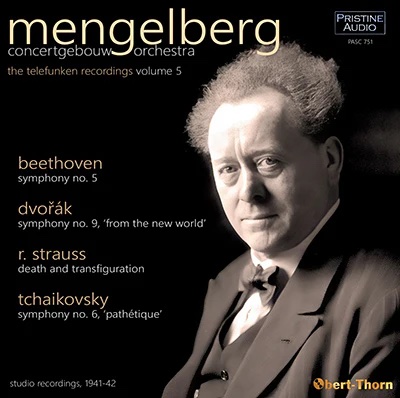
Mengelberg Concertgebouw Orchestra: The Telefunken Recordings, Vol. 5 = TCHAIKOVSKY: Symphony No. 6; DVORAK: “New World” Symphony; R. STRAUSS: Death and Transfiguration; BORODIN: In the Steppes of Central Asia; BETHOVEN: Symphony No. 5 – Concertgebouw Orchestra of Amsterdam/ Willem Mengelberg – Pristine Audio PASC 751 (2 CDs = 2:25:28) [www.pristineclassical.com] *****
Producer and Restoration Engineer Mark Obert-Thorn pays continued tribute to conductor Willem Mengelberg (1871-1951) in this, his fifth volume of Telefunken documents, here in honor of the conductor’s 150th anniversary of his birth. I am reminded that Obert-Thorn had previously ministered to the 27 April 1941 account of Tchaikovsky’s Pathétique Symphony – which Mengelberg debuted in Amsterdam in 1893 – for the Naxos label (8.110885). It seems appropriate, therefore, to open my review by commenting on what proceeds as a grandly exalted performance.
Mengelberg would often boast his especial knowledge and expertise in the music of Tchaikovsky, citing conversations with the composer’s brother, Modeste, as his source of authority. The Concertgebouw players, after years of such glamorous insight, would quip, while Mengelberg performed the music of Bach with his idiosyncratic distortions, that the permission had been granted by Modeste Bach! Nevertheless, this reading has both precision and dramatic tautness at every turn, notwithstanding the often, amazing freedom of rhythm and portamento to allow the melodic content to soar into the stratosphere. The vivid articulation from the COA winds and brass contributes to the potent effect of the drawn out, first movement Adagio, which erupts in visceral passion for the ensuing Allegro non troppo. Mengelberg, moreover, sculpts his transitions with graduated refinement, assured that his responsive ensemble will embellish every orchestral detail with inspired fury.
Orchestral sheen and beauty of tone mark the second movement, 5/4, Allegro con grazia, a tender waltz rife with sentiment. But do not assume Mengelberg does not infuse his patented urgency into this movement, whose middle section literally throbs with nostalgia. A colossal momentum informs the Allegro molto vivace third movement, a demonic scherzo whose martial drive frequently convinces listeners that its coda ends the work as a whole. Mengelberg elicits a blistering attack from his strings, answered by a brass ensemble already on the march. The acoustical drama, punctuated by cany placement of the various horns, produces a relentless assault that no less betrays an underlying malaise. The concluding Adagio lamentoso reveals another level of virtuosity, as if Mengelberg had not already awed us by dint of orchestral discipline. An operatic passion unfolds before us, an aching despair and spiritual fatigue expressed in figures of sincere, resolute nobility. If you will, acquire the set purely on the basis of Obert-Thorn’s seamless restoration of this towering performance.
Having meant to offer Mengelberg’s 1941-1942 recordings chronologically, Obert-Thorn notes that space limits of the CD medium prevent his coupling the Tchaikovsky with the Beethoven Fifth from 15 April 1942, which appears on Disc 2. But we next audition Borodin’s symphonic poem In the Steppes of Central Asia (24 April 1941), whose exotic landscape first revealed itself to me by way of Leopold Stokowski on RCA (LM 1816) and then, equally effective, readings from Mitropoulos and Fricsay. Mengelberg establishes the inverted string pedal that opens the sultry procession, answered by horns and a muezzin call to the dawn. The pace moves briskly, fanfares marking the aristocratic purpose of the travelers. The lure of the horizon beckons us as the two major motifs mingle in subtle, colored counterpoint, enhanced by the sheer scope of the panorama, before the whole dissolves into a splendid vapor.
Dvorak’s “New World” Symphony (23-24 April 1941) represents Mengelberg’s sole, commercial exploration of the composer’s oeuvre, once more an exhibition of the conductor’s willful drive and insistence on virtuosic clarity of line. The given lines enjoy fluency and lyric exaltation, given the brisk tempo of the opening Adagio – Allegro molto, at times volcanic – especially in the in COA brass choirs – in its gathering momentum. Stil, the reading remains essentially optimistic in tone, unlike the tragic sensibility Ferenc Fricsay elicits in his two readings from RIAS and Berlin.
A dire ceremony marks the famous Largo movement, with an exalted cor anglais part intoned with regal authority. Stately and processional, the pauses pregnant, the music moves forward with etched, lyric power. The transparency of Mengelberg’s string line captures our musical imagination. The elegiac development of this inspired second movement plays out with haunting, soaring lyricism, slightly exaggerated by Mengelberg’s idiomatic rubato, but touchingly effective in the chamber music moment of “Goin’ Home.” The ensuing Scherzo: Molto vivace resonates with pagan rites and impulses, hearkening back to Beethoven’s Ninth Symphony timpani while blending Kickapoo Indian calls infused with Bohemian colors. Rarely has trio’s triangle vibrated with such authority.
The last movement seems tailored to Mengelberg’s flamboyant personality: a terse, driven move to the opening fanfare and its syncopations lead to a thrilling, whirling march almost reluctant to cede its momentum. The second woodwind tune offers some lyrical solace with its string complement, only to yield to another martial impulse, both playful and tentatively solemn, at once. The full sonority of the COA, especially in the bass fiddles, makes us wonder what Koussevitzky might have realized in this music comparatively. Both heroic and nostalgic, the music achieves a glowing humanity of expression, the intensities punctuated by ardent COA brass, moving to a magnificent peroration that includes Dvorak’s signature “legend” coda that might signify “and so my children. . .”
To complete Disc 1, Obert-Thorn addends Mengelberg’s 14 April 1942 reading of the 1889 tone-poem of Richard Strauss, Death and Transfiguration, his sympathetically colored reaction to a poem by Alexander Ritter, in which a dying man has moments of both physical torment and vivid recollection, concluding with his passing into the next realm of existence. In the two sections preceded by a stealthy introduction, Allegro molto agitato and Moderato, a solo flute and oboe, respectively, initiate the rites of passage. Given Mengelberg’s fondness for the Strauss oeuvre, his recordings remain scanty, indeed: two versions of Ein Heldenleben and one Don Juan, in addition to the present document.
A thoughtful, intensely articulated introduction sets Mengelberg’s tone, with the composer’s calling upon the tympani and two harps to reinforce the dramatic lyricism of the occasion. A violin solo – likely Ferdinand Helman – serves as a voice of the protagonist, while the forces of nature, physical and psychical, gather round his death bed. Mengelberg’s capacity for sudden, explosive transitions serves him well for the galloping throes of torment besetting the dying man. A prominent horn theme suggests the innate heroism in his character, and he then dreams of youth, its “impudent play,” as Ritter terms it. The oboe, on the other hand, suggests the dream of childhood, a motif that no less informs the final, transfiguration sequence. The urgent vitality of the performance, vividly restored by Obert-Thorn, imbues the spiritual odyssey with a shimmering. palpable presence impossible to resist.
Mengelberg re-made his very first recording for Telefunken, originally in 1937, of Beethoven’s Fifth Symphony (15 April 1942), possibly to correct technical and ensemble issues that plagued the original. The first movement undergoes a series of temperamental shifts that attest both to his affectations and his orchestra’s capacity for response. To call the reading “willful” seems a vast understatement, but the dramatic effect cannot be denied. Fate here does not merely “knock” at the door but has a SWAT team break it down. The successive Andante con moto, on the contrary, proceeds, despite selective dynamic stresses, a highly disciplined, lyrical theme and variations, much in sensitive accord with the Classical tradition.
The last two movements proffer, respectively, a dire sense of tense expectation and the hard-won, heroic conclusion. Genuinely exciting, the two movements coalesce into a dramatic unity of manic, resolute proportions, schizophrenically tender as they are brutal. Etched pizzicatos compete with spasmodic tuttis, immense and portentous. The level of execution challenges description, the colossal discipline and unanimity of tone seamless, despite the astounding sped of delivery. Perhaps Mravinsky and his intimidated Soviet players in Leningrad offer the same level of agitated momentum. Whatever, you won’t soon forget the Mengelberg reading, which vibrates in your aural imagination long after the coda.
–Gary Lemco
Mengelberg Concertgebouw Orchestra: The Telefunken Recordings, Vol. 5 =
TCHAIKOVSKY: Symphony No. 6 in B Minor, Op. 74 “Pathétique”;
DVORAK: Symphony No. 9 in E Minor, Op. 95 “From the New World”;
R. STRAUSS: Death and Transfiguration, Op. 24;
BORODIN: In the Steppes of Central Asia;
BETHOVEN: Symphony No. 5 in C Minor, Op. 67
.