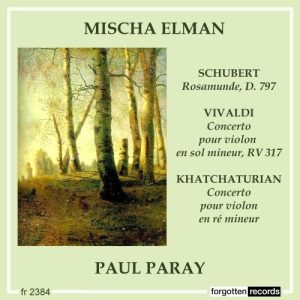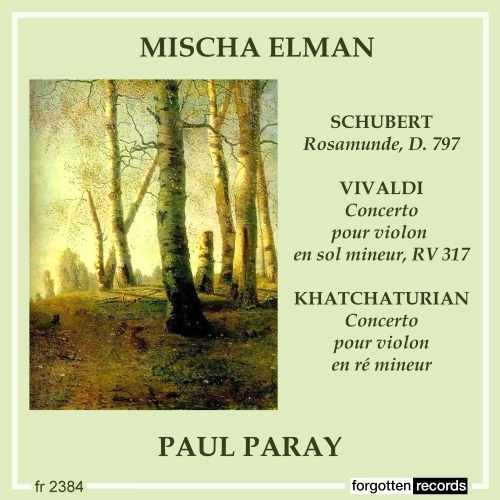
MISCHA ELMAN = SCHUBERT: Rosamunde Overture; Entr’acte No. 2; Ballet No. 2 from D. 797; VIVALDI: Violin Concerto in G Minor, RV 317; KHACHATURIAN: Violin Concerto in D Minor – Mischa Elman, violin/ Detroit Symphony Orchestra/ Paul Paray – Forgotten Records 2384 (72:26) [www.forgottenrecords.com] ****:
I had the distinct privilege to have heard violin legend Mischa Elman (1891-1967) in concert at Lewisohn Stadium in New York City, performing two concertos – the Mendelssohn and the Tchaikovsky – on the same evening, the orchestra under the direction of Alfredo Antonini. Even in his advanced maturity, Elman projected his famed, singing violin tone, his innately romantic approach to his repertory, and a palpable audience rapport. Forgotten Records revives Elman’s 10 March 1960 Detroit concert with French conductor Paul Paray (1886-1979) that features Elman’s penchant for Baroque repertory, along with the spirited, Armenian inflections of the 1940 Khachaturian Violin Concerto.
Paray begins the concert with the three mainstay excerpts from Schubert’s 1823 incidental music for Rosamunde, Princess of Cyprus, after the play by Helmina von Chézy, which closed after a mere two performances. The Overture, a re-assignment of the 1820 piece Schubert wrote for The Magic Harp, moves in suavely lyrical and alternately impetuous, galloping and obsessive ensemble. The sweet Entr’acte No. 2, which likewise serves for one of Schubert’s impromptus and his A Minor String Quartet, here shows off the string and wind choirs to studied effect. Ballet No. 2 in G major moves with a pointed, martial swagger, the wonderfully transparent and homogeneous blend of instruments a testament to the Paray ear for meticulous balances.
Elman appears first in Antonio Vivaldi’s 1711 Violin Concerto in G minor with String Orchestra, whose first movement, Allegro, allows Elman to display a range of colors in alternately dramatic and arioso contexts. When the dynamic softens, the sense of intimacy and expressive nuance becomes palpable as the esteemed soloist’s calling cards. The middle movement, a pensive Largo, casts an aura of pious devotion, on a par with Bach’s lauded Air on the G String. Elman often championed Baroque concertos by Tartini, Vivaldi, and Nardini precisely for the opportunity to showcase his patented arioso and fluent trills made incandescent by his Stradivari instrument. The final, buoyant Allegro drives forth with bustling energy and attractive rhythmic allure. Both Elman and Paray realize Vivaldi’s knotty, stop-on-the-dime antics, rife with sudden dynamic shifts and slides for the string complement. The high spirits and musical spontaneity quite sway the audience into a hearty show of appreciation.
Aram Khachaturian composed his vivacious Violin Concerto specifically for Russian virtuoso David Oistrakh. All three of its movements indulge the composer’s native, Armenian rhythmic and ardent melodic energies; in Elman’s case, this performance with Paray comes about a year after his commercial recording of the work with Vladimir Golschmann in St. Louis for the Vanguard label. In the first movement, Allegro con fermezza, Elman applies a thin, nasal tone to the various, oriental effects, held in a loose sonata form. A kind of whining, muezzin call saturates the melodic progression, countered by heavily applied repeated notes and flute-tone utterances. A definite sense of nostalgia permeates the orchestral tissue. Interrupted mid-course by a double-stopped cadenza in which Elman momentarily shares the stage with the flute. The main, martial theme, taken a bit more marcato than by some interpreters, assumes a noble stance prior to its various flurries into the Armenian stratosphere. The pounding coda comes to a dead stop, the audience in silent thrall.
The heart of the Concerto, the Andante sostenuto, provides a luxurious rondo in the form of an improvised, rhapsodic song of exotic beauty. The wiry melody seems to seek, a la Solomon and Sheba, a lover who lies just beyond the next desert dune. A throbbing sensuous marks the entire movement, and Elman’s vibrant tone impels the movement with a fervor all its own, to which the orchestra responds with equal ardor. A sustained intimacy settles upon the extended song,
—Gary Lemco