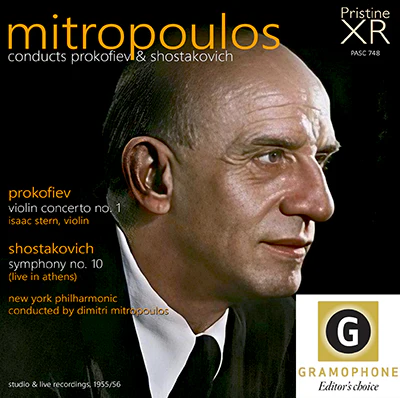
MITROPOULOS conducts PROKOFIEV and SHOSTAKOVICH = PROKOFIEV: Violin Concerto No. 1 in D Major, Op. 19; SHOSTAKOVICH: Symphony No. 10 in E Minor, Op. 93 – Isaac Stern, violin/ New York Philharmonic/ Dimitri Mitropoulos – Pristine Audio PASC 748 (69:57) [www.pristineclassical.com] *****:
The appearance of this disc from Pristine – especially the performance of the Shostakovich Tenth Symphony from the Orpheum Hall in Athens, Greece (2 October 1955), came as a remarkable discovery, given that no recorded documentation has existed for conductor Dimitri Mitropoulos (1896-1964) from his native country. The Shostakovich symphony, gestating between 1946-1951, had its premiere in December 1953 under Yevgeny Mravinsy and the Leningrad Philharmonic, and early commentary cited the music corresponded to qualities of the late Soviet dictator, Stalin. While Mitropoulos and the New York Philharmonic did make a commercial, studio recording for CBS, the present document derives from a post-war, European tour that allowed the Greek populace to witness their master musician in concert with the ensemble he had honed since 1949, after having shared leadership duties with Leopold Stokowski.
The opening movement, Moderato, stealthily and in sonata form, insinuates the personal motto DSCH (D-E-flat-C-B) in musical terms as an anagram of the composer’s himself, surreptitiously imposing his ego in a world fraught with malice. The NY Philharmonic string section asserts its intense supremacy in emotionally charged work when led by the inspired Greek conductor. An elastic but elongated movement, the taut line and dark evolution of its themes catch equal fire in the Philharmonic’s woodwinds, brass, and battery. At the mid-point of the progression, a manic, dizzy climax reaches a kind of apotheosis, finally resolved by groans in the cello line. A wind serenade ensues, a fluttering lyrical exposition on the motto theme, complemented by the awkward, meandering waltz tune. Having alluded both to Mahler and to his own Pushkin Verses, Shostakovich has the extended coda realize a haunted version of his motto, melancholy while somewhat uplifted by the flute choir that may refer to Nature’s eternal judgment.
The visceral scherzo (Allegro) emerges in frenetic militant, syncopated 16ths that buzz and whirl in spectacular fury. Whether a Soviet march or hustling orchestral étude in rhythmic gymnastics, the severe, demonic discipline of the Philharmonic rivals accounts left us by Mravinsky and Ancerl. There inhabits the Allegretto (Largo) movement a touch of Wagner’s Tristan, given the merger of two motives, the DSCH and the so-called “Elmira” motif, named for Elmira Nazirova (1928-2014), a composer for whom Shostakovich felt an enduring kinship. French horn and pizzicato strings set a fateful tone to which assorted woodwinds contribute an ambiguous, exotic series of color modulations, until a martial waltz erupts, a kind of angular, vehemently percussive variation on Borodin and the simian call from Mahler’s Das Lied von der Erde. A plaintive viola has the last word here, along with pizzicato strings, flute, and horn.
While the last movement, Andante-Allegro, contains the D-S-C-H motif and its variation D-C-B-E-flat, the mood strongly resembles that of Bartok, in particular, aspects of that composer’s 1944 Concerto for Orchestra, featuring strong presence from oboe and flute. A heaving, visceral anguish permeates the progress, until a jaunty – perhaps insincere – levity erupts in contrapuntal motion, the colors once more evocative of Bartok but colored by Russian folk energies. Mitropoulos’ control of divergent metrics and dynamic pulsations proves ever fertile, bristling, acerbic, headstrong. The colossal insistence, the feral, obsessive propulsion breaks off into a modified dirge in plaintive terms, pleading for reconciliation. A sense of mordant humor manages to appear, athletic circus music touched by Bartok’s woodwinds and snare drum. Are the last bars jubilant or simply mad? Whatever, the “hometown” audience virtually screams their adoration.
For the CBS performance of Sergei Prokofiev’s 1923 Violin Concerto No. 1 in D Major (rec. 27 February 1956), Mitropoulos has the assistance of American soloist Isaac Stern (1920-2001), who at this period in his career maintained a solid tone and effective technique, witnessed as well by his concerto recordings of Brahms and Sibelius with Sir Thomas Beecham. This performance was coupled (ML 5243) with the G Minor Concerto led by Leonard Bernstein. Constructed in three movements, the outer movements essentially lyrical and the middle movement a savagely ironic, flippant scherzo, the piece casts a luxuriant, exotic charm, often in the form of a reverie. Prokofiev alters the textures accompanying the solo in the course of the work no less demanding varying color effects from Stern, including ariosos, pizzicatos, ponticello chords, alternation of arco and plucked effects, and high harmonics. The duet with flute John Wummer, then the harp near the coda remains a moment of fine beauty. The whirling dervish Vivacissimo first revealed itself to me via Joseph Szigeti and Sir Thomas Beecham. Stern and Mitropoulos inject hiccups and dainty frenzy galore, a tour de force for all participants. The last movement, another suavely executed dream sequence, proceeds in a loose binary form, eventually dissolving in a rarified, cyclical ether here enshrined by Pristine’s XR process of amplified sonics.
Highly recommended, this fine restoration, with thanks to Andrew Rose and his team.
—Gary Lemco
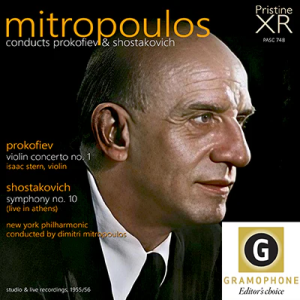
From Pristine Audio, Dimitri Mitropolous condcuts Prokofiev Violin Concerto and Shostakovich Symphony No. 10. Classical Music Review by Robbie Gerson.