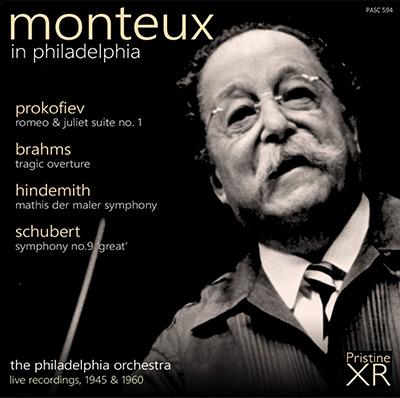
PROKOFIEV: Romeo and Juliet – Suite No. 1, Op. 64b; BRAHMS: Tragic Overture, Op. 81; HINDEMITH: Mathis der Maler – Symphony; SCHUBERT: Symphony No. 9 in C Major, D. 944 “Great” – Philadelphia Orchestra/ Pierre Monteux – Pristine Audio PASC 594 (2 CDs) 68:09; 52:11 [www.pristineclassical. com] ****:
The relationship between the Philadelphia Orchestra and French conductor Pierre Monteux (1875-1964) included some twenty appearances, and the pity remains that we have so little preserved documentation for them all. The concert from 6 January 1945 – preserved by Andrew Rose in ambient stereo – opens with six scenes from Suite No. 1 from Prokofiev’s Romeo and Juliet, repertory Monteux rarely traversed, having left us only a Classical Symphony from another live broadcast. This music inhabits a special, personal music space in this reviewer’s consciousness, having come to him first – raucously – through Karel Ancerl, then to better effect, respectively, via Dimitri Mitropoulos, Charles Munch, and Leopold Stokowski. Of these, the Mitropoulos produced the most lasting effect, and it supplied the very first cut of my radio career in 1966, over WHRW-FM, Binghamton, New York, in a program entitled “Mitropoulos and Rhythm,” in which “Romeo and Mercutio Masked” made my own broadcasting debut. The selections from Monteux’s suite each have a lithe, seamless energy, thoroughly stylistic. The sense of Renaissance antiquity remains even in the midst of modern harmony and passing dissonance. The “Scene” that features bassoon and solo violin, marcato, moves into brisk gestures that explode and disappear. Each of the successive dance sequences haunts us with a lyrical sense of tragedy, culminating in the love scene, “Romeo and Juliet, where the music passionately concludes, not having included the customary “The Death of Tybalt.”
Brahms retained a special place in Monteux’s repertory, his favoring the Symphony No. 2 more than any other piece in the composer’s oeuvre. The Tragic Overture in D minor, Op. 81 of 1880 – a product of the composer’s concession to his “melancholy nature” – did not receive any commercial recording from Monteux, but this performance from 4 March 1960 opens the entire program restored by Pristine; and a San Francisco rendition with Monteux appeared some years ago in a set devoted to the Standard Hour broadcasts. Typical of Brahms, the work progresses in sonata-form, well appealing to Monteux’s strong sense of musical architecture. But the work becomes potent and expressive in modal terms, strong in emotional shifts, dotted rhythms, and striking syncopation and counterpoint. This gorgeously restored concert performance resounds from first declamation in falling fourths to the passing heroic gestures and final, doomed coda with a sure and direct line of momentum, the taut grip of the vision unrelenting.
For sheer aural sensuousness, few pieces of music have the power to “show off” an orchestra’s luster like Paul Hindemith’s 1934 Mathis der Maler – Symphony, given its world premiere in Berlin under Wilhelm Furtwaengler. The inspiration for the music – originally a full opera – derives from the life of painter Mathias Grunewald (1475-1528), who, while living at the time of the Peasants’ War in Germany, created a huge alter-piece, a triptych of St. Anthony, for the abbey of Isenheim in Alsace.
The first section, Engelkonzert, serves as an overture to the opera and depicts – in shining G Major and G minor chords in trombones – an Angelic Consort, rife with medieval musical allusion, such as the song Es sungen drei Engel, the Three Singing Angels whose wings flutter with the Philadelphia flute part and violin eighth notes. A crucified Jesus adorns the second of the alter-piece panels, a Grablegung or Tomb-motif, from the last scene in Hindemith’s opera. In staggered progression, them music conveys the intimate and then glorious, even lyrically sorrowful beauty, of the paradoxically transcendent moment. Two Isenheim painting provide the impetus for the final tableau: St. Anthony confronts twisted demons of his own capacity for sin; and St. Anthony meets with Peter the Hermit, only to intensify and to exalt St. Anthony’s spiritual crisis. The explosive sonorities, galloping rhythms, and thick polyphony capture the paroxysms in St. Anthony’s soul – an obvious metaphor for us – as it had been in its time – for Germany’s crisis of faith in the 1930s. Late in the score, the woodwinds intone the Medieval chant Lauda Sion Salvatorem, answered by the Philadelphia brass in Alleluias, a triumphant sound welcomed with audience abandon at the Academy of Music.
The second half of the restored concert belongs to the Symphony No. 7 [sic] of Franz Schubert, that truly Viennese vision of “Heavenly length.” Monteux leads the entire work as an uninterrupted series of songs of varying character: lyric, hymnal, meditative, declamatory, triumphant. We note, mostly because of Monteux’s emphases on textural clarity, the presence of two competing rhythmic pulses vying either for dominance or conciliation. The brisk pace of the Allegro non troppo section of movement one has a limber audacity of spirit, a delicacy in its homogenous sonority that seduces us even as the music achieves a wicked momentum. Monteux treats the Andante con moto in A minor as a Viennese bucolic dance, explosive at moments, but whose pantheistic impulses do not become so mystical as they do under Furtwaengler in Berlin. The Philadelphia woodwind articulation finds warm response from the French horns and strings, a sound Stokowski first cultivated and to which he would return in 1962, a sound Fritz Reiner coveted to the day he died. Monteux’s Scherzo has dash and wit, maintaining a fine sense of the tympani’s contribution. The Trio section introduces a generous, outdoor, Austrian impulse, rich and creamy in winds and horns. The segue to the da capo, smooth as glass, returns us to the enchanted vistas of Schubert’s Viennese spirit. The final Allegro vivace bestows a whirlwind of virtuoso energy upon us, a tour deforce in dotted notes against triplets. The martial trumpet work! Then, the repeated four notes that become obsessive as the music generates two opposed metric impulses that will gravitate as far as E-flat Major for a false recapitulation. The entire progression, suave, almost effortless in its cumulative, heroic effect, emerges a miracle of not merely “French” conducting but of a lone master of his craft, Pierre Monteux, too often neglected in the first rank of those who occupy the Pantheon.
—Gary Lemco