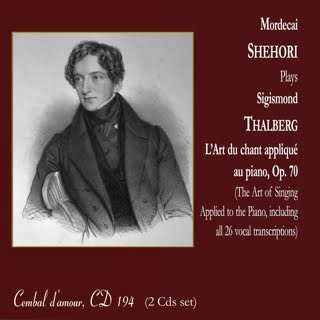
THALBERG: L’Art du chant applique au piano, Op. 70 – ercaordecai Shehori, piano – Cembal d’amour CD 194 (2 discs) 67:07; 53:01 [www.cembaldamour.com] *****:
In his ceaseless effort to expand upon and inculcate pianistic principles of his beloved teacher, Mindru Katz, Mordecai Shehori addresses the musical phenomenon Sigismond Thalberg, whose reputation as a most serious rival of Franz Liszt has a pedagogical component in his advocacy of bel canto, legato application at the keyboard. Mr. Shehori has supplied me his preface – here somewhat abridged – to his most recent release:
“My latest 2-CD set was just published. It features only the 2nd recording ever of the complete Sigismond Thalberg’s: L’Art du chant applique au piano, Op. 70, published in 1853. It seems that even in Thalberg’s era (8 January 1812 – 27 April 1871), there were piano bangers who degraded the piano from its original design and role as a “singing” instrument – which follows the Bel canto principles – into a vertical, percussion nightmare. There are 26 stunning vocal arias, duets, and vocal quartets with orchestra. I consulted the full orchestral scores and added many vital flute, oboe, and other “instruments’” melodic lines that that were not included in the original Thalberg scores.”
It behooves me to mention that no less a musical influence upon Shehori’s concept of vocalism in keyboard playing derives from his profound admiration of Brazilian soprano Bidu Sayao (1902-1999), who possessed a voice unique in its youth, charm, and capacity for dramatic projection.
As for Thalberg’s pedagogically important contribution to music, the Art of Song as Applied to the Piano, realized by Shehori, conforms to Shehori’s own training. His teacher, Katz, emphasized legato playing and the production of lovely tone, qualities too often sacrificed – even in Thalberg’s era – to volume and speed. The major criticism of Thalberg concerned his predictability of means:
“His bravura pieces, fantasies on melodies from Rossini’s Mosè and La donna del lago, on motifs from Bellini’s Norma and on Russian folk-songs, became extraordinarily popular through his own, brilliant execution; however, they treat their subjects always in one and the same way… to let the tones of a melody be played in the medium octave of the keyboard now by the thumb of the right, now of the left hand, while the rest of the fingers are executing arpeggios filling the whole range of the fingerboard.” [ Carl Friedrich Weitzmann, Geschichte des Klavierspiels]
One needs merely to listen to Shehori’s reading of Mozart potent Lacrimosa from the D minor Requiem to appreciate how sighs may be rendered by two legato notes. Thalberg uses the term “kneading” to indicate how he prefers the performer “mold” the melodic line in the manner of a baker’s shaping dough, but the term will not translate to the arm and wrist articulation he means to create fluidity of sound. The lovely Mozart aria, “Sull’aria, Che soave zeffretto,” from Le Nozze (known to many of us via The Shawshank Redemption) pours forth in duet harmony. Note Shehori’s canny pedal – which Thalberg claims as “indispensable to a breadth of execution” – for the Rossini “Perche mi guardi e piangi” from Zelmira. The subtle swell in volume occurs with no “visible” sense of pressure. Of course, the “truest” test of Bel Canto comes from Bellini, here in Thalberg’s transcription of the cavatina Casta diva, che inagenti. . .from Norma. Even the accompanying bass notes offer a lifting power, intensified by the transparency of the upper line. The similarity in the breathed phrases immediately “translates” to the fluid line in Schubert’s Der Mueller und der Bach on Disc One. The subtle agogic shifts in melodic statement give the sense of variety even to reprised phrases, requisite in true musicianship. The last minute of the Bellini aria, with its inserted parlando and a Sayao trill, grant us a sense of absolute closure.
Immediately on the heels of the Bellini, Mozart’s magical Voi che sapete che cosa e amor of Cherubino unfolds in a music-box sonority that feels almost balletic. Besides the “expected” duet, La ci darem la mano – exploited by Chopin as well as Thalberg – the other colossus of transcription comes in the form of Il mio tesoro intanto from Don Giovanni. This aria lacks high notes but demands a sustained breath rife with color; and, for me, realized by two great Irish tenors, John McCormack and Richard Crooks. Like the aria from the Requiem, the simplest parlando contains a host of passions, and the trills and sudden, martial air bequeath a solemn scope to the occasion. Listen to Shehori’s “kneaded” transition to the da capo. Elegant and emotionally persuasive, the air has assumed that “quietude” of which Thalberg speaks to achieve “sonorousness, the quality of the beauty of the tone produced upon the piano.”
Happily, the collection draws upon music beyond the “mere” parameters of Italian opera and Mozart: we have selections from Beethoven (Adelaide), Weber (Der Freischuetz, Euryanthe and Preciosa), aforementioned Schubert, Haydn (Die Jahresziten), and French models from Meyerbeer and Gretry. The Welsh air Dafydd y garreg wen presents a lovely A minor lyric that celebrates an orphic player on his harp. Shehori imparts a diaphanous texture to its plaint, a melos worthy of its mighty poet Dylan Thomas. The set concludes with another moment of folk wisdom, the Neapolitan song, Fenesta vascia, whose “low window” leads to a woman who does not requite the love of her admirer. So ends Shehori’s version of the Thalberg banchetto musicale, a true feast of pianistic musical invention from which many an aspiring keyboard artist might partake of its fruits. Likely the first of my Best of the Year for 2020.
—Gary Lemco
Contents:
Disc One:
Bellini: I puritani A te, o cara
Pergolesi: Tre giorni son che Nina
Beethoven: Adelaide, Op. 46
Stradella: Air d’eglise: Pieta, Signore
Mozart: Requiem: Lacrimosa
Mozart: Le nozze di Figaro: Sull’aria, Che soave Zeffiretto
Rossini: Zelmira: Perche mi guardi e piangi
Mercadante: Il giuramento: Romance: Bella adorata incognita
Meyerbeer: Il crociato in Egitto: Coro nel Congiuratti: Nel silenzio, fra l’orror
Weber: Preciosa: Einsam bin ich nicht allein
Schubert: Der Mueller und der Bach
Weber: Der Freischuetz: Schelm, Halt fest! Ich will dich’s lehren!
Mozart: Don Giovanni: Il mio tesoro intanto
Disc Two
Rossini: Il Barbieri di Siviglia: Serenade: Se il mio nome. . .
Mozart: Die Zauberfloete: Bei Maennern, welche Liebe fuehlen
Donizetti: Gianni di Calais: Barcarolle: Una barchetta il mar. . .
Mozart: Don Giovanni: Protegga il giusto
Mozart: Don Giovanni: La ci darem la mano
Gretry: L’amant jaloux: Serenade: Tandis que tout sommeille
Rossini: Otello: Assisa a pie d’un salice
Bellini: Norma: Casta diva. . .
Mozart: Le nozze di Figaro: Voi che sapete. . .
Weber: Euryanthe: Quartet: Froehliche Klaenge, Taenze, Gesaenge
Traditional: David of the White Rock
Haydn: The Seasons: Winter: Ein Maedchen, das auf Here hielt
Traditional: Fenesta vascia