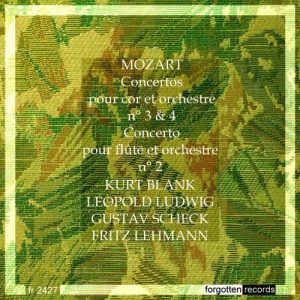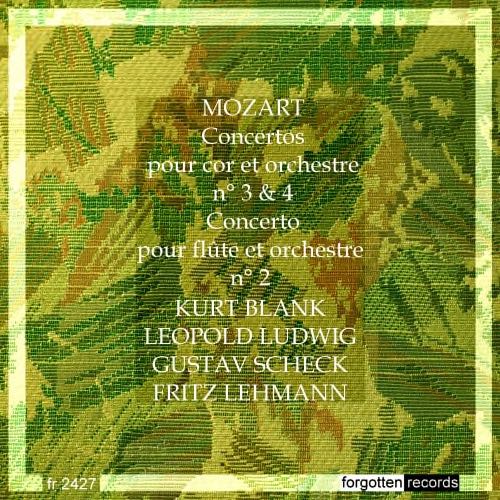
Mozart – Horn Concertos Nos 2 & 3, Flute Concert No. 2 – Forgotten Records FR 2427 (54:04, complete credits below) [forgottenrecords.com] ****:
Forgotten Records restores vintage DG recordings from 1956, music by Mozart performed by German artists who had to compete with horn virtuoso Dennis Brain and flute virtuoso Jean-Pierre Rampal for primacy in this repertory. The two conductors featured, Leopold Ludwig (1908-1979) and Fritz Lehmann (1904-1956), noted for their security in an imposing range of repertory, provide solid, colorful accompaniment for the two instrumentalists. Horn player Kurt Blank earned distinction from his association with the RIAS Symphony Berlin, especially as led by its principal conductor Ferenc Fricsay (1914-1963). Flute player Gustav Scheck (1901-1984) enjoyed a career with the Hamburg State Opera and the Wenzinger Chamber Orchestra.
Mozart conceived four horn concertos for friend (and victim of Mozart’s coy humor) Joseph Leutgeb (1732-1811), in truth a gifted player from Salzburg of the natural, valveless horn who received in Mozart’s scores teasing, salacious, and demeaning remarks in multicolored inks, like “For you, Mr. Ass,” “quick, get on with it,” and “sheep could trill like that.” Leutgeb tolerated Mozart’s gruff humor and managed to master the delightful effects Mozart invented for the horn, involving hand stopping to achieve the dancing and hunting motifs of immediate wit and chromatic, plastic charm.
The two concertos in E-flat major, composed respectively in 1783 and 1786, owe debts to Joseph Haydn, but no less to Michael Haydn, whose slow movement from his Horn Quintet in A-flat Major likely served as a model for the Romance: Larghetto of the Concerto No. 3. In the first movement Allegro, solo Blank executes the dotted rhythms and scalar melodies with easy grace. Although not so fluidly deft in the last movement Allegro as legendary Dennis Brain in his historic collaboration with Herbert von Karajan, Blank injects quick, agile humor into the hunt motifs that define Mozart’s ironic concession to Leutgeb’s splendid gifts. So, too, the 6/8 “hunting” Rondo from the Concerto No. 4 proves equally engaging, especially in contrast with the shimmering tone presented in the Romance movement. Blank’s smooth transitions between the horn’s upper and lower registers testify to a seamless technical command.

Wolfgang Amadeua Mozart
Mozart’s Flute Concerto No. 2 in D Major (1778) constitutes his re-casting of his earlier Oboe Concerto, K. 314, originally conceived for a Dutch player of the Salzburg Court Orchestra. The new commission, as it were, came from a gifted (but limited) amateur Ferdinand Dejean, as part of a group of pieces that included three flute quartets. Despite Mozart’s bristling at both the short fee and the amateur’s technical deficiencies, he produced an idiomatic, often colorfully compelling work of enduring quality. Gustav Scheck and the ever-reliable Fritz Lehmann provide a rich tapestry through which Scheck glides and soars in the opening Allegro aperto whose cadenza is an object lesson in breath control and instrumental nuance. The slow movement projects a sincere melancholy supported by the orchestra’s sustained melody line. Lastly, the 2/4 Allegro finale indulges in a rondo theme Mozart found distinctive enough to reuse in his opera The Abduction from the Seraglio. When Mozart “steals” from himself, no one feels any poorer. For the better part of an hour, this disc rewards us with Mozart’s spontaneous joie de vivre.
—Gary Lemco
Mozart – Horn Concertos Nos 2 & 3, Flute Concert No. 2
1Horn Concerto No. 3 in E-flat Major, K. 447;
1Horn Concerto No. 4 in E-flat Major, K. 495;
2Flute Concerto No. 2 in D Major, K. 314
1Kurt Blank, horn/
2Gustav Scheck, flute/
1RIAS Symphony Berlin/
2Bamberg Symphony Orchestra/
1Leopold Ludwig, conductor/
2Fritz Lehmann, conductor