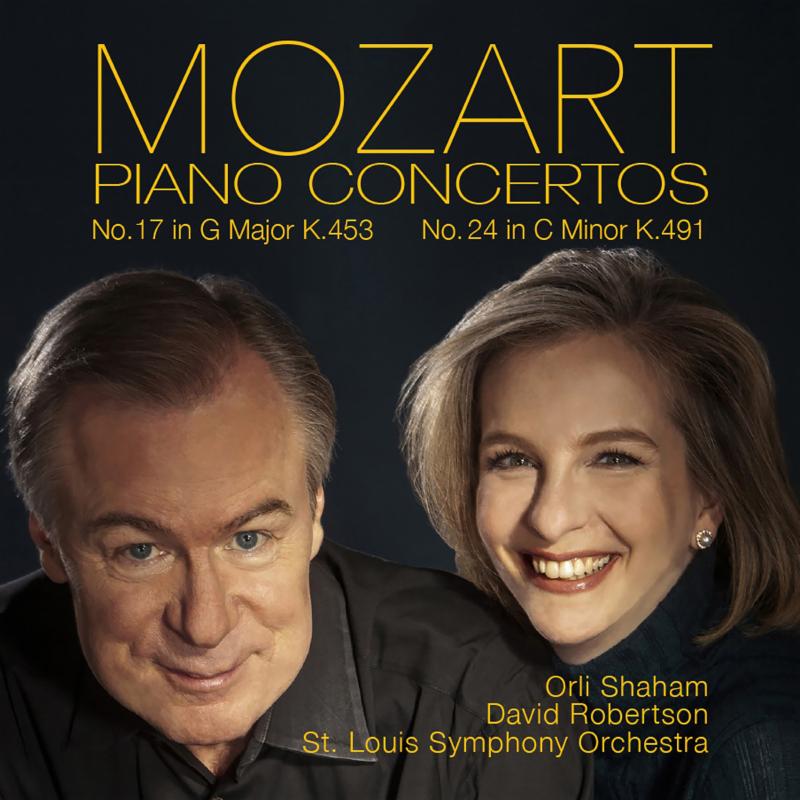
MOZART: Piano Concerto No. 17 in G Major, K. 453; Piano Concerto No. 2 4C minor, K. 491 – Orli Shaham, piano/ St. Louis Symphony Orchestra/ David Robertson – Canary Classics CC18, 59:10 (8/23/19) [Distr. by Harmonia mundi/PIAS] ****:
Orli Shaham and conductor David Robertson perform (rec. 14 November 2017 and 24 January 2018) two emotionally disparate concertos by Mozart, the first of which, the G Major, K. 453, comes at the peak of the composer’s popularity in Vienna, 1784. Mozart had in this work a fine vehicle for his own talents, and he claimed that its uncanny flexibility of style and tone would appeal to both connoisseur and dilettante alike — such music of surpassing technical brilliance, but also, in Mozart’s own words, “written in such a way that the less learned cannot fail to be pleased, though without knowing why.” The first movement Allegro has something of the military about it, and the secondary theme takes “circuitous routes” in terms of key sojourns. At various points in the development section, the music moves into a lyrical E-flat Major. Orli Shaham and conductor Robertson remain quite attuned to Mozart’s sense of inflection and spontaneous capacity for invention, especially when musical lines and accidentals are repeated, and so they avoid mere verbatim tediousness. The music of the last movement – apocryphally attributed to Mozart’s pet starling – strikes us a variant of the theme of movement one. No less impressive, the vocalism in Shaham’s playing reminds us that for Mozart, the operatic medium and purely instrumental mode share a commonality of expression.
The most fascinating movement, the C Major Andante, moves in starts and stops, chromatic and transparent, at once. Jean Casadesus, in his Piano Literature class at SUNY Binghamton, treasured this Mozart moment above all others for its compressed drama and richly modulated turns of phrase, alternating in shifts between major and minor. The last movement Allegretto literally flows in color, the variations upon the ‘starling theme’ becoming more complex, dense and chromatic, with variation four’s assuming a dark menace. Theurge to militancy affirms itself, even as the music wants to anticipate the unfettered joie de vivre of The Marriage of Figaro. As playfully intimate as it can become passionately assertive, the collaboration breezes into the extended coda, which plays as a combination cadenza and knotty operatic aria. Concerto, symphony, opera, the last pages bustle with false endings and deliberate, fanciful wit, all borne of a musical imagination singular in the history of music.

Wolfgang Amadeus Mozart
The 1786 Piano Concerto in C minor possesses a mass and dark tenor unique in Mozart’s concerto oeuvre. Somber and tragic, the piece calls for a large orchestra, and the woodwinds, especially – employing both oboes and clarinets – contribute to the symphonic breadth of the conception. The opening Allegro, ¾, announces a militancy to which the keyboard answers with a minimal, restrained declamation that soon climbs to a tender evocation of primal innocence that the winds support. The strings, however, add the elements of unrest, while the secondary tune in the winds and piano offer something like consolation. Despite the anxiousness expressed in the interplay of orchestra and keyboard, the lines retain a directness and chaste simplicity that belies the urgency of the affect.
The E-flat Larghetto has had its profound effect upon this auditor ever since he first heard the tranquil music performed by Artur Rubinstein and Josef Krips. The woodwind writing assumes a a concertante quality, which along with the music’s intimacy, gives it a chamber music quality, rivaling the Quintet, K. 452. A rondo, the music occasionally wanders into a dark C minor and permits inspired moments of counterpoint. Late in their musical course, Shaham and Robertson subdue their dynamics to a barely audible pianissimo. The last movement reverts to Mozart’s wonderfully elastic notion of a theme and eight variations, two of which lighten the dark hues with major keys of A-flat and C. The music assumes a military resolve, threatening a symphonic storm, only have the winds break off and make an outdoor jaunt of a rather melancholy gesture. Orli demonstrates the Bach influence on late Mozart with a solo in four-part counterpoint. The final pages, in 6/8, do not exude cheer but rather a grim resolve that finds smiles in spite of tears. A minor Mannheim rocket takes us to the inevitable conclusion.
–Gary Lemco