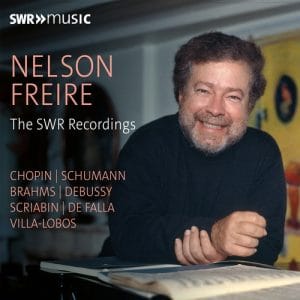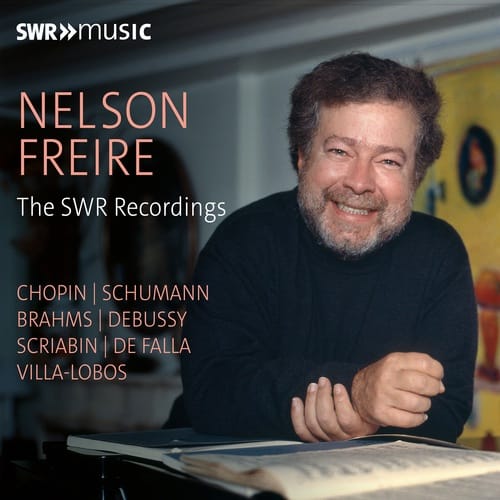
Nelson Freire: The SWR Recordings – Piano works of Chopin, Brahms, Schumann, Scriabin, Debussy, Villla-Lobos, Falla – SWR19161CD (3 CDs= 45:11; 62:26; 66:59, detailed contents listed below) (2/14/25) [Distr. by Naxos] *****:
Pianist Nelson Freire (1944-2021) established – with his compatriots Martha Argerich and Daniel Barenboim – a Brazilian keyboard triumvirate of international repute and musical authority. In several respects, Freire became the natural heir-apparent to Brazilian virtuoso Magda Tagliaferro (1893-1986), noted for her absorption of the great French tradition, along with her penchant for contemporary scores by Heitor Villa-Lobos. Freire recorded his first album of works by Frédéric Chopin at the age of twelve. The composer remained one of the loves of his life. Freire disliked the heavy demands of travel required for concert tours, and he eschewed publicity and interviews. One of his more experimental endeavors was his signing with Julian Kreeger’s Audiofon label for a limited number of recital programs. Freire cut off all recording projects around 2010. The SWR label restores four different, live concerts, recorded 1968-1999, vividly exemplifying his spontaneity and innate lyricism of execution. The included booklet by Christoph Vratz provides colorful commentary about the Brazilian pianist’s evolving personality.
This SWR set opens with an all-Chopin recital, the dreamily liquid 1834 Andante spianato in radiant, salon pearls, establishing an intimate quietude that never hints the orchestra attends him. The trumpet volley announces that the salon has expanded to the concert hall, where Freire’s lithe agility gives the 1831 Grande Polonaise an elastic élan. Trills, double notes, astounding passages in leaping figures pass by in Freire’s silken motley, the rhythm unwavering in its combination bravura, bel canto style. The magical coupling introduced itself to the Paris audience in 1835, the orchestra part ornamentally attractive but virtually inessential but for some nice color pageant.
Follows the ubiquitous 1840 Sonata No. 2 “Funeral March,” so named for its dire, potent third movement. Freire imbues the first movement with a tragic tension, moving between B-flat minor and D-flat major, between agitato and sostenuto, a true chiaroscuro of vehement passions. At key periods, Freire imposes a willfully driven momentum, as fierce as it can become exquisitely tender. At the coda, the themes have become layered in stretto application, authoritative in their menace and bitter resolve. The final tones seem to carry over into the impetus of the E-flat minor Scherzo, which Freire executes with a sense of macabre grace. The Trio section, in G-flat major, Più lento, becomes a kind of cradle song or bitter-sweet mazurka, a Proustian remembrance of lost time. The return of the Presto assumes more dire finality, the rising scalar passages in quick staccato punishing and burning with repressed remorse. Now, the Funeral March, actually composed two years prior, centered on a triumvirate of chords, minor and major, in B-flat, D-flat, and G-flat. Freire’s delicacy of transparent execution in the lightly trilled Trio bears the palm for haunted evocation of a lost age. At each repetition of the tender theme, Freire’s touch becomes more personal, sounding on the lyre of Orpheus. The last movement, Finale: Presto, convinced Schumann that the music represented a sonata not at all. The epithet, “wind over cemetery graves,” coined by Artur Rubinstein, ever seems apt, the scurrying motif emanating an eerie vision out of Bram Stoker and film-maker Tod Browning. The convulsive chords at the coda leave us mesmerized by our own haunts.
Freire concludes with the 1843 Scherzo No. 4 in E Major, the lightest of the quartet of so-called “jokes,” and one which relishes bravura flourishes in runs and scalar passages, offset by contrapuntal gambits. Freire takes the middle “nocturne” relatively quicky, though maintaining its fluid lyricism and bel canto arioso. Whatever narrative survives of the original Mickiewicz poem that inspired it, Freire invests the piece with a dramatic urgency and agile quickness, making the piece serve as an étude in graduated dynamics and digital prowess. The audience reaction resounds with a hearty “Bravo!”
Disc 2 explores the intense side of musical Romanticism and its successor Impressionism, via the music of Schumann, Brahms, and Debussy. A soft, luxuriant sonority invests Schumann’s 1839 charming Arabesque in C with the dreamy nostalgia it requires. A poignant rondo, the music simultaneously embraces Schumann’s inner life, his eternal dialogue of two competing and reconciled impulses, Florestan and Eusebius. Freire, while incorporating a subtle rubato, does not dawdle nor insist upon exaggerated pathos. The magnificent 1838 Fantasie in C Major serves the dual purpose of fulfilling Liszt’s project for a Bonn monument dedicated to Beethoven by subscription and compositions; and it testifies to Robert Schumann’s immortal passion for his future wife, Clara Wieck.
Freire addresses the opening with a vehement outburst in the left hand, a gesture of poetry and resolve, moving to a descending octave statement whose motto infiltrates the work as a whole. The sense of grand, poetic occasion, tempestuous, finds a narrative in the middle section, characterized as “in the manner of a legend.” The fanciful urgency means to hypostasize the romantic ego, already evident in the Carnaval, Op. 9, as those dedicated to creativity march against the spirit of callous, materialistic complacency. Freire’s pacing and sonorous articulation of Schumann’s many-colored mood shifts prove compelling, driven to attend the poet Schlegel’s “one soft note that calls to the secret listener.”
The middle movement indeed asserts a potent march, a kindred spirit to the middle movement of Beethoven’s Op. 101 Sonata in A Major. Freire sets a compulsive, dotted rhythm whose fragments bounce against each other so as to evolve new melodic kernels accompanied by flamboyant trills. Again, the Davidsbündler assert their spiritual supremacy in the face of spiteful adversity. The daunting, chordal leaps and syncopated metrics seem mother’s milk to Freire, who relishes their innate controversies that resolve into a grand pageant. The last movement, with its blatant evocations of Beethoven’s own Sonata quasi fantasia, “Moonlight,” presents a haunted, ineluctable nocturne set as a call – once more to quote Beethoven – “to the distant beloved.” The personal intimacy that Freire projects becomes a palpable hymn to music itself, almost “Schubertian,” for want of a better analogy for the lyric impulse. With the last, dying chords, the dramatic fermata holds sway for us all.
Freire then turns to the music of Johannes Brahms, itself a natural outgrowth of the Schumann sensibility, given that Robert Schumann served as the younger composer’s guide and mentor. The 1879 Two Rhapsodies, Op. 79 – in B minor and G minor, respectively – instantiate the urge Brahms felt to control his most ardent passions within the constraints of sonata form. Freire, nevertheless, instills a manic fervor into the extended first section of the B minor, and then finds solace in its B major, middle section lament. The return of the agitato section seeks Beethoven for his “fate” motif, further augmented by potent runs and octave leaps. The last page, a broken form of the earlier melodic tissue, projects the autumnal, bachelor music of late Brahms. Freire obeys the directive ma non troppo allegro for the G Minor Rhapsody, allowing its thickly textured notion of “fate” a broad expression. Freire’s passionate resolve, however, includes a distinctive sense of menace in the Brahms gestures, a defiance of the composer’s resignation to live “free but lonely.”
Freire concludes this set with Debussy’s 1903 collection Estampes, three distinct landscapes set impressionistically in his distinctive colorations that include, especially in the opening “Pagodes,” the gong and gamelan of Indonesia; modal, pentatonic, two-bar melodies; and low pedal fifths that alternate with quick figures, ostinato. The sense of continuous harmonic flux emerges from Freire’s palette, Debussy in the best tradition of Gieseking and Casadesus.
La Soirée dans Grenade combines a habanera rhythm in duple time with Moorish timbres. Soon, the sound of distant guitars infiltrates the steamy, sensuous atmosphere, here in rapid, spread chords. In addition to whole tone scalar patterns, Debussy builds parallel chords and expressive dissonances in cross-hand technique, again a concession to the Moorish sensibility of this glorious piece.
Virtuoso chromatics dominate Jardins sous la pluie, a depiction of a rainstorm in a Normandy garden. Despite the brilliance of the color in staccato notes and whole tone major and minor scales, Freire institutes a disarmingly soft palette to his chosen instrument, a pianistic equivalent of his grisaille technique in the orchestral Nocturnes.
Disc 3 gives us Freire in concerted works of diverse, coloristic power. Prior to his untimely death at age 77, Nelson Freire expressed a desire to explore further music by Schubert and Scriabin. In November 1979, Freire took up the piano part in Alexander Scriabin’s ambitious 1910 score Prometheus – Poem of Fire, the performance from Baden-Baden under the direction of Dennis Russell Davies. A monumental effort to convert color energy into sound, this Symphony No. 5 calls for a color organ to help embody the composer’s vision of the legendary Greek titan, said to have created Man, delivered him fire; and thus, having opposed the will of Zeus, Prometheus became the Romantic incarnation of resistance to tyranny in the name of individual freedom. Scriabin had long rejected traditional triadic harmony in favor of a system built on fourths.
Here, Scriabin employs his “mystic chord”: A D♯ G C♯ F♯ B, which suffuses the score until a glorious revelation in F# major, the same key both Liszt and Mahler utilize for personal epiphany. Freire executes splashy chords, trills and runs meant to glorify the power of synesthesia as an indicator of (erotic) cosmic unity and transcendence. Conductor Davies has done without the color organ, but Freire, the orchestra, and the Kammerchor Karlsruhe provide a vivid, raptly manic realization that tests the limits of Wagner’s original idea of “the total artwork.”
Falla’s 1915 love-letter to his native Andalusia, Nights in the Gardens of Spain, has had many esteemed keyboard advocates on record, including Soriano, Casadesus, Ciccolini, De Larrocha, Haskil, and this present performance from 1972. The collaboration with Ernest Bour basks in Iberian nuance, rife with guitar strums, Moorish exoticism, and ecstatic chants of the Alhambra.
The final collaborative enterprise, this from 1999, Villa-Lobos’ 1929 Fantasie for Piano and Orchestra, literally, the “Gifted King of the Carnival.” Seen from a child’s perspective, the various characters – originally set in 1919 as seven, individual piano pieces – from the commedia dell’arte, like Pierrot and Pierette and their assorted animals, emerge in daring and diverse colors. Doubtless, as Freire relished the vibrancy and riches of the score, he had been well aware that Magda Tagliaferro had set the model in her recording with the composer conducting. The entire enterprise bristles and shimmers in Brazilian Technicolor, a fine testament to composer and our lamented performer, Nelson Freire.
—Gary Lemco
Nelson Freire: The SWR Recordings =
Solo Piano
CHOPIN:
Piano Sonata No. 2 in B-flat Minor, Op. 35;
Piano Sonata No. 2 in B-flat Minor, Op. 35;
Scherzo No. 4 in E Major, Op. 54;
SCHUMANN:
Fantasie in C Major, Op. 17;
Arabesque in C Major, Op. 18;
BRAHMS:
Rhapsodes in B Minor and G Minor, Op. 79/1-2;
DEBUSSY:
Estampes;
Piano and Orchestra
CHOPIN:
Andante spianato and Grande Polonaise brillante in E-flat Major, Op. 22;
FALLA:
Nights in the Gardens of Spain;
SWR Symphony Orchestra, Baden-Baden/ Ernest Bour cond./
SCRIABIN:
Prométhée (Poem of Fire), Op. 60;
SWR Symphony Orchestra, Baden-Baden/ Dennis Russell Davies, cond.
VILLA-LOBOS:
Momoprecóce – Fantasie for Piano and Orchestra
German State Philharmonic, Rhineland/ Theodor Guschlbauer, cond.