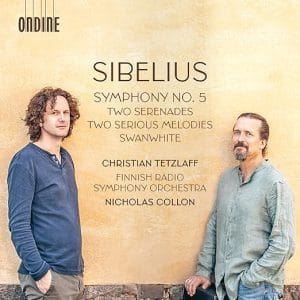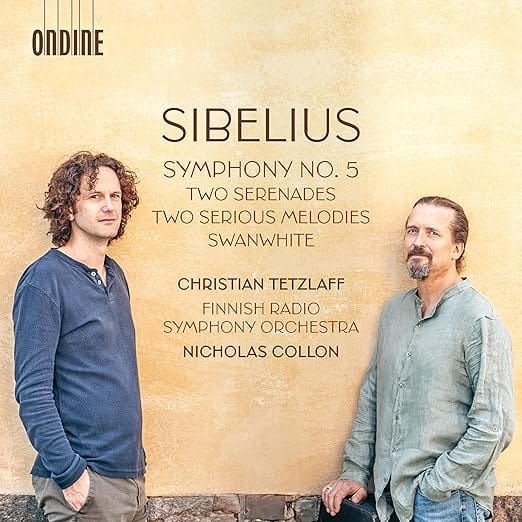
SIBELIUS: Symphony No. 5; Two Serenades; Two Serious Melodies; Swanwhite Suite – Christian Tetzlaff, violin/ Finnish Radio Symphony Orchestra/ Nicholas Collon – Ondine ODE 1468-2 (77:16) (3/26/25) [Distr. by Naxos] *****:
The Sibelius works presented here were recorded live between 2022 and 2024 at the Helsinki Music Center, Finland and focus on the composer’s opera contemporaneous with the outbreak of WW I. In point of fact, much of the program on this disc recaptures that of the 8 December 1915 semicentennial celebration in Helsinki, conducted by Sibelius, in which the Two Serenades were performed by violinist Richard Burgin, who would assume a post with the Boston Symphony Orchestra. At that concert, Sibelius also led the Fifth Symphony. The Fifth Symphony (1915) had undergone several revisions before its formal appearance in 1919; and, unlike its two immediate predecessors, it revisits the pantheistic impulses that had served Sibelius as part of his earlier nationalistic, artistic identity. The last movement, in particular, remains famous for its so-called “Swan Theme” that emerges from a raucous intricacy, an evocation of Sibelius’ Nordic landscape, especially his new home near Lake Tuusula here modulating from its E-flat major context to a radiant C major coda, ending in six, resolute chords.
Sibelius constructs this first movement, Tempo moderato vivace – Allegro moderato (ma poco a poco stretto), as an arch-form in “rotational” sonata-form, building upon chords in thirds and passing dissonances, a combination of his Romantic impulse and the urge to experimental Expressionism. He spoke of his symphony as a heaven-sent, symmetrical, major key, “mosaic” emergent from a trumpet motif perhaps indebted to the admired Gustav Mahler, particularly his own Fifth Symphony. Cascading in a double exposition, 12/8, between E-flat major and G major, the progression breaks off to form a new movement, essentially a Scherzo, set in ¾. The Finnish Symphony Orchestra under conductor Collon resounds sounds alert and clearly, the often playful, variegated impulses virtually whistling with evocations of aerial affects. Collon’s relatively breezy, even carefree, evolution proves a startling contrast to that provided by Sergiu Celibidache in Sweden, whose stretti project more incremental ferocity than those of all other interpreters.
Flutes and pizzicato strings announce the second movement, Andante mosso, quasi allegretto, a 3/2 set of six bucolic variations in the manner of a pedal-point intermezzo. Though rising in dynamics, the gentle suasion of the music changes only by degrees until a long pedal over the tympani, with pizzicato strings and woodwinds, beckon a an arco, string evocation of the theme rife with sentiment. Buzzing tremolando strings invoke the third movement, Allegro molto, leading to the famed call of the (apocryphally, sixteen) swans in all their majesty of form. At moments, conductor Collon exacts an exquisite diminuendo from his players as to render us witness to an exalted piece of string Schamber music, misterioso, on an ostinato tune. The tune then dances, in syncopation, reversing the original scoring to resemble an extended palindrome, what the poet Blake would celebrate as “fearful symmetry.” We hear hints of the Second Symphony’s own, exalted finale. A huge sigh emerges that itself swells to heroic proportions, ending with another of Thor’s “hammer blows” attributable once more to Mahler – in his Sixth Symphony – with pungent, staggered chords of colossal resolution, and “the rest is silence.”
Violinist Christian Tetzlaff enter the Sibelius arena first in Two Serenades, Op. 69 (1912-13). The first of the two, Andante assai, in D major, casts an open-air, sensibility, folkish and light of foot. It may remind some listeners of the mood of the Historic Scenes, Op. 66. The second half becomes more introspectively impulsive, even virtuosic and expressive, at once. No. 2 in G minor, Lento assai, at first sports a lovely melody not so distant from Fauré’s familiarly wistful Pavane. The Allegro section exploits high tessitura for the solo reminiscent of the Humoresques by Sibelius, but the dance passes quickly then returns to the dark, thoughtful impulses that suddenly seem to desire to burst the confines of the genre.
Sibelius’ Two Serious Melodies, Op. 77 (1914-15) capture, in the first, Moderato assai, the elegiac Cantique, subtitled (in Latin) “Rejoice, my Soul,” an ancient, harp and tympani, Scandinavian sensibility, wrought with occasional, strong strokes of orchestral, bardic luster as Tetzlaff’s violin sings a nobly expressive melody. The second of the diptych, Tempo molto moderato, Devotion, is subtitled (in Latin) “From my very heart,” and it proceeds in sparse, chaste environs while the violin pours forth a tenderly lachrymose melody. The middle section, more tumultuous, projects a fevered, passionate dance tune that soon yields to the opening plaint The cool sensibility of the surrounding tissue reminds us of Sibelius’ means in his symphonic poems The Bard and The Oceanides.
Sibelius composed music for Swanwhite (1908) of playwright August Strindberg (1849-1912), with its Symbolist ambitions in the mode of Frenchman Maurice Maeterlinck. Much of the connection lay in Sibelius’ friendship with actress Harriet Bosse, Strindberg’s wife, who had separated from Strindberg at the time of composition. The play combines fairy-tale elements with devotional mysticism: Swanwhite is courted by Prince, son of a neighboring King. A magic harp and horn become elemental to the storyline, especially after Prince is believed drowned and must be restored to life. Of the thirteen numbers Sibelius conceived, he set aside seven for the suite; and the performance by Sir Thomas Beecham 16 September 1954 at Royal Festival Hall (BBC Legends BBCL 4041-2), in celebration of Sibelius’ 90th birthday, provides an excellent point of reference. In Beecham’s version, the opening sequences play at broader tempos; in the later episodes, Collon allows more space. “The Harp” and “The Prince Alone” stand out as especially expressive and colorful. The final number, “Song of Praise,” follows after a delightfully transparent, swaggering “Swanwhite and the Prince,” and soars to a convincing, chorale apotheosis. I enjoyed this Ondine release thoroughly.
–Gary Lemco
Nicholas Collon Conducts Sibelius – Finnish Radio Symphony Orchestra with Christian Tetzlaff, violin
Symphony No. 5 in E-flat Major, Op. 82;
Two Serenades, Op. 69;
Two Serious Melodies, Op. 77;
Swanwhite Suite, Op. 54