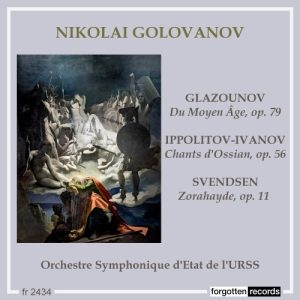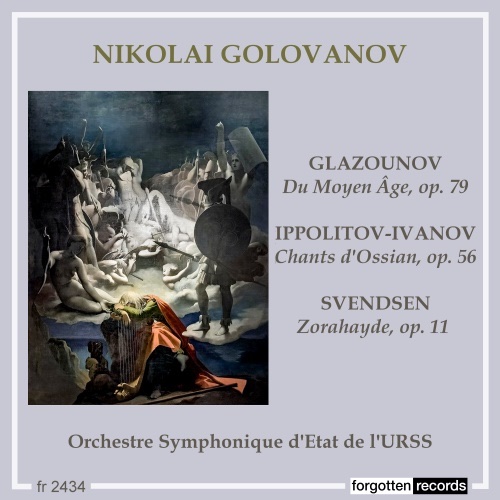
Nikolai Golovanov = GLAZOUNOV: From the Middle Ages, Op. 79; IPPOLITOV-IVANOV: Songs of Ossian, Op. 56; SVENDSEN: Zorahayde, Legend for Orchestra, Op. 11 – State Symphony of the USSR/ Nikolai Golvanov – Forgotten Records FR 2434 (66:02) [www.forgottenrecords.com] ****:
Russian conductor Nikolai Golovanov (1891-1953) gleans the decided benefit of Forgotten Records’ restoration of the 1952 and 1950 performances of vivid, colorful music by Glazounov, Ippolitov-Ivanov, and Norway’s second most-famous composer, Johan Svendsen (1840-1911). Noted for his distinctive work with the Bolshoi Opera, Golovanov fell out of favor with the despotic whims of Josef Stalin, who censured Golovanov for his choice of a Jewish lead soloist, Mark Reizen, for a production of Boris Gudonov. A brilliant colorist, Golovanov imbues his interpretations with a vivid sense of drama, and the Russian repertory flourishes under his capacity for lyrical nuance. The two opening selections have had previous review from me in 2010, when the Historic Recordings UK label brought the original Melodiya discs out in transfers by Neal Kurz. With the addition that Forgotten Records’ transfers prove equally quiet and seamless, I retain much of my original thinking on the first two offerings.
The Suite From the Middle Ages (1902) by Alexandre Glazounov (1865-1936) has had various conductors of the past devoted to its colors, like Victor de Sabata and Fabien Sevitzky. The Suite is cast in E Major in four movements, the first a rather erotic affair of lovers who embrace while a churning sea casts itself at their castle’s foundations. The ensuing Scherzo: Allegro assai jitters with Russian character, a clear imitation of balalaikas juxtaposed against the Dies Irae from the Requiem Mass. Truly virtuosic playing emanates from the Moscow Radio strings, brass, percussion, and harps, colored as a festival of dervishes.
The Troubadour’s Song approaches the love music from Prokofiev’s Romeo and Juliet for the melodic evocation of romance by starlight. At moments, the scoring resembles a piece by Respighi. The music enjoys a stately and delicate grace – in strings and harps – certainly touched by Hollywood’s having co-opted this sound for every Biblical epic we know. The Finale: Allegro movement, The Crusaders, begins with a call to arms, quite heraldic, and a pageant, a militant tocsin, emerges reminiscent of Rimsky-Korsakov’s The Battle of Kershenetz, the trumpets and piccolo riding out in full caparison. Some fugal writing – likely obligatory, courtesy of Tchaikovsky’s legacy –slows down the drama but shows off Glazounov’s pedagogy.
The Sons of Ossian Suite (1925) by Mikhail Ippolitov-Ivanov (1859-1935) treats the Celtic bard musically – as had Gade and Mendelssohn – recall that Ossian is Fingal’s father, as in the Fingal’s Cave Overture. The first section, Lake Lyano, offers us wonderful color effects, similar to the Enchanted Lake of Liadov. The rocking rhythms enjoy the fact that Golovanov can elicit great tone from his bassoon, double basses and low strings. Some, however, may find his tempo sluggish, more like Rachmaninov’s Isle of the Dead. The use of low winds and strident horns and cymbals reflects palpable Liszt influence, particularly the string passages from Eine Faust-Symphonie and Les Preludes, which Golovanov takes full throttle.
The sensual middle movement, Kolyma’s Song, utilizes woodwinds and swirling strings to effect its lyrical pulse and evocation of the Russian soil. The melody, however, seems derivative of the opening section of Rimsky-Korsakov’s The Invisible City of Kitezh. Perhaps the most Tchaikovsky-like movement, Ossian’s Monologue on Contemporary Heroes, employs balletic and martial figures, the brass, tympani, and cymbals in full glory. The conscious attempt to create a musical edifice, a potent apotheosis, finds its merits and its sonic splendor in Golovanov’s reading.
Svendsen composed Zorahayde, Légende pour Orchestre, Op. 11, in August 1874 (rev. 1879) in Christiania. Svensen adapted a text from the American author Washington Irving (1783-1859), an extended, moody scene that retells a Moorish legend about love, magic, and religious conflict. Svendsen’s work, in six sections, focuses on the story’s turning point, which is the meeting between Zorahayde and Jacinta by the fountain, a moment in fact that parallels Svendsen’s own romance with his future wife, Sarah Levett. Violin pizzicatos and solo effects create a mood of nostalgic reflection and dramatic anticipation, supported by ominous winds, a sense of building, passionate tension. A more animated section invokes the mortal storm that ensues, and the passionate theme that emerges proceeds to the quiet coda with decided languor.
—Gary Lemco