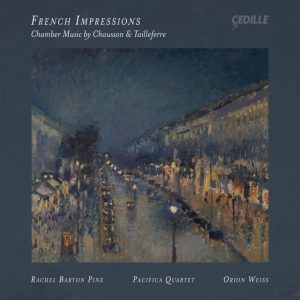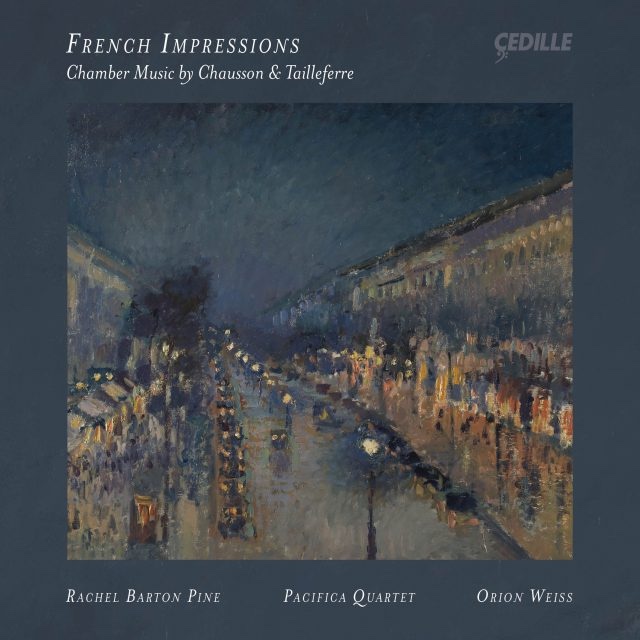
FRENCH IMPRESSIONISM: CHAMBER MUSIC by CHAUSSON & TAILLEFAIRE = CHAUSON: Concert in D Major for Violin, Piano and String Quartet, Op. 21; TAILLEFAIRE: Violin Sonata No. 2; Pastorale; String Quartet; Berceuse – Rachel Burton Pine, violin/ Orion Weiss, piano/ Pacifica String Quartet – Cedille CDR 90000 238 (7/11/25) (67:40) [Distr. by A440Arts] ****:
Violinist Rachel Barton Pine addresses the Gallic musical scene of the late 19th and early 20th centuries in Belgium and Paris, when Romanticism had embraced the cyclic principal firmly established by Franck as the emblem of structural unity within a composition. Simply put, following the example of Beethoven’s 5th Symphony, the initial motives of a work would reappear, economically, in original or varied form, throughout a classical piece. The album was recorded on 5-6 January 2025 at Mary Patricia Gannon Concert Hall, DePaul University (Chicago, IL) and 3 February 2025 at Sasha and Eugene Jarvis Opera Hall, DePaul University (Chicago, IL).
Ernest Chausson (1855-1899), a disciple of Franck who commanded even more lyric power, conceived his Concert for Violin, Piano and String Quartet, Op. 21 in 1892. A modified concertante chamber work, the piece explores the harmonies of contemporary France and of the operatic giant from Germany, Richad Wagner. Chausson, however, was an advocate of Ars Gallica, devotees of an essential, French mode of expression. Designed to highlight Pine’s warm tone and Weiss’s brilliant articulation, the piece made its first, visceral impression upon me via Zino Francescatti, Robert Casadesus, and the Guilet Quartet. A 3-note motto infiltrates the first movement, which proceeds like a concerto grosso, pitting the small, duo ensemble against the larger, sextet. While shifting meters and textures hold sway, the piece culminates in virtuoso counterpoint and cascading piano arpeggios.
The second movement Sicilienne moves gently but firmly to a grand, passionate expression. The movement closes with an ardent gesture from the solo violin. The third movement is marked Grave. Somber and melancholy, it resembles a funereal dirge, the solo violin’s providing the main melody. The piano forms the duo that dominates until late, when the quartet becomes dramatically active, even as the piano gains an “orchestral” sound. The last movement, Finale waxes energetic, a hybrid of rondo and theme-and-variations. Marked Quite animated, each of the instruments plays a slightly different version of the recurrent theme. The dynamic proves no less variable: softly intimate and explosive in the manner of a piano concerto. Motifs from previous movements recur, true to the format César Franck established for Gallic music late in the 19th century.
Marcelle-Germaine Tailleferre (1892-1983) joined a group of dedicated French musicians known as Les Six, determined to set simplicity of style as their banner. Tailleferre, like her compatriot Poulenc, favored a carefree, boulevard style, breezy and buoyant. A winner of numerous premier prix, she studied with revered composers including Maurice Ravel, whose work significantly influenced her versatile style.
Violin Sonata No. 2 (1947) was composed after WW II, composed for Yvonne Astruc, and quite virtuosic. The first movement, Allegro non troppo, exploits the violin’s solo features and moves to an agitated middle section. The main melody returns, only to ascend to a soft, sighing coda. The second movement, Adagietto, offers a harmonized, autumnal ballad for violin and piano. Final: Allegro proceeds with a sense of urgency, a breathless dance that assumes a mysterious demeanor before the circuitous, harmonic adventures conclude in a dazzling color display.
The 1942 Pastorale for Violin and Piano pre-dates Tailleferre’s leaving wartime France for the United States. Its rocking, sicilienne rhythm might suggest an Italian barcarolle, a Mediterranean wistfulness.
String Quartet in C# Minor (1919) takes several of its harmonic means from Claude Debussy, while the second movement nods to Ravel. The first movement, Moderé provides two themes with no development. The second movement is a gentle scherzo, Interméde, that utilizes syncopations. The last movement Final: Vif plays as a colorful jig in Italian saltarello rhythm, 6/16, metrically and polyphonically inventive. The piece is dedicated to the great Polish pianist, Artur Rubinstein.
Berceuse (1913) means “lullaby” and is dedicated to Tailleferre’s harmony professor at the Paris Conservatory. Passing dissonances do not interfere with the expansive melody of the violin, while the piano gently rocks the cradle with its suave accompaniment.
—Gary Lemco