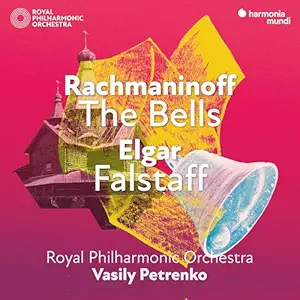
RACHMANINOFF: The Bells, Op. 35; ELGAR: Falstaff – Symphonic Study, Op. 68 -Mirjam Mesak, soprano/ Pavel Petrov, tenor/ Andrii Kymach. Baritone/ Royal Philharmonic Orchestra/ Philharmonia Chorus/ Vasily Petrenko – Harmonia Mundi HMM 902788 (72:35) (9/3/25) Distr. by PIAS] ****:
Russian conductor Vasily Petrenko (b. 1976) inaugurates his Royal Philharmonic’s association with the Harmonia mundi record label with two performances from 2024 – 11 April (Rachmaninoff) and 9 June (Elgar) – that capture the aesthetic spirit of 1913, just prior to the outbreak of World War I, the most epic disillusionment of Mankind up until that time. The juxtaposition of the two large works – Rachmaninoff’s The Bells and Elgar’s Falstaff, might be construed as a movement from tragedy to decadent comedy, especially as the Poe sequence of four poems becomes increasingly dark, and Sir John Falstaff comes to realize the wayward carousing of youth must yield to a more earnest wisdom
Edgar Allan Poe wrote “The Bells” c. 1848, demonstrating his neurasthenic musicality through a virtuosic sense of onomatopoeia, an eruption of sounds he gleaned from the chimes of Fordham University in the Bronx, New York. The four poems comprising “The Bells” indicate a “seasonal” procession, moving from “Silver Sleigh Bells” of youth, sonorous with “childlike laugher”; to the “golden wedding bells” which promise “golden futures”; to the brazen tocsin of the “howling warning bell” that signifies the horrid realization of mortality; to the final “iron” bells’ “leaden peeling,” the wretched alchemy announcing death, that “the soul is entombed in stone.” Rachmaninoff, rendering his musical adaptation, utilized for his “choral symphony” a translation (and some augmentations) into Russian by Konstantin Balmont (1867-1942), capitalizing on Rachmaninoff’s own penchant for the spirituality of Russian Orthodoxy.
After the sounds of Natural and spiritual awakening, “The Sleigh Bells” invoke a magical element into the atmosphere, the tenor (Pavel Petrov) and chorus extolling enchantment, though Balmont has added a meditation on mortality, suggesting Heaven as a reward. This morbid motif will cue Rachmaninoff to invoke his standard Dies Irae trope – as well as rhythms from his tone-poem The Isle of the Dead – into the evolving mix as an uninvited “wedding guest.” Poe’s celebratory verses of wedding bells feel singularly subdued and resigned in Rachmaninoff’s treatment. Soprano Mirjam Mesak finds her voice surrounded by impressionistic scoring, her “melodious notes gazing at the moon.”
The third (Gothic) movement, devoted to hearing “the howling warning bell” of bronze, serves as a scherzo, decidedly grim in tone and texture, with the warring (Presto) turbulence of chorus and orchestra’s often devouring the enunciation of the text. The imagery of the dissonant chorus reminds us at once of Biblical Judgment Day and the final trump envisioned by Hieronymus Bosch. More than any other musical antecedent, the musical means resemble the dark sides of Mussorgsky. Lastly, “The Mournful Iron Bells” lead Rachmaninoff to demand Lento lugubre, much in the way of Tchaikovsky’s Pathétique Symphony. The virtuoso scoring and its evocative colors remind us that this cantata’s dedicatee is Willem Mengelberg, whose Concertgebouw Orchestra held pre-eminence among European ensembles. Baritone Andrii Kymach sings of a distant cry, “groaning, Sorrowful, angry, And lamentable,” all intent upon a Dantesque effect. The plunging of the chorus may remind some of the Brahms moment of “Headlong!” in his 1881 Nänie after Schiller. Yet, the eternal crisis here in Rachmaninoff softens, responding to Balmont rather than to Poe, with major, ilumined chords to invoke “the quiet of the tomb” in glorious Technicolor.
Edward Elgar conceived his Falstaff “a symphonic study in C minor,” a one-movement (in four sections and two interludes) character development that follows a single personage, Sir John Falstaff from Shakespeare’s Henry IV, Parts 1 and 2, and Henry V. I like to extract the essence of his persona from the Orson Welles film Chimes at Midnight (1966), in which “the betrayal of friendship,” that is, by Prince Hal of his comrade-in-drink Falstaff, finds compensation in the pride Falstaff takes in his young protégé’s moral evolution that makes him a worthy successor to his father, Henry IV. Falstaff, via Elgar, reveals two sides: a rambunctious, jaunty, syncopated energy and a tender, melodically lyrical aspect, a combination of flesh and fantasy. Prince Hal has his own theme, more protean, given his emotional distance from Falstaff, as either a budding voluptuary or a nobly aristocratic, young man about to ascend to royal power and responsibility.
The music depicts in this spiritual history eleven specific, narrative episodes, involving plots and robust sallies of the picaresque quality, like a plot to rob travelers to Gadshill that inversely has Falstaff himself predated upon. Much in the manner of a Rabelais satire, Elgar applies the notion “gargantuan” to notate Falstaff’s woodwind motifs. Blustery fanfares abound, punctuated by dissonances and combative timbres among the selected instruments. Elgar makes use of strict counterpoint when he wishes to invest his characters with internal, psychological conflict. Perhaps the most poignant music occurs in the first interlude in romantic syntax, Falstaff’s dream of his youth, in service to the Duke of Norfolk, when hopes flourished in a full, optimistic heart before Falstaff became a social miscreant. Often, the musical means resemble those of Richard Strauss in Till Eulenspiegel, parodic and sarcastic figures that verge on the morally corrupt and grotesque.
With the Battle of Shrewsbury comes the weight of grim fact, since the debacle disperses the “army of scarecrows” who had ben meant to establish Falstaff’s virtues as a warrior. When Henry IV dies, Prince Hal must accede to the throne and so cast off his childish things. Falstaff has hurried (Allegro molto) to London in expectation of courtly recognition and honor, only to receive rebuke and repudiation. From a series of mock fanfares belonging to Falstaff, a regal theme (“the man of stern reality”) arises, livid at Falstaff’s presumption. Cast away from honor and glory, Falstaff will die alone amidst his fond memories, recalling his once-potent influence on the young king. The precipitous fall from grace and the drawn-out coda well resemble – even to the point of a brief cello solo – the Richard Strauss Don Quixote finale. Orson Welles smiles in dying, knowing he has served as a moral force, perhaps inversely, behind the Throne. Elgar’s mighty symphonic study premiered 5 August 1913, mere days before the greatest moral catastrophe the world had yet known erupted across Europe.
These are vivid and conscientious performances of notable music, much recommended.
—Gary Lemco