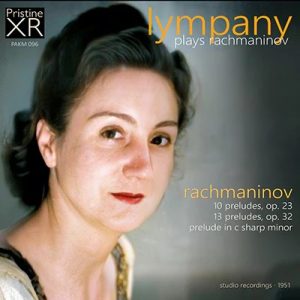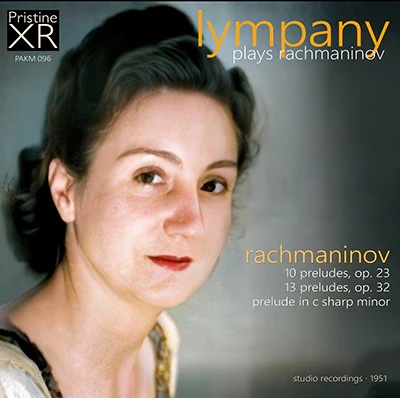
RACHMANINOV: The 24 Preludes – Moura Lympany, piano – Pristine Classical PAKM 096 (73:20) [www.pristineclassical.com] *****:
Dame Moura Lympany (1916-2005) remains among the most gracious and conscientious of British musicians, a lyrical artist of thought and intuition who possessed a towering technique that did not ostentatiously assert itself despite her broad, virtuoso repertory. Pristine revives her 1951 complete Rachmaninov Preludes, a musical enterprise she had addressed for Decca shellacs 1941-1942 and would once more, in stereo sound for Erato, in 1993. Born in Cornwall as Mary Gertrude Johnstone, she adopted her stage name at the suggestion of conductor Basil Cameron that arranged her mother’s maiden name, Limpenny along with a Russian diminutive of Mary. Lessons with Mathilde Verne (1868-1936) and Tobias Matthay (1858-1945) proved decisive in the formation of her musical approach, though later study with Edward Steuermann and Ilona Kabós refined her technique in 20th Century compositions. Her recordings of concertos by Rachmaninov, Mendelssohn, Schumann, Saint-Saens, and Khachaturian have consistently rewarded repeated listening, projecting a freshness and spontaneity of effect that avoids mannerism associated with more “potent” interpreters. This 1951 version of the Preludes had life on the Testament label.
Pristine has done an exemplary job in eliminating defects from which the Decca/Testament issue of these readings suffered. The stunning bass chords in the ubiquitous Prelude in C# Minor ring without upper level shatter, especially precious since Lympany sports a fluid legato and stunning sense of structural transition. The searching, poetic character of No. 1 in F# Minor has a lyrically volcanic No. 2 in B-flat Major as successor, the tumult of arpeggios and thick chords controlled but ardently driven. The mincing, martial figures of No. 3 in D Minor achieve a limpid, flexibly luminous texture. Poetic reflection suffuses No. 4 in D Major, diaphanous in color content but tautly focused on what the composer called “the point” in drooping phrases. Lympany’s sonic palette offers a dazzling array of colors, immediately persuasive, tinted cautiously by an idiosyncratic rubato. The infectious, militant buoyancy of No. 5 in G Minor finds a spectacular haze in its middle section, a sensuous romance. The dream-nocturne No. 6 in E-flat Major enjoys a hazy insistence, palpably intimate. Swirling arpeggios mark No. 7 in C Minor, an eddy of toccata motion, soft in allure and vibrant periods. The A-flat Major, No. 8, extends energies from a colorful, mesmeric eddy of impulses, Lympany’s selective pedal adding a seductive bass line. The brief Prelude No. 9 in E-flat Minor conveys a nervous syncopation, a study in distinct legato and staccato touches, much in the Chopin style. Rachmaninov’s Op. 23 ends with Prelude No. 10 in G-flat Major, here played by Lympany in the style of a ballade, taking on girth, color, and dynamic nuance in a richly parlando style. Lympany’s palette feels a mere step away from Debussy in its graded hues.
Massive chords and deft articulation define Lympany’s hefty realization of Prelude No. 1 in C Major from the Op. 32 set of 1910. The Schumann-like innigkeit of the Prelude No. 2 in B-flat Minor projects an insistent nostalgia that spins a long-lined melodic curve. Prelude in E Major throbs with Russian bells, virtually an orchestral tone-poem set upon a troika. The tonic minor, that in E, Op. 32, No. 4, casts a severe, dramatic tenor in the form of a colloquy that becomes quite intense, offering a temporary, far-and-away emotional asylum in its middle section. The relentless momentum regains ascendancy, though Lympany avoids a mere cacophony of percussion in order to release its melodic kernel. While Lympany’s shaping of the diaphanous Prelude No. 5 in G Major projects exquisite sensitivity, she still must yield to Benno Moiseiwitsch for interpretive alchemy of rarest invention. The No. 6 in F Minor intrudes upon us, an angry toccata a la Russe by way of Franz Liszt. The wide leaps and jabbing accents flutster Lympany not at all. The ensuing F Major Prelude approaches the same technical issues with a lighter, happier countenance, the patented cross rhythms in voluptuous, fluid motion.
For volatility of articulation, Rachmaninov’s terse Prelude No. 8 in A Minor has few rivals, here performed with an aggressive boldness that ripples with steely control. The companion Prelude in A Major, builds on a series of rising chordal patterns, almost a hymn-in- progress. Chopin would qualify as the likely model but influenced by a sense of Bach’s legacy fertilized by Russian chimes. “The Return” served as Rachmaninov’s definition of No. 10 in B Minor, and Moiseiwitsch had to concur. Lympany kneads a striking concoction of melodic clusters based on the falling motif, and the whole rises in a yeast of explosive, yet tempered fury. Another fine female interpreter, Gina Bachauer, had, like Lympany, a singular sympathy for this massive, poignant work. Does the piece end with an evocation of the South Seas, or is that Hollywood talking? The Prelude in B Major plays in the form of an antique dance, cautiously lyrical. Lympany generates throbbing, tremolando tension for No. 12 in G# Minor, a cascade of mystery and reverie that dissolves into a spatial ether. The final Prelude in D-flat Major rather serves as an epilogue to the entire set, in the lyrical-dramatic fashion of Robert Schumann. Eschewing rubato for its own sake, Lympany exhibits a fine sensibility for narrative proportion, especially since this prelude verges on the composer’s notion of an étude-tableau. The epic finality of the last chords may well stand for Moura Lympany’s especial sound, a mastery of every aural nuance.
—Gary Lemco