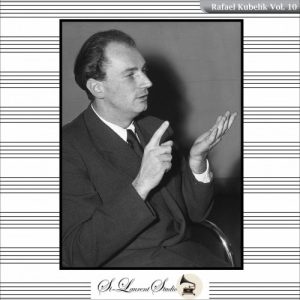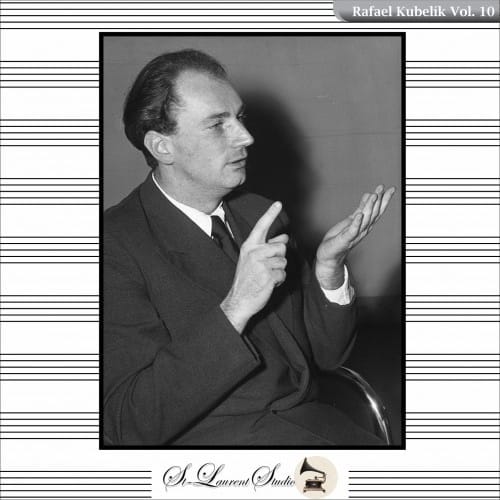
MOZART: Symphonie concertante in E-flat Major for Violin, Viola and Orchestra, K. 364; BRAHMS: Violin Concerto in D Major, op. 77 – Henryk Szeryng, violin/ Georg Schmid, viola/ Bavarian Radio Symphony Orchestra/ Rafael Kubelik – Yves St-Laurent YSL T-1572 (76:55)[78experience.com] ****:
Two monumental, musical personalities – violinist Henryk Szeryng (1918-1988) and conductor Rafael Kubelik (1914-1996) – collaborate on this disc from Yves St-Laurent, the Mozart from Munich, 3-5 December 1969, and the Brahms from Vienna, 11 June 1967. No less significant musically, veteran viola player Georg Schmid (1907-1984) joins Szeryng in Mozart’s extraordinary 1779 Symphonie concertante, noted for its scordatura tuning of the viola part a half-step to bring its glowing tone into D major. A product of Mozart’s tours in Paris and Mannheim, the Symphonie allows Kubelik his own forte in orchestral dynamics to shine in what proves to be a leisurely but grandly broad conception of the piece.
In conversation I had with the late conductor David Randolph, we both remarked on the magic of the instrumental writing, not only in the Mannheim crescendos allotted the orchestra part, but the way in which the violin makes its initial appearance in the Allegro spiritoso first movement, descending out of nowhere, Heaven-sent. In this instance, the lovely duet-cadenzas between Szeryng and Schmid provide seamless deliveries, nuanced and affectionately lilted, at once. Mozart’s innate capacity for operatic utterance saturates the second movement, Andantino grazioso, while the rondo of the third movement, Tempo di Menuetto sparkles with high-flown, buffa energy, neither Szeryng nor Schmid taking time to loiter in the midst of their exalted interchanges. The blend of the two soloists with the BRSO strings, winds, and horns progresses in explosively synchronized grace, dynamic, even thrilling, in effect. A pity Yves St-Laurent did not maintain the applause.
The Brahms Violin Concerto performance is exactly that issued by Orfeo in 2007 (C719071B), which I reviewed quite favorably for Audiophile Audition. The sound quality seems a bit improved and in sharper focus than on the Orfeo disc, but my impressions remain unchanged, and so I offer them as originally presented:
The long association of Polish-Mexican violin virtuoso Henryk Szeryng with the 1878 Violin Concerto of Johannes Brahms has become, by virtue of a pantheon of recorded collaborations, virtually definitive. Kubelik takes the opening tutti – and the entire movement – in a leisurely, thoughtful manner, emphasizing the growing intensity that culminates in Szeryng’s explosive entry, with razor-sharp intonation over the woodwinds and pedal point that support and decorate the melodic outline. The accompanying string and horn work is pure warmth, to suit the no less plastic lyricism from Szeryng. We recall how much Brahms and dedicatee Joseph Joachim admired the A Minor Concerto No. 22 of the very Giovanni Batista Viotti who inaugurated the French style of violin playing Szeryng inherited. The conceptual largesse of the first movement embraces all of the Brahms periods, their luxurious, nostalgic moments and their epic, dark convulsions. The clarity and authority in Szeryng’s delivery, his flawless transitions, might well become required listening and study for all adherents of this monumental work. The first movement cadenza enjoys a stratospheric elegance, leading, seamlessly, to the re-entry of the Bavarian players led by an inspired conductor.
The well-known Adagio in F and its oboe melody may have rankled Pablo de Sarasate, but we have no such reservations. The uncredited Bavarian player and his French horn and flute counterparts create a loving aura for Szeryng to enter on equally rapt terms. The entire, nine-minute slow movement evolves as an unbroken song, ardent, introspective, and unapologetically passionate, especially in the central episode, in the remote key of F# Minor. The finale, a Hungarian rondo, Allegro giocoso, in shifting, duple and triple meter, abounds with virtuoso flair and piercing accents, the very meat of Szeryng’s gypsy style. Kubelik here relishes in the work’s aggressive, “symphonic” style, investing the tuttis with explosive power alternated with quiet, even intimate, nuances. The final gambit in the coda, its switch to 6/8 for a “Turkish” effect a la Mozart, has Szeryng and Kubelik exchanging voluptuous power for acerbic wit, and the effect up through the triplets and final chords, has the enthralled audience in a concerted uproar of appreciation. A more-than-historical document, heartily recommended.
—Gary Lemco