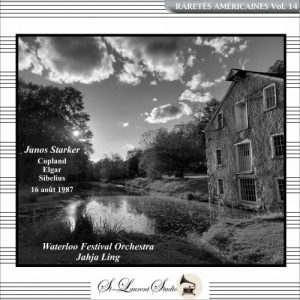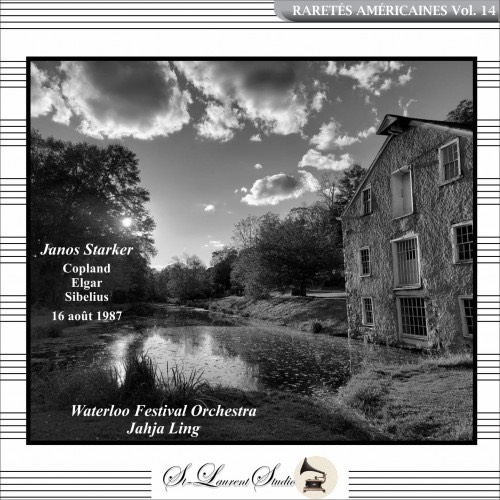
Raretés Américaines, Vol. 14 = COPLAND: An Outdoor Overture; ELGAR: Cello Concerto in E Minor, Op. 85; SIBELIUS: Symphony No. 2 in D Major, Op. 43 – Janos Starker, cello/ Summer Waterloo Festival Orchestra/ Jahja Ling – Yves St-Laurent YSL T1711 (2 CDs = 36:11; 45:30) [www.78experience.com] *****:
The opportunity to savor the imperial artistry of cellist Janos Starker (1924-2013) should forever be embraced, and this live rendition of the 1919 Cello Concerto by Sir Edward Elgar from 16 August 1987 pre-dates the RCA recording with Leonard Slatkin by some 10 years. Chinese-American conductor Jahja Ling (b. 1951) became the first musician of his ancestry to assume the post of a major American ensemble, the San Diego Symphony, as well as leading the Sa Francsico Youth Orchestra before establishing a long-term relationship with the Cleveland Orchestra that lasted for 38 seasons.
Ling opens the program with Aaron Copland’s 1938 An Outdoor Overture, conceived as an “optimistic” vehicle for orchestra, commissioned by Alexander Richter, Music Director of the High School of Music and Art in New York City. A hearty energy salutes us, as Copland starts with the full orchestra, and then a prolonged trumpet solo ensues. A martial, percussive theme, rather jaunty, with echoes of the trumpet tune, yields to a persuasive, lyrical melody for strings. The syncopations return for another march, more resolute. Copland then assembles the diverse impulses into a mix of insistence and consolation, deftly organized. The verve and open-air character of the music begot its “outdoor” sobriquet, and the coda rounds off its confident sensibility.
Janos Starker makes his presence known at once, his recitative firm and plaintive, answered by clarinet, bassoon, and horn, until the cello takes up the meandering theme that soon develops into a mighty, impassioned declaration of poignant feeling. The move to a suave E major flows without seams, and Starker’s sojourns into high register convey blithe energy. The main theme diminishes to segue, crescendo and pizzicato from Starker, into the Lento opening of the second movement. The Allegro bustles with 16th notes, with Starke’s maintaining an elastic tension in perpetual motion.
The Adagio, 3/8, sighs with reminiscence, the Starker restraint polished and understated without any loss of pathos. The rough energy of the last movement has Starker crescendo and fortissimo, Allegro, 2/4, leading a martial impulse complemented by Starker’s urgent declamations. A silken dialogue ensues between solo and responding ensemble. A fugal section ensures that the German mind will approve of Elgar’s means. Starker’s capacity to make his Goffriller instrument sing emerges in glorious Technicolor, a consistent, “gem-like flame,” to paraphrase Walter Pater. The fusion of sheer power and refined intimacy imbues the performance with a rare nobility. The final measures and their resultant coda confirm that the audience has been well convinced of the stateliness of the occasion.
The Second Symphony of Sibelius (1901-02) emerges as a mosaic of musical impulses that converge into a pantheistic paean, a hymn to landscape. The music has had many esteemed adherents, among them Kajanus, Beecham, Karajan, Erhling, and Sanderling, but none so apocalyptic in vision as Koussevitzky. From the Allegretto’s outset, Ling invests a warm affection into Sibelius’ figures, advancing the long line that ends with a woodwind and timpanic flourish. That critic Virgil Thomson could deem this powerful, ardent score “provincial” strikes me as envious condescension. The merger of brass fanfare, chirping woodwinds, and fluttering strings creates a bucolic tapestry of fervent beauty.
Sibelius begins his Tempo andante, ma rubato with a timpani roll and restless, bass pizzicato strings – the pride of Koussevitzky’s BSO – from which a bassoon tune struggles to emerge within an Aeolian harmonic context. A dramatic struggle ensues, much in the Brahms vein, from which the melodic tissue will surge with passionate vitality. The pregnant pauses assume a telling, mystical character as the landscape opens to throbbing, pantheistic suggestion.
The sudden death of Sibelius’ sister-in-law may have inspired the sorrowful oboe theme that interrupts an otherwise breathless scherzo, Vivacissimo, that whistles with some dark portent toward the grand finale that, attacca, will bloom from the voluptuous froth of the third movement. The discipline of Ling’s ensemble shines through, quite a remarkable homogeneity of texture accomplished within the limits of a summer music festival. Sibelius would comment that, for him, “pieces of Heaven’s floor had been presented to him in mosaic,” so the last movement, Finale: Allegro moderato rises up as a progressive unveiling of a mystically grand, cosmic design. This performance, wrought neither by Koussevitzky or his faithful acolyte de Carvalho, achieves its especial grandeur that deserves the widest possible acclaim.
—Gary Lemco