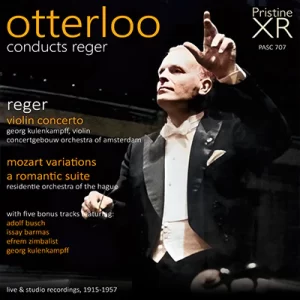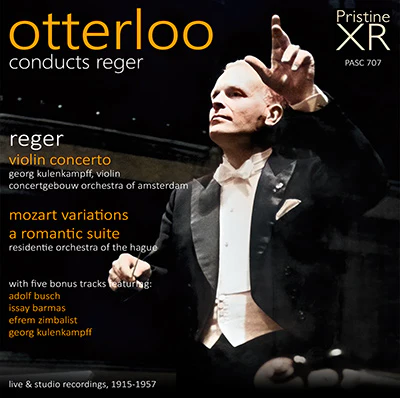
Reger – Orchestral and Chamber Music, Willhem von Otterloo conducting – Pristine Audio PASC 707 (2 CDs: 2 hr 10:31, complete content list below) [www.pristineclassical.com] ****:
Though this Pristine Audio restoration purports to feature Dutch conductor Willem van Otterloo (1907-1978), the basis lies in the music of Max Reger (1873-1916), with selected performances from the archives, 1915-1944. The major work, the 1908 Violin Concerto in A Major, comes from a wartime broadcast of 1944, when the Netherlands suffered Nazi occupation. Otterloo had worked with the Concertgebouw Orchestra since 1932, the ensemble under the general directorship of Willem Mengelberg. Otterloo after WW II would direct the Residency Orchestra of the Hague, 1949-1973, then move on to Australia, where he conducted both the Melbourne Symphony Orchestra and the Sydney Symphony Orchestra. His recorded work, mainly for Philips, reveals a broad taste in European repertory – including Bruckner and Mahler – and contemporary music. Otterloo died in a Melbourne suburb as the result of an automobile accident and was transported to the Hague for cremation.
The major composition featured, Max Reger’s huge three-movement Violin Concerto had few exponents since the Henri Marteau premiere in 1908 with Artur Nikisch and the Leipzig Gewandhaus Orchestra. The soloist here, Georg Kulenkampff (1898-1948) enjoyed a solid reputation as a musician and pedagogue, noted for his revival, much as a form of propaganda for the National Socialists in Germany, of the long-buried Violin Concerto in D Minor by Robert Schumann, which Kulenkampff recorded – in an abridged edition – with Hans Schmidt-Isserstedt. The Reger performance of 16 January 1944 remains for the most part intact, barring some measures deleted from the score in the latter two movements.
The impression that the Concerto imbues is that of a highly virtuosic rhapsody in three movements, sensitive to the demands of a virtuoso instrumentalist, but so consumed by effects that any resolution to real melody goes by the board. What melody does exist will not sustain development. Kulenkampff executes complicated shifts and double stops, octaves in diverse registers, arpeggios and varied bowings, but the series of rising cadences never resolves into a big melody in the way, for instance, of Tchaikovsky. Reger’s style, post-Romantic and highly dependent on Wagner harmony and Brahms orchestration, does not offend us but neither does it compel us emotionally. Lasting some 55 minutes, the massive enterprise fails to sing and dance but simply “endures,” an example of musical stamina of a curious nature. Unusual for performances preserved during the Nazi regime, the enthusiastic audience response resounds with force.
Disc 2 offers two major orchestral works by Reger led by Otterloo, respectively, 26-27 March 1957 (Mozart Variations) and 9-10 March 1956 (Romantic Suite). The 1914 Variations and Fugue in A Major on a Theme by Mozart utilizes the opening movement of Mozart’s Piano Sonata, K. 331, set as the original, orchestrated theme, eight variants, and a fugue. Beginning in the mode of a wind serenade, the music invites the strings to complement the lovely tune and then extends the dialogue of the two choirs. Otterloo delicately molds the phrases, retaining their galant character. From Variation I on, Reger adds (often thick) color touches and slight dissonances to transform the musical line in a manner reminiscent of Dvorak, sometimes hiding the Mozart original in modal intricacy.
We realize that Reger’s working model lies in the Brahms Op. 56 Variations on a Theme of Haydn but now subject to Reger’s idiosyncratic scoring and post-Wagner modulations. Otterloo injects good energy into the Quasi presto Variation V, and his Residence Orchestra produces attractively rich sonority in the expansive Molto sostenuto Variation VIII. Ever the Bach acolyte enamored of counterpoint, Reger fashions a cleverly witty fugue that plays with marcato effects in the orchestra, at first marked Allegretto grazioso. Gradually, the texture has become massive, grounded by fierce pedal points in martial contours. When the music temporarily thins the texture in serenade or cassation form, the transparency is to be appreciated. The ferocious mass returns, aiming to a majestic peroration that utters the Mozart original in Herculean terms.
Reger’s A Romantic Suite (1912) takes as its inspiration three poems by Joseph von Eichendorff: “Nachtzauber” (Night magic), “Elfe” (Fairy) and “Adler” (Eagle). Reger opts for simple tempo indications, Notturno (Molto sostenuto), Scherzo (Vivace) and Finale (Molto sostenuto). Otterloo’s performance (9-10 March 1956) enjoys the clear resonance afforded by Andrew Rose and his patented XR sound processing. The Notturno shimmers in a color manner of late Romantics or early Impressionists, touched by hues from Richard Strauss. One might ascribe the dominant work of the woodwinds to the Belgian school, disciples of Franck or D’Indy; in England, we would volunteer the name of Delius. The texture becomes rich and luxuriously impassioned before the forest sounds and sensibility recedes in vivid glory marked by strings, horn, and harp.
The middle fast movement, Scherzo, opens rather balletically, harp, strings, and woodwinds, in a sprightly dance a la Mendelssohn. A waltz rhythm takes over, but it sustains itself through brief interruptions. For Reger, this moment of expanded whimsey proves an anomaly: Reger’s attempt to imitate Glazunov? The Finale frames the middle with another slow movement, again a kind of Mallarmé dream scenario in hazy, meandering colors. Some four minutes into the performance, the music gains momentum, almost a Wagnerian vitality, maybe a borrowing from Franck’s Psyche. The heated emotions resolve, at the last, into a grand apotheosis that has passed once more into the idyll of the Notturno, in which cymbals now add the touch of glory to the effect.
The last five tracks provide acoustic and electric chamber music from Reger, from a range of committed interpreters. From the Polydor label, 1926, we have Kulenkampff and pianist Hermann Hoppe on a stately Praeludium from Op. 103a, a clear imitation of a Bach unaccompanied slow movement. Kulenkampff’s attractive tone potently manifests itself, reminding me that he counted among Ruggiero Ricci’s several mentors, despite Kuelnkampff’s lack of fluency in English. The Bach influence asserts itself more so in the expressive Andante sostenuto (rec. November 1936 for Telefunken) from the Suite in A Minor, which might make us wish Kulenkampff had bequeathed us a recorded legacy in Bach proper. The name of violinist Issay Barmas was new to me, but it seems he was a member of Reger’s circle. He plays with an uncredited pianist the Romanze in G (Polyphon, 1919), which treads out an angular melody of sentimental appeal. The earliest entry, from violinist Efrem Zimbalist (HMV, 8 June 1915), offers a solo Andantino. The wiry Zimbalist tone makes an impression in spite of aged sonics, especially when the tempo increases for the central section. Finally, the celebrated duo of Adolf Busch and son-in-law Rudolf Serkin collaborate for HMV in London 7 May 1933 for the vivacious Allegretto from Op. 84a, whose verve and spiky élan testify to an easy fluidity of kindred spirits.
—Gary Lemco
REGER – Orchestral and Chamber Music
Violin Concerto in A Major, Op. 101;
Concertgebouw Orchestra of Amsterdam/ Georg Kulenkampff, violin/
Variations & Fugue on a Theme by Mozart, Op. 132;
A Romantic Suite, Op. 125;
Residency Orchestra of the Hague
Suite in A Minor, Op. 103a: Praeludium;
Georg Kulenkampff, violin/ Hermann Hoppe, piano
Sonata in A Minot for solo violin, Op. 91/1: Andante sostenuto;
Georg Kulenkampff, violin
Romanze in G Major, WoO 11/10;
Issay Barmas, violin
Sonata in A Major for solo violin, Op. 42/2: Andantino;
Efrem Zimbalist, violin
Violin Sonata in F# Minor, Op. 84: Allegretto (poco vivace)
Adolf Busch. Violin/ Rudolf Serkin, piano
More information through Pristine