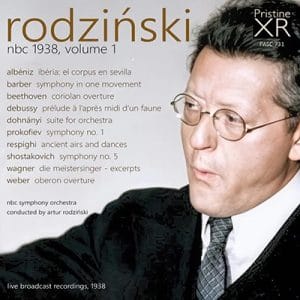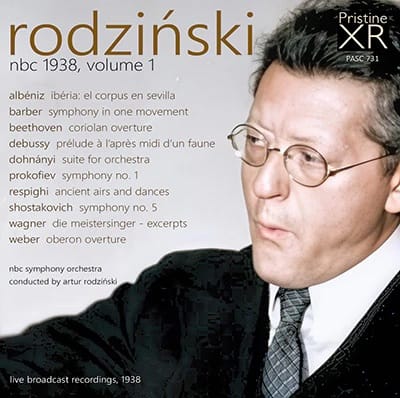
Rodzinski: NBC 1938, Volume1 = Works by ALBÉNIZ; BARBER; BEETHOVEN; DEBUSSY; DOHNÁNYI; PROKOFIEV; RESPIGHI; SHOSTAKOVICH; WAGNER; WEBER – NBC Symphony Orchestra/ Artur Rodzinski – Pristine Audio PASC 731 (2 CDs = 77:09; 78:48, detailed content listing below) [www.pristineclassical.com] ****:
In preparation for the advent of conductor Arturo Toscanini’s debut (25 December 1937) with David Sarnoff’s NBC Symphony Orchestra, Artur Rodzinski (1892-1958) and Pierre Monteux (1875-1964), respectively, recruited personnel and officially launched the first broadcast of the new ensemble, laying a firm foundation of instrumental response and execution. Of the seven concerts Rodzinski led in 1938, this Pristine issue, remastered by Andrew Rose, offers the two live concerts, 2 & 9 April 1938, from NBC’s Studio 8-H. The most important work -despite the severe edits – remains the radio premiere of the Shostakovich Fifth Symphony, the score of which had been obtained by NBC executives at considerable cost and with equally deep reservations on the part of Artur Rodzinski.
Rodzinski opens on August 2 with a driven, pungent account of Beethoven’s 1804 Coriolan Overture, based on a play by one Heinrich Joseph von Collin, a setting of a Roman tragedy: a formerly victorious Roman general turns traitor when his own political aspirations encounter resistance, leading to his eventual suicide. Set in Beethoven’s ever-dramatic C minor, the tumultuous, syncopated music urges but one tender theme, that of Coriolanus’ mother’s plea for self-restraint. The last measures, heavy with regret, utter the protagonist’s motif in broken, stifled fragments.
Samuel Barber’s Symphony in One Movement (1936; rev. 1942) stands as a testament to his resistance to the kind of atonal “modernism” that early infected American musical composition. Cast in a tonal, Romantic syntax, the piece follows a traditional structure of four sections, beginning Allegro non troppo. Barber here demonstrates his capacity for orchestration in varying weights and timbres, emphasizing his strings, brass and winds. Built on three themes, the music breaks off any recapitulation in favor of diminishing theme one as a basis for the ensuing scherzo, marked vivace. Some wickedly busy brass punctuations, brass pedals, and timpanic emphases move us forward. The third movement, Andante tranquillo, typifies Barber’s deep sense of emotional repose, introduced by an oboe over muted strings. A cello solo extends the meditation, soon joined by winds and sympathetic strings, with harp colors, and the whole swells luxuriously. The stunning crescendo leads to a finale in the Brahms mode: a passacaglia evolves from the low strings that soon embraces earlier motives that serve as a recap for the symphony in economically compressed terms. Rodzinski’s apparent sympathy for this music makes us wonder why CBS delayed the first recording until 1945, when veteran Bruno Walter did the honors with the New York Philharmonic.
An entirely contrasting sensibility follows: Sergei Prokofiev’s flamboyantly mischievous Classical Symphony in D of 1917. Perky, spicy, acerbic and paradoxically “conventional” at once, the music bounces and bubbles with delightful glee at the various Haydnesque gambits it satirizes. The middle of the second movement, Larghetto, features some wonderful bassoon moments that contrast with the high, lyric theme that sails above the various, chirping textures below. Prokofiev eschews classical tradition by substituting a two-beat gavotte in place of the minuet, a jaunty “baroque” moment that no less suits his later ballet Romeo and Juliet. Any number of major key, chord shifts define the last movement, set in a dazzling sonata form that provides a pièce de résistance for the solo flute. Rodzinski whips the last page into a fine, coloristic fettle.
That same flute – I speculate he may be Ben Gaskins – prevails in Debussy’s 1894 Prélude à l’après-midi d’un faune, which proceeds suavely into its exotic landscape, painted in the evocative reveries of the faun, the Symbolist textures suggested by the poet Mallarmé. After a slightly askew opening phrase, the NBC French horn redeems himself in vibrant, pulsating colors to accompany the languorous strings, harp, and winds. A bit of old-world portamento inhabits the erotic glaze of romantic sound, almost as if Willem Mengelberg had taken up the baton for a moment. The last pages linger, haunting us with the quietly spectacular revolution Debussy penned that broke anything like “German hegemony” in classical music.
The concert ends with Dohnányi’s 1909 Suite in F# Minor, Op. 19, often called his “Romantic Suite.” The piece well serves Rodzinski as a virtuoso exercise in lush, often snappy, instrumentation, colored by the composer Hungarian ethos. The first movement, Andante con variazione, proceeds in diverse tempos and textures, some of which may hint at Elgar’s influence. The heroic impulse is no stranger to Dohnanyi, who lavishes singing colors on his expansive gestures. The relatively brief Scherzo seems a combination of Mendelssohn impishness and Dvorak folk lyricism, the brass and harp’s adding an exotic hue to the proceedings. When the music explodes, we feel a Bruckner sense of colossal power unleashed. The third movement, Romance, projects a long melody, the viola prominent over a pizzicato bass line, much in the Tchaikovsky mode. Harp figures then accompany a more sinuous vocal line, exotic in the manner of Borodin. The color mix might owe a debt to Ippolitov-Ivanov’s Caucasian Sketches. The expansive, ethnically diverse Rondo enjoys an earthy flavor, with running lines in woodwinds and strings, the melody intentionally glamorous, rounded off by a brash flourish. If any lingering model exerts itself, it points to the cosmopolitan, virtuoso style in Richard Strauss. The eclectic splash evokes an enthusiastic audience response.
Music of Carl Maria von Weber opens the 9 April 1938 concert, with Rodzinski’s leading an Oberon Overture wise in the ways of the Black Forest, by way of Shakespeare. Once the aroused tempo sets in, the reading assumes a decidedly athletic posture, a blend of woodland mysticism and some Germanic concessions to classical procedure. A bit of upper register shatter unfortunately intrudes on the restored sound. The large work on the program – the Shostakovich 5th – is advertised as the “First performance outside the Soviet Union,” a tacit concession that Evgeny Mravinsky had served as the music’s original acolyte. Besides the severe cuts to the score, Rodzinski’s brisk approach moves the remaining torso along quite quickly; yet, the color pageantry and dire, militant sense of occasion make their presence felt. Shostakovich freely admitted that his idea had been to construct a testament to human personality in the manner of Mahler’s First Symphony in the tonic D major. The NBC brass inject a piercing set of attacks late in the Moderato, making the ensuing polyphony feel aggressively ferocious. The last canonic pages, of muted strings, harp, violin, piccolo, brass and celesta bell tones, leaves us with a mournful countenance.
The ironic second movement Allegretto bears the hallmarks of Schubert and Mahler at once: the cellos and bass fiddles announce an Austrian laendler motif, one that will endure parody and distortion as it evolves. The violin entry reminds us of the image of Death that Mahler invokes in the grotesque second movement of his Symphony No. 4. A swirling dance insinuates itself into the Shostakovich march rhythms, which, when sounded by gruff woodwinds and plucked strings, has an eerily haunted effect. The coda in A minor, or a modal version of the tonality, vibrates with gallows humor. The ensuing Largo movement presents an essentially string-dominated dirge that opens in F# minor, the violins divided to create an antiphonal sound reverberant with antique sonorities. The music becomes lyrical with a nostalgia that swells, agonized and even desperate. A long brooding, introspective section, no less agitated in the bass line, assumes a polyphonic menace over a sustained pedal point, a lament for the state of the world. The effect of anguished chamber music prevails, as though we were privy to a most painful confession, ending with tones of the celesta and muted strings worthy of Vaughan Williams.
The last movement, Allegro non troppo, has been characterized as a forced celebration, a festival under duress. Rodzinski sets a blistering pace for this excursion of breathless energies, the themes and gestures virtually toppling upon each other, until the trumpet announces a kind of manic march. From a sense of calamity a sense of slow rebuilding emerges, the tempo of the march now slowed down to its individual instrumental elements. Shostakovich employs his polyphonic gambits to raise the emotional intensity, with the brass and battery free to salute the brazen effort at joy. Much of the gradual evolution to the final pages has been excised for this performance, but the audience applauds the perceived spectacle.
Frankly, after the grueling contortions of Shostakovich, the remainder of the program feels anti-climactic, a study in musical styles and brilliant execution. The four Ancient Airs and Dances of Respighi resound effectively, a charming, balletic potpourri in antique colors. It has become abundantly clear that Toscanini will inherit a responsively superb band of musicians. The uncredited harp solos by Edward Vito deserve more than honorable mention for their sterling sonorities. The same plaudits attach naturally enough to Carlton Cooley, the NBC principal viola. The two extended last pieces, by Albéniz and Wagner, respectively, serve to mount pelion on ossa, to add unnecessary accoutrements to an already satisfying series of works. This same tendency would mark Dimitri Mitropoulos’ habit of concert programming with the nearby New York Philharmonic, somewhat to his discredit.
Annotator and restoration engineer Andrew Rose calls the two Rodzinski concerts “pretty packed programs. . .to a carefully worked out schedule.” At the very least, we receive a full measure of conductor Rodzinski’s volatile stylistic diversity.
—Gary Lemco
Rodzinski: NBC 1938, Volume1 =
ALBÉNIZ: Iberia: El Corpus en Sevilla;
BARBER: Symphony in One Movement, Op. 9;
BEETHOVEN: Coriolan Overture, Op. 62;
DEBUSSY: Prélude à l’après-midi d’un faune;
DOHNÁNYI: Suite for Orchestra, Op. 19;
PROKOFIEV: Symphony No. 1 in D Major, Op. 25 “Classical”;
RESPIGHI: Ancient Airs and Dances – Suite No. 1;
SHOSTAKOVICH (abridged)): Symphony No. 5 in D Minor, Op. 47;
WAGNER: Die Meistersinger- Act III – excerpts;
WEBER: Oberon – Overture