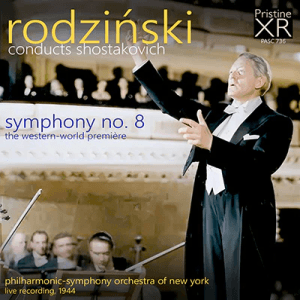
SHOSTAKOVICH: Symphony No. 8 in C Minor, Op. 65 – Philharmonic-Symphony Orchestra of New York/ Artur Rodzinski – Pristine Audio PASC 736 (66:05) [www.pristineclassical.com] ****:
The performance of the Shostakovich Eighth Symphony under the direction of Artur Rodzinski offered here by Pristine Audio, given at Carnegie Hall, New York City, 2 April 1944, predates the earlier 2007 issue from the Guild label (GHCD 2322), whose Rodzinski performance dates some months later, 15 October 1944. The music had received its premiere in Russia by Yevgeny Mravinsky, and somewhat debated, its European debut in England, under Henry J. Wood. This historic concert recording, made on 78rpm acetates, served as the preservation of the live broadcast performance, the music’s American premiere before conductors like Serge Koussevitzky took the score to Boston and then beyond. Conceived in a speedy three weeks in the summer, 1943, the music – set in the same harmonic progression as the Beethoven Fifth, from C minor to a conclusion in C major – pays homage no less to Mahler, given the work’s severely elegiac character, what Shostakovich calls “a Requiem for all those who had died, who had suffered” [from Nazi oppression].
The 2 April reading generally takes a broader approach to the score than that of October, excepting the fourth movement, Largo. The first movement, Adagio – Allegro non troppo, sets the dire tone of the work and constitutes its longest section. Much of the low string figures remind us of the 5th Symphony by this composer, although the Mahler 10th might be an influence. When the melody arrives, we feel a reminiscence of the abrasive anger in the No. 7 Leningrad Symphony.
The dreary landscape undergoes a shift to 5/4 and assumes a searching, forlorn character. What are canonic and contrapuntal kernels will emerge as a fully formed fugue for the music’s development section. Rodzinski leads an evolving crescendo, marked by oppressive intensity and blatant violence. Snare drum tattoos and martial trumpet orisons compete with cries and bleatings in the strings of a tortured humanity. The artistic equivalent of this music lies in Picasso’s Guernica. A brazen march ensues, but it substitutes hauteur for justifiable pride, a Pyrrhic victory. Out of the rubble an English horn – a la Sibelius’ The Swan of Tuonela – intones over a low ostinato, and the expansive landscape sounds like that visualized for us in Lewis Milestone’s All Quiet on the Western Front. The Philharmonic strings continue the elegy; and if one does detect C major in all this blasted heath, it comes with little consolation. Extended applause – which occurs virtually after each movement – interrupts the flow until 29:03.
Following Mahler, Shostakovich inverts the form of the following movements by inserting two scherzo-like movements before the appearance of the slow movement. The second movement Allegretto (in D-flat major) proffers a sardonic march with acerbic shrieks and jabbing accents in the strings and winds. The three-note punches from the brass adumbrate one of the themes for Jurassic Park. High pitched winds against low members in syncopation create a sleazy circus environment. As in the next, E minor, movement, a grisly toccata for clarinet and strings marked Allegro non troppo, a deadly monotony sets in, despite the brilliant use of orchestral colors – especially in the brass – and timbres to realize a vision of Hell. The latter half of movement three transforms into a military celebration in sinister form, the brass soon replaced by sliding strings and glissando effects, over a relentless, pulverizing bass rhythm. For sheer orchestral bravado, the Philharmonic should win kudos, but the music immediately segues into the Largo. Set as a learned passacaglia in G# minor, the music assumes its most potent expression of loss. The horn and wind parts alternately sail and plod over a desolate plain, the latter intoned by sustained, pedal strings.
The final, pastoral, movement, Allegretto, supposedly marks a sense of hard-won victory from devastation, but the recurrence of the initial impulse – of C-B-flat-C – from the first movement more than hints that tragedy lies behind every sigh of relief. The opening bassoon finds color mates in flute and clarinet, but the fugal strings once more impel us along a dark course, invaded by martial punctuations, sardonic in tone. The fugal element serves to act like a quicksand that will not allow a vision of freedom. Our musical, as well as emotional, stamina has been tested, and the entry of blaring horns and echoes of hollow jubilation do not assuage our anxieties. Once more, as in the 5th Symphony, we hear the brutal command, “You will rejoice!” The music explodes in utter frustration, even ironically quoting Mahler from his Resurrection Symphony. A weird chamber music episode emerges in the last five minutes of the work, a parody of Mahler’s klezmer impulses, with percussive effects added to the now wistful gestures. Solo violin, plucked string chords, and brass held-notes proceed tentatively, over another string pedal, slowly fading into a waiting expanse of silence. Huge applause.
—Gary Lemco