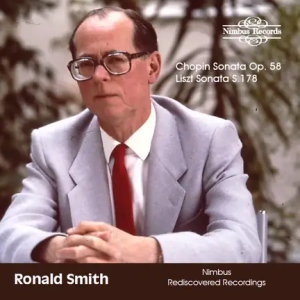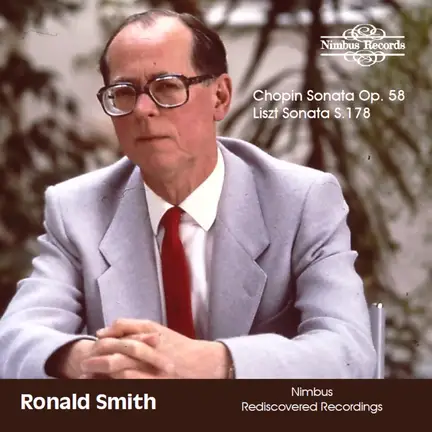
Ronald Smith: Rediscovered Recordings = CHOPIN: Piano Sonata No. 3 in B Minor, Op. 58; LISZT: Sonata in B Minor – Ronald Smith, piano – Nimbus NI 7115 (54:24) (3/6/26) [www.wyastone.co.uk] *****:
In a recent letter to me concerning this Nimbus release of February and August 1980 recordings by British pianist Ronald Smith (1922-2004), record collector and radio broadcaster Lance G. Hill noted, “Isn’t it a pity that many of the younger generation do not know of Ronald Smith, an imposing artist?” Correlative to Hill’s remark, Nimbus record producer Adrian Farmer writes:
The sessions in 1980 were both ‘analogue,’ being made on reel-to-reel tape machines. We had little idea how quickly such Industry wide state-of-the-art technology would be brutally swept aside by the arrival of digital recording, and its market counterpart, the Compact Disc. Ronald’s Chopin Etudes were released on LP the following year. The LP sleeve went as far as announcing the catalogue number of the upcoming Chopin/Liszt Sonata pairing. The master was approved and ready to go. But all things ‘digital’ upended all sense: the record world, its media and followers clamored for digital recordings of standard works. Labels rushed to satisfy the demand (Nimbus was no exception), and unreleased ‘analogue’ masters fell into a dark hole. Ronald Smith’s later digital recordings enjoyed immediate release, but not so the Chopin/Liszt Sonatas, until now, 45 years on.
Ronald Smith, despite his natural affinity for music of the Romantic Era, found his greatest inspiration from having worked with Swiss master Edwin Fischer (1886-1960) in the music of J.S. Bach. Fischer’s penchant for classical architecture in music brought discipline and clarity to the otherwise difficult, almost impenetrable scores of Valentin Alkan and Mili Balakirev, both of whom Smith championed. His coloration for Chopin’s 1844 Sonata in B Minor graces the first movement Allegro maestoso with a florid combination of idiosyncratic Bach counterpoint and Chopin’s especial chromatic harmony. The runs and small, right-hand canons flow with a liquidity of motion that conveys a lyrical momentum informed by the dramatic content, a hybrid of nocturne and ballade. While the volume and dynamics retain their capacity for explosive propulsion, the atmosphere remains one of intimate restraint, more of Robert Casadesus and Alfred Cortot than of Vladimir Horowitz.
Smith’s Scherzo: Molto vivace bears an elfin quickness, offset by a hazy, introspective episode rife with unresolved harmonic motion. We think that Smith would excel in the four Chopin Impromptus, where the fleetness of his diaphanous runs would enjoy full rein. If ever the art of Bellini’s operatic bel canto found instrumental means, Chopin’s third movement Larghetto proves the analogy secure. After an opening in dotted rhythms, a groping series of chords resolves into a sustained, processional nocturne of extraordinary, mesmeric power. Smith fashions an interior dialogue of seamless beauty, the keyboard’s having renounced anything like percussive power. The moments of recitative savor the silences between the chords, where true drama lies. The last movement Finale: Presto non tanto unleashes Smith’s flair for bravura expressivity, a potent rondo whose fury does not abate. Smith hurtles through Chopin’s martial sensibility, wherein brilliant runs and cascades tumble forth in breathless impetuosity, a force from the Romantic Abyss. The coda rounds of a cataclysmic sense of dramatic flourish, a proclamation of hard journey well met.
Franz Liszt’s 1854 Sonata in B Minor has inspired much rhetorical speculation on its ‘meaning’ or ‘programmatic intent.’ Liszt himself offered no clues to this unique piano composition, sometimes referred to – given its Beethoven-like girth, vehemence of expression, and dynamic, polyphonic means – as “Beethoven’s 33rd Sonata.” For both lyric power and unity of form, the Sonata has few rivals, since it compresses into one extended movement a ground theme that permeates the work entirely, sometimes as a fugato impulse played against itself in inversion. Likely having taken Franz Schubert’s 1822 Wanderer Fantasy as his model, Liszt subdivides the one movement into four sections (three, in the present recording divisions), displaying what Blake would call ‘fearful symmetry,’ as the key scheme: C-E-A-flat-C draws a fatal, epic circle around the plethora of emotions and shifts of mood. Ronald Smith here enters the realm dominated by the likes of Horowitz, Cziffra, Cortot, Kentner, Petri, Arrau, and Barere for theatrical bravura on the grand scale.
After a mysterious Lento assai, Smith launches (sotto voce) into the group of three themes that establish the exposition, including a voluptuous appearance of the amazing trill that hurdles the material into Dante’s depths. The grand D major theme offers lyrical consolation as the original motif transforms itself while maintaining its essential character, close to Hegel’s dictum: “the Idea unfolds itself in the form of being different.” The silken runs and resolute marcatos proceed with stunning clarity of motion, Allegro energico, pulverizing and insistent. Andante sostenuto The provides the heart of the music, a slow movement suavely consoling and perhaps religious in its gossamer realignment of the opening motif. Smith plays the entire section in the manner of a bravura improvisation, at moments sounding like an operatic reminiscence. The various fingering approaches Smith utilizes play like a compendium on piano technique, a textural tour de force.
Then, after the opening riff, Liszt offers the fugato announcing the third, demonic progression. Serving as a kind of development section, the expansive fugue injects a fury into the textural mass that defies classical categories. Each articulation of the impulse intensifies the staggering effect, so no wonder the orchestral version often appeared in Universal horror films! The consolation of the D major theme arises out of the emotional rubble, devoutly delivered and beatific in visionary power. Smith then mounts to a grueling, cataclysmic moment, furioso, since it is better to rule in Hell than to serve in Heaven, the ultimate expression of individualistic pride. Yet, Liszt resists the apotheosis of the Abyss and reintroduces his grand anodyne, the Andante sostenuto theme after a pregnant silence. The snake bites its own tail; the ouroboros, the eternal circle, is complete.
—Gary Lemco