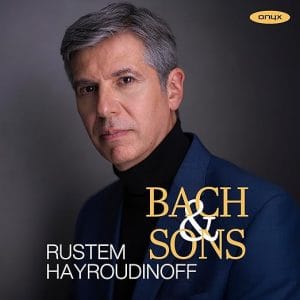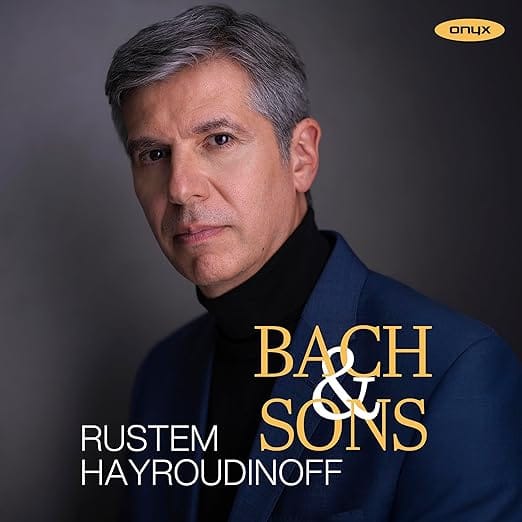
BACH&SONS = Keyboard works of J.S. Bach, W.F. Bach, C.P.E Bach, J.C.F Bach – Rustem Hayroudfinof, piano – ONYX 4267 (3/28/25) (75:40, complete contents listed below) [Distr. by PIAS] *****:
Any detailed exploration of the music of J.S. Bach and his gifted sons ought to mention that, musically speaking, the sons found their father’s “learned style,” his supreme authority in polyphony, an artificial imposition on what they felt to be a more natural mode of expression. Their respective call to “sensibility,” to an emphasis on emotionalism, came to be labeled empfindsamkeit, the style of “true and natural feelings,” that often took the form of chromatic slow movements, close attention to dynamic shifts, and contrasts of register, tone color, and affective rhetorical devices.
Suitably, Hayroudinoff in his conversation for Piano magazine asserts J.S. Bach to be “the greatest composer that has ever lived,” his the playing of Bach’s (c. 1717-1723) English Suite No. 3 in G Minor sets the tone for the recital. Hayroudinoff’s opening “French” Prelude resounds with the quick energies of an Italian concerto grosso in pungent 16ths, a moto perpetuo in miniature, florid in its animated counterpoints. The Allemande trades its motifs between the hands, inverted in the latter half, subdued and thoughtful in tone. A three-voice Courante rushes forth in 3/2, polyphonically ambitious even in its brevity, the pulse’s occasionally hinting at duple meter. The biting staccato from Hayroudinoff may remind some auditors of the virtues in Glenn Gould. The musical residue of Spain, the ensuing Sarabande, urges a new gravitas, a note of somber though ornamental introspection. The formulaic galanteries – Gavotte I and II – dancelike and texturally transparent in the counterpoints and drone effects. The latter of the two offers a Musette in G major. The impulse to dance merges with that “learned style” in the final Gigue, a three-voice fugue that scurries rather athletically to a rounded conclusion that has nonetheless landed on its head.
W.F. Bach (1710-1784) retains a darkly chromatic affinity for the otherwise defunct polyphony of his father, settling for a style both galant and high expressive. Hayroudinoff overtly admits a fondness for Friedemann Bach’s polonaises, which he calls “gorgeous lyrical pieces,” and he also draws from the 8 Fugues without Pedal, F 31, performing No. 4 Fugue in D minor and a Fantasie in D minor F 19. The D minor Fugue proves highly chromatic, almost a piece by Max Reger, in which a four-note motif asserts its dominance amidst the intricate textural development. The highly ornamental, mercurial Fantasia plays like a two-part toccata, a fiery, potent example for the claim that W.F. Bach had been the greatest organist in Germany, especially in its frequent reversions to strict fugal sensibility.
Carl Philipp Emanuel Bach (1714-1788), the so-called “Berlin Bach,” whom Hayroudinoff praises as “a true genius of invention,” appears in his first work, the 1787 Sonata in D, characterized as “jazzy and manic” by our interpreter. The Allegro di molto first movement progresses in skittish, rapid, somewhat broken figures, with sudden injections of forte dynamics in shifting metrics. An incomplete cadence leads to the slow movement, syncopated and rather ornamental. The last movement, Presto di molto 6/8 enjoys a flurry of impulsive activity in competing registers, playful a la Scarlatti.
Johann Christian Friedrich Bach (1732-1795) proffers, from his collection of Six Easy Keyboard Sonatas of 1783, his third, the well-wrought Sonata in E Major. Despite its claim to facile execution, Hayroudinoff confesses that the work challenged him constantly, with its relentless action in 8th notes, expansive Allegro moderato, its shifts in dynamics and quick metric demands, much in the manner of Scarlatti, Galuppi, and early Haydn. The Larghetto presents a stately court dance in staid figures, delicately processional, with affective nuances that attach to its double notes. The final Allegro demonstrates why Hayroudinoff struggled with Bach’s fleet and knotty figures, surely a testament to the inventive, polished craft of the composer, a veritable force at the keyboard in his own time.
Hayroudinoff turns to the first of two polonaises by W.F. Bach in a collection of 12 (c. 1765), works he calls “gorgeous, lyrical pieces,” of which No. 8 in E Minor projects a mystery entirely its own, a subdued moment of rare intensity. Its passing series of parlando leaps, dissonances, and soft arpeggiors contribute to an empfindsamkeit aura prophetic of Chopin, Schumann, and Scriabin. No. 10 in F Minor from the same set, concluding the recital, reveals even more concentration, a sarabande as such, somber and ornate. The anguish in the delicately accented notes, sforzato, bears a passion we could attribute, in a vocal context, to Gesualdo. The last page fades away, but the lingering affect does not.
Hayroudinoff turns to the set of 1763 Six Sonatas of C.P.E. Bach, Wq 52, of which No. 4, in F# Minor, proves especially passionate and intense, opening Allegro with a triplets fury we associate with Schumann’s Kreisleriana. The delicate counter theme serves as a foil that periodically interrupts the mania of the initial thrust. The music plays like an impulsive, improvisational toccata, a test of competing affects in virtuoso style. The second movement, Poco andante, extends the galant sensibility as an operatic or trio sonata aria, almost a duet. The finale, Allegro assai, exploits the broken style of sudden rests in the music, once more emphasizing the composer’s innate sense of drama. Leaping figures in dotted rhythm move us into some circuitous harmonic areas, the tensions extended and then relaxed in the manner of a bemused improvisation.
Music by the “London Bach.” Johann Christian Bach (1735-1782), remains, his 1774 two-movement Sonata in A, Op. 17, No. 5, in a style (for the emergent fortepiano) that moves from the galant to the pre-Classical with a suave grace and sureness of craft. The genial first movement, a sonata-form Allegro, offers a singing melody from Hayroudinoff beset by passing ornaments and fleeting, scalar figures that eventually accent the F# minor mode. The sympathy of this music to the burgeoning style of the younger Mozart becomes increasingly obvious. The second movement, Presto, asks Haroudinoff to execute a tour de force, another toccata exercise in restless series of running motion touched by Classical grace and innate, instrumental poetry.
Guided by Producer Annabel Connelian, the brilliance of the entire Bach recital has been admirably captured by Sound Engineer Ben Connellan at the St. George Heastone, Harrow, 23-25 January 2024.
—Gary Lemco
Rustem Hayroudinoff – Bach & Sons
J.S. BACH: English Suite No. 3 in G Minor, BWV 808;
W.F. BACH: Fugue in D Minor, F. 31/4; Fantasie in D Minor, F. 19;
C.P.E. BACH: Sonata in D, Wq 61/2;
J.C.F. BACH: Sonata No. 3 in E, Wf XI 3.3;
W.F. BACH: Polonaise No. 8 in F# Minor, F.12/8;
C.P.E. BACH: Sonata in F# Minor, H. 37;
J.C. BACH: Sonata in A, Op. 17/5;
W.F. BACH: Polonaise in F Minor, F. 12/10