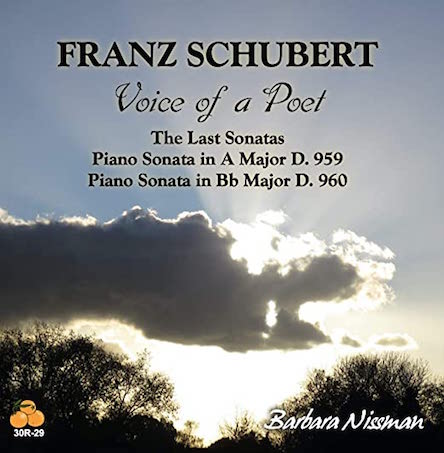
SCHUBERT: Voice of a Poet = Piano Sonata in A Major, D. 959; Piano Sonata in B-flat Major, D. 960 – Barbara Nissman, piano – Three Oranges Recordings 3OR-29 (3/12/21) (77:56) [www.threeorangesrecordings.com] *****:
Pianist Barbara Nissman (b. 1944) often receives epithets such as “one of the last pianists in the grand Romantic tradition,” and her many researches into the music of Prokofiev and Ginastera transcend that limiting definition to indicate something of her extraordinary quests in musicology. So, it seems appropriate for her to explore (rec. 2-3 August 2019) the two great, last sonatas (1828) of Franz Schubert, whom she calls “the master of combining melody with poetry.”
Despite Nissman’s deep respect for Schubert’s innate lyric gifts, she addresses the first of the two sonatas, that in A Major, with the explosive, even percussive, energy of operatic drama, intensified in scope by her taking the first movement repeat – in both of the sonatas – to add to their “heavenly length.” The majestic contours of the A Major’s opening themes and their somewhat manic changes of emotional direction point to the duality in the composer’s nature, a habit of mind typical of the Romantic ethos. The tender E Major subject yields to a chromatic impulse in triplet, descending arpeggios that tolerates dissonance and disruption. Nissman does not sugar-coat the angst in Schubert, its refusal to conform to traditional sonata procedure, with its incursions into C Major, B Major and C Minor. Given the often unnatural demands made upon the fingers, the music incurs a tension that a merely “sunny” disposition denies, and the task of holding this large, disparately emotional canvas together presents another hurdle to be overcome by Nissman’s suave grasp of structure.
For many of us, Schubert’s second movement, an Andantino in F-sharp Minor, serves as the divine heart of this sonata, moving in seconds in the manner of a sad barcarolle. Its tragic ethos seems close to the lied “Der Leiermann” from the cycle Winterreise. Suddenly, the music assumes a feverish impulse like a Bach chromatic fantasy that wends its way to a punishing C-sharp Minor. With a percussive recitative, Schubert moves to the serenity – although with a disruptive trill that will haunt the D. 960 first movement – of the opening, now with Nissman’s haunted trills in the upper part. The staccato dance of the third movement Scherzo: Allegro vivace dispels much of the “terror by night” of the former music. This, too, in its sense of rustic relief, has a moment of storm in its descending scalar passage. The Trio appears almost hymnal, except Nissman’s speedy realization refuses to grant it the kiss of peace.
For his last movement, Rondo: Allegretto, Schubert leaned upon two models: first his own, the theme from the slow movement of the A Minor Sonata, D. 537, and Beethoven’s Sonata in G Major, Op. 31, No. 1. Nissman plays a seemingly unending pattern of triplets from which an eternal song rises. The sudden shift into C-sharp Minor introduces the “cyclic” procedures of much Romantic music; here, the drama from the Andantino. Nissman punches out the sforzando chords with relentless fury, in spite of the optimism of the sonata’s general tone. Schubert displays some bitter humor in his application of false recapitulation, a device he likely took from the impish side of Beethoven. Schubert marks his coda Presto, and the lush arpeggios from movement one recur. The music occasionally achieves a torrent of energy before the main theme assumes its pp incarnation, with some dark colors applied to the grand choral design that began the Sonata as a whole.
Nissman gained much of her sense of structural continuity in large works from her mentor Gyorgy Sandor.My own teacher, Carmine Arena, used to declaim of the great B-flat Major Sonata, D. 960 that its ethos protested against the tragic awareness of loss. Again, Schubert’s model for his last sonata may well have been Beethoven, who in his Op. 7 Sonata and that in D, Op. 10, No. 3, provided four movement works with sonata-form-hybrid rondos as finales. Once more, elements of the cyclic procedure and an improvisational atmosphere contribute to this massive work’s structural unity. The disturbing element in this piece occurs in the first movement, a trill on G-flat that comes to rest on F. Schubert’s love for enharmonic development, a likely concession to harmonic wit, makes much use of F-sharp as a fulcrum for modulations.
The melodic breadth of the first movement, Molto moderato, given Nissman’s pace, allies the music with the opening of Beethoven’s Archduke Trio, in the same key. At bar 78, the second subject enters in F via triplet arpeggios; and, with some modulations enharmonically executed, it’s time for the expansive repeat, announced in thrilling, even “fateful,” chords. Nissman herself injects her impression that this music contains “much beauty, tenderness and sadness” within this large sonata movement. The development section exploits Schubert’s economics of C-sharp Minor and F Major as competitive, emotional poles. The distress can be quite telling, moving into D-flat, and that unnerving trills makes its presence known in the bass, the impetus of which itself announces the recapitulation. At the coda, the menace of the trill somewhat abates, as though the melodic consolations have had a power to renew Schubert’s stamina and faith.
The key of the first movement’s development section, C-sharp Minor, sets off the wonderful Andante sostenuto, among the songful miracles of music. A kind of doleful habanera, the music moves in A-B-A form, with a modulation to A Major. The plasticity of the melody seems to bear pain and its own consolation. How even an usually acute critic as Robert Schumann could not appreciate the rich beauty of this movement remains a mystery that took almost a hundred years and Artur Schnabel to solve. Late in the progression come Neapolitan harmonies that add a touch of exotic color to the “Southern” rhythm, aided by incursions into soulful variants in E Major.
The ensuing Scherzo: Allegro vivace e con delicatezza serves, as Nissman puts it, in a “music box” capacity, a relief from emotional gravity. Schubert’s wit infiltrates the brief Trio section in B-flat Major, alive with jarring sforzandos in syncopation that play duple against triple meter. This charming moment fades away to prepare us for the last movement, Allegro ma non troppo, declaring itself on the octave G. Some auditors feel a similarity here with the ever-amiable Trout Quintet. Nissman sings in F Major a moment and then erupts with F Minor ff chords to embark on some polyphonic treatment of the dual aspect of Schubert’s first theme. What then must be construed as a transcendence of rhythmic motives calls on Nissman’s temperament for potent energies and operatic drama, including a long line of keyboard coloratura. The last pages involve a pregnant pause before the fateful onrush to judgment or self-discovery, whichever conceit bears the wonder of this grand sonata.
Schubert well done, intelligent and masterful at every moment, Period.
—Gary Lemco