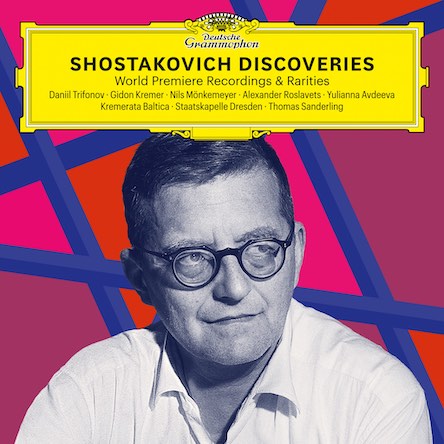
SHOSTAKOVICH DISCOVERIES = Anti-Formalist Rayok; Impromptu for Viola and Piano; Scherzo for Piano; Three Fugues for Piano; Three Fragments from theThe Nose; Five Pieces for Two Violins and Piano; In the Forest; Prelude and Fugue for Piano in C# minor; Murzilka; Yelabuga Nail – DG 28948671908 (78:00) (5/23/25) [Distr. by Universal] ****:
Marking the 50th anniversary year of Shostakovich’s death, Shostakovich Discoveries features world premiere recordings and rarities from the renowned composer, performed by such artists as Daniil Trifonov, Gidon Kremer and Nils Mönkemeyer. Most of the pieces were recorded at the International Shostakovich Festival in Gohrisch (Saxony), the world’s only annual Shostakovich festival.
The totalitarian Stalin regime in Soviet Russia restricted and even destroyed many creative artists, Dmitri Shostakovich (1906-1975) among those whose works were selectively repressed. Recently, musicologist Olga Digonsaya has unearthed some 300 compositions, in varying states of completion, from the composer’s estate in Gohrisch, near Dresden, Germany. The works cover a range of dates, 1920-1955, in diverse arrangements and genres. This disc offers 10 compositions, several in their world premiere performances.
Anti-Formalist Rayok (1948) is a bitterly satiric cantata for bass voice and chorus, a parody of the political correctness that insisted upon a clear distinction between “Realism and Formalism on Music,” the latter unsympathetic to the needs of “The People.” The bass becomes four characters, and their discussion abuses music with dissonances and atonal effects. Recall that a melodious Lezghinka was Stalin’s preferred style. We must look everywhere for instances of subversion: Vigilance!
Impromptu for Viola and Piano (1931) was discovered in 2017. The sad Adagio in G minor lasts for 17 measures, and the ensuing, folksy Allegro is 20 bars. Respectively, the two sections imitate the styles of Glinka and Tchaikovsky.
Scherzo for Piano, Op. 1a (c. 1920) is a keyboard reduction of an orchestra piece Shostakovich penned at 15. A folk tune that invokes some contrapuntal development, it enjoys a light, dizzy, percussive brightness. The middle section, sentimental, may owe debts to Prokofiev and the romance of the night club.
Three Fugues for Piano (1934) testify, as do his Op. 34 and Op. 87 contrapuntal collections, to Shostakovich’s veneration of J.S. Bach. The pieces here soon emerge as character pieces: No. 1 is lyrical and meditative; No. 2 brief but animated in staccato figures; No. 3 projects a mood of nostalgic reflection.
Three Fragments from the opera “The Nose” (after Gogol, 1928): Shostakovich wrote his full opera in 1931 on the 1836 satiric short story that mocks society’s obsession with status. After a potent organ solo, the Entr’acte: In front of the Cathedral breaks into a
raucous dance. A substantial timpani and brass fanfare marks the Beginning of Act III, rife with wind and percussion effects for a mock, military episode. Entr’acte No. 10a assumes the character of a weakly accented waltz or polka. The martial impulse again makes its presence known, but the dissonant tone remains mockingly inflated.
Five Pieces for Two Violins and Piano (1933-55) represent a compendium of tunes from various sources: the Prelude from the 1955 The Gadfly; the Gavotte, Elegy and Polka derive from 1930s dance suites; and the Waltz from an animated cartoon film of the opera The Tale of the Priest and his Worker Balda (1936). The present, chamber music arrangement (1961) was created by Levon Atovmayan.
In the Forest (1919) originally appeared in the 12-year-old composer’s lesson book as an arpeggiated, piano solo improvisation. It sounds, in its trills, often like a musical box.
Prelude and Fugue for Piano in C# minor (1950) had meant to be included in the Op. 87 set of 24 Preludes and Fugues. The Prelude exploits a Romantic ethos, positing the C major triad inverted. The knotty Fugue projects a quirky, asymmetrical rhythmic verve, at times quite aggressive.
Murzilka had been a children’s magazine in the mid 1920s; here, in this 1944 piano piece of a mere 22 measures, Shostakovich fashions a humoresque in two-part, staccato style. Sometimes in two keys at once, the piece may suggest a hunt episode.
Yelabuga Nail (1971) takes its grim tone from a poem by Yevgeny Yevtushenko that relates the suicide in 1941 of celebrated poet Marina Tsvetayeva, likely impelled by Stalin’s political lackeys. Set for bass voice and piano, the writing proves harsh, anguished, and punishing. The use of chord progressions in 5/4 would become a motto for Symphony No. 15.
–Gary Lemco
SHOSTAKOVICH DISCOVERIES
1Anti-Formalist Rayok;
2Impromptu for Viola and Piano;
3Scherzo for Piano, Op. 1a;
3Three Fugues for Piano;
4Three Fragments from the opera The Nose;
5Five Pieces for Two Violins and Piano;
6In the Forest;
7Prelude and Fugue for Piano in C# minor;
7Murzilka;
8Yelabuga Nail
1Alexei Mochalov, Andrei Pushkarev, Kremerata Baltica/
2Nils Mönkemeyer, Rostislav Krimer/
3Daniil Trifonov/
4 Staatskapelle Dresden, Thomas Sanderling/
5Gidon Kremer, Madara Petersone, Georgijs Osokins/
6Daniel Ciobanu, piano/
7Yulianna Avdeeva/
8 Alexander Roslavets, Andrei Korobeinikov