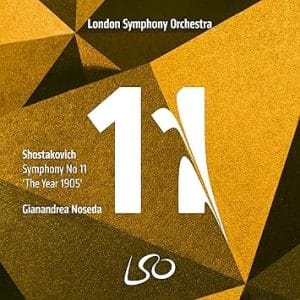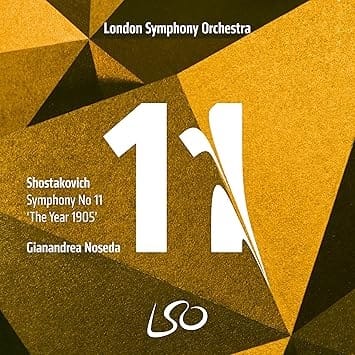
SHOSTAKOVICH: Symphony No. 11 in G Minor, Op. 103 “The Year 1905” – London Symphony Orchestra/ Gianandrea Noseda – LSO Live LSO0888 (1/14/15) (63:07) [Distr. by PIAS] ****:
Those familiar with film director Sergei Eisenstein’s 1925 Battleship Potemkin already know something of the 1905 political context of Dmitri Shostakovch’s 1957 Symphony No. 11, which confronts, by programmatic and dramatic means, the infamous massacre of unarmed, working-class citizens outside the absent Tsar’s winter palace. On 9 January 1905, the palace guards fired upon a peaceful crowd of workers, inciting the “little Revolution” with this unhappy incident in St. Petersburg’s Palace Square that came to be labelled “Bloody Sunday.” To commemorate the 40th anniversary of the October Revolution of 1917, Soviet officials commissioned Shostakovich to compose this symphony, written at the time of Shostakovich’s 50th birthday, somewhat coincident with the date of the historic tragedy.
Shostakovich conceives a four-movement symphony in rather pictorial, even cinematic, terms: played with no pauses between sections, the music proceeds with a motto drumbeat from the Palace Square, a slowly brooding, moodily haunted movement (Adagio) beset by two revolutionary songs, “Listen!” and “The Prisoner,” which hold us in thrall while the unarmed petitioners approach the standing, malignant palace guards. The literary equivalent of attending to the imminent catastrophe lies in Joseph Conrad’s “fascination of the abomination” in Heart of Darkness. Distant fanfares evoke a soldiers’ reveille and a general, spiritual awakening to the nature of tyranny.
Active low strings announce the ensuing Allegro: The 9th of January and its apocalyptic end of all and any Russian’s faith in Tsar Nicholas II, in any justification by “divine right.” Susceptible to the epithet “movie music,” this huge movement does seem a literal depiction of the crowd’s entreaties to a sullen and implacable authority, soon exploding in blatant war against its own people. The high woodwinds, ostinato strings, and brass quite scream their plaint of palpitating hearts to the absent Tsar, when, after an ominous silence, the sound of unleashed, unprovoked rifles, with (fugally) martial, snare and kettle drum and cymbal effects, scatter the peaceful throng into paroxysms of panic and sudden death. A real test of the LSO’s battery, the clarity of the punishing lines – courtesy of Nicholas Parker, producer and editor – becomes fiendishly palpable, at the Barbican Hall, London (24 November 2022). The vertigo that sets in after the slaughter, the sense of a physical and emotional wasteland, settles in with remnants of the chants of the petitioners and the timpanic motto, all in bleak tatters.
The final two movements prove less programmatic as such, entitled, respectively, In Memoriam: Adagio and Tocsin: Allegro non troppo. Pizzicato filigree in the opening strings of the elegiac Adagio accompanies the funereal song, “You fell as a sacrifice,” a lament for all humanity that suffers martyrdom. Set in soft, contrapuntal motion, the atmosphere assumes the haunted ethos of Mahler’s Kindertotenlieder. The melodic climax becomes heart-rending, perhaps laced with a touch of defiance and even heroic resolve. The Tocsin last movement obviously sounds a universal alarm bell, the signal that human catastrophe remains ever vigilant of opportunities for expression. The music appears to describe yet another open conflict, fraught with gunfire and merciless aggression. The people’s moral outrage emerges in two songs, “Tremble tyrants” and “Whirlwinds of danger.” When the volcano subsides, we encounter the old Palace music now accompanied by a sad English horn, perhaps a plea to the earth of Mother Russia. The pastoral, as such, includes harp riffs and then a sudden descent into a bassoon and timpani-led maelstrom. A kind of Devil’s dance erupts from the dissonance, capped by the sound of distorted bells and martial drums. If celebratory, the G minor temper gives us pause, for any revolt, already violent in-itself, may eventually resolve into another tyranny.
—Gary Lemco
More Information through Amazon