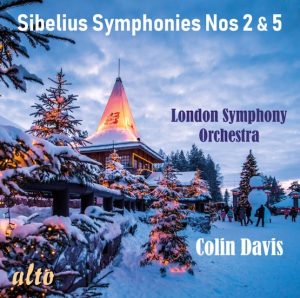
SIBELIUS: Symphony No. 2 in D Major, Op. 43; Symphony No. 5 in E-flat Major, Op. 82 – London Symphony Orchestra/ Sir Colin Davis – Alto ALC 1713 (75:35) (10/20/25) [www.altocd.com] ****
The symphonies of Jean Sibelius consistently appealed to British conductor Sir Colin Davis (1927-2013), who recorded the cycle thrice, once with the Boston Symphony Orchestra and twice with the LSO. The present Alto disc derives from the LSO’s own label, the recordings having been taped in live performance in 2006 (Op. 43) and 2003 (Op. 82). In terms of classic recordings, both the 1901 Second Symphony and the 1915 Fifth Symphony fared brilliantly under the direction of conductors Robert Kajanus (1856-1935 and Serge Koussevitzky (1874-1951), although neither completed a complete cycle for musical posterity. The Colin Davis cycles, however estimated by critics and connoisseurs, must suffice for the fact that the great British acolyte of the composer, Sir Thomas Beecham (1879-1961), left only a select few commercial recordings, buttressed by some privately made sound documents, which still fail to render a complete cycle.
The D Major Symphony may be appreciated as both a rousing, nationalist score and a pantheistic hymn, at once. Stylistically, the symphony benefits from Beethoven’s exploitation of short, rhythmic fragments capable of explosive development, and Tchaikovsky’s grand expression of the heroic, melodic line. In addition to an Italianate, lyrical lightness in the opening movement, Allegretto, the music obeys the composer’s idiosyncratic notion of sonata form, pulsing and frittering in strings and woodwinds, and then uttering a passionate melody the composer termed “the most joyful I have ever written.” The LSO responds with rich tapestry, the sound graduated to embrace an athletic invocation of the Finnish landscape.
The second movement, Tempo Andante, ma rubato opens with an extended pizzicato bass line that conductor Koussevitzky – himself a former, virtuoso bass player – relished and made an archetype in his BSO recording for RCA in 1950. This music swells and retreats, bucolic lyricism pitted against emotional anguish, oceanic moments of grand power often interrupted by enigmatic silences. Sibelius often invokes the Aeolian mode rather than A minor, injecting an antique, intimate beauty into the melancholy and brooding Finnish vistas.
For sheer virtuosity of execution, the LSO has few competitors in the third, Vivacissimo movement, a scherzo that outdoes Mendelssohn for deft, unison articulation of the strings. The plaintive oboe theme, possibly a carryover from a Prague visit by Sibelius, offers brief, warm consolation from the fierce momentum, appearing twice then ceding to the attacca arrival of the heroic last movement, much in imitation of the Beethoven Fifth Symphony, played Allegro moderato. The apotheosis offered by the three monumental statements of the grand theme might derive from the Tchaikovsky Fifth Symphony, but here the beneficiary of the Finnish composer’s own sense of resolve and epic closure.
Sibelius expended considerable effort on his Symphony No. 5 between 1915 and 1919, revising its original four-movement structure into a compressed, three-movement form. The result finds a through-composed motif, a “swan theme,” that evolves into an arch form, whose first movement, Tempo molto moderato, exerts considerable tension via the use of orchestral stretti, layered melodic lines of both declamatory and heroic character. Though many fine conductors – Kajanus, Koussevitzky, and Sir John Barbirolli (1899-1970) – recorded potent versions of the Fifth, my own preference falls on that by Sergiu Celibidache (1912-1996), who led grippingly expansive renditions with Swedish and Danish ensembles.
Colin Davis appears perfectly at ease with the demands of the work, its glowing winds and horns rife with natural allusions to landscape and waterfowl, and its folk impulses that capitalize on periods of modal, even grueling, pedal-point. The LSO brass project a clear, resonant series of fanfares that herald the heroic aspirations behind the influx of rippling and thunderous motifs that assail the melodic arch, with the movement’s seamlessly transitioning into the second movement Andante mosso, which serves as a moody intermezzo and scherzo whose model may well be Brahms. A five-note, flute-initiated figure over pizzicato strings provides the basis for a set of loose variations that Davis guides with a lightly transparent hand. The melodic tissue becomes enriched momentarily, a noble moment true to the Sibelius ethos, as the sonority increases in luxuriant, pagan gestures that celebrate an immense, naturally melancholy vista.
The last movement, Allegro molto, grows from a dissonance alerting us to a busy, ceaselessly quivering rush of string, wind, and tympani notes that soon allow a theme, the swan-motif, to arise and dominate the landscape. A sort of hymn, the music persists in a steady, resolute pulsation that heaves with the air of heroic deeds. The music commentator Sir Donald Tovey heard Thor’s hammer, perceiving in the music something like those dire blows that ring in Mahler’s Sixth Symphony. Here, the North Wind seems to whistle through the motif, lightly but also armed with menace. The music descends in spirit only to arise once more, ennobled by its moments of doubt. For Sibelius, the moment is an apotheosis, a declaration of personal affirmation affirmed by six blows – well paced by Davis – that transcend personal glory.
—Gary Lemco