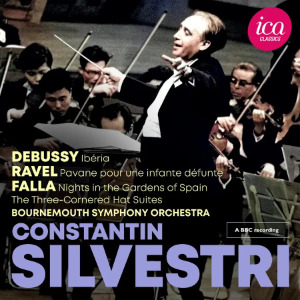
DEBUSSY: Iberia from Images pour Orchestre; RAVEL: Pavane pour une infante défunte; FALLA: Nights in the Garden of Spain; The Three-Cornered Hat: Suite I-II – Sylvie Mercier, piano/ Bournemouth Symphony Orchestra/ Constantin Silvestri – ICA ICAC 5182 (73:09) (1/25) [Distr. by Naxos[ ****:
ICA extends the recorded legacy of Romanian conductor Silvestri (1913-1969), noted for his excellent results with his Bournemouth Symphony Orchestra, especially between 1962 and 1968. In my brief Atlanta interview with one of his main students, Sergiu Comissiona (1928-2005), he praised Silvestri as “the most natural executor of orchestral colors, certainly comparable to the French masters.” Culled from Silvestri’s private collection and vividly restored by Glenn Gould and Paul Baily, all but the Ravel prove new to the Silvestri discography.
The set opens with the second of Debussy’s triptych Images for Orchestra, “Iberia,” from 31 March 1967. As Silvestri does in the music of Falla, Silvestri emphasizes the thinner textures to heighten Debussy’s color palette and its sensuous allure. The innate fire and volatility of Silvestri’s leadership shines through from the outset, a luminous we so often attribute to Toscanini. Silvestri takes a rather broad approach to the first sequence, Par les rues et par les chemins, attacking the percussive rhythmic strokes with a vitality competitive to what Pierre Monteux could garner in his various orchestral venues. A kind of sultry fever invests the colors, nuances of a rich, erotic life hovering just beneath the surface patina. The exotic, virtually Moorish tone painting becomes even more intense in the central Les Parfums de la nuit, where muezzin allusions permeate the lingering, serpentine atmosphere. The last sequence, depicting the Morning of a Day of Festival, literally throbs with seductive energy, the woodwinds, battery, and brass in competition for dominance in gypsy and flamenco figures. A lusty violin flares up in double stops, accompanied by tambourine strokes and a flirtatious clarinet. The last pages rise up, brass inflamed, an aural spectacle that continues to resonate long after the fermata.
Silvestri turns to a familiar staple by Maurice Ravel, his stately Renaissance dance originally conceived for piano in 1899, his Pavane for a Dead Princess, orchestrated in 1910. Essentially a rondo in G major, the music establishes a tenderly slow processional, enhanced by a number of 7th chords set in archaic, (Dorian) modal harmony. Horns announce the first of three motifs, of which the woodwind response insinuates an intimate eroticism, echoed flavored by gypsy and Chabrier allusions, and by the Bournemouth nuanced string line with harp. The ephemeral, transparent texture Silvestri conjures well reminds us of the magic Charles Munch could evoke from his Boston players. Recorded 22 April 1968, along with Falla’s concertante Nights in the Garden of Spain, the haunting rendition bears repetition.
For the Falla ‘concerto,’ Silvestri has the skills of pianist Sylvie Mercier (b. 1934), whose alternately gossamer and strikingly aggressive rendition reminds this reviewer of Gonzalo Soriano and his driven account with conductor de Burgos. Once more, the Moorish elements of the Iberian sensibility come to the fore, as in the Generalife Gardens, sinuous and flavored by gypsy and Andalusian impulses. Silvestri’s pace remains brisk but innately sensitive to Falla’s color spectrum, evincing from his players a plastic, kaleidoscopic tapestry in which the obbligato keyboard part serves to illuminate a glowing pageant. Distant Dance vibrates with pagan, savage possibilities, played quickly but with clear, rhythmic and color articulation. A mesmeric repetition sets in, with native horn and wind sounds intricately snaking through the textures. A jazzy sequence ushers us fervently to the lush transition, attacca, to the final panel, In the Gardens of the Sierra de Cordoba, whose strings whistle as the tutti thunders and Mercier performs lustrous guitar glissandos. The entire panorama relaxes in a haunted recollection of the former passions, the tympani’s underlining our and the piano’s nostalgia. A last Cri de Coeur announces a farewell to this land of palatial dreams and mystical enchantment.
Originally conceived for a two-scene pantomime The Magistrate and the Miller’s Wife (1917), a tale of an attempted seduction, Falla recast the music for Sergei Diaghilev and the Ballets Russe for a 1919 production, with choreography of twelve numbers by Leonide Massine. Gypsy, folk, and flamenco rhythms abound, as do passing references (in the uncut score) to Classical compositions by Beethoven and Stravinsky. Ernest Ansermet set the bar for recorded performances of this flighty and passionately whimsical ballet, but Silvestri proves himself an able alternative to my initiator to this score, the Columbia rendition by Dimitri Mitropoulos and the New York Philharmonic. Silvestri evokes a creamy, luxurious, triptych, as serpentine in the middle movement as it is ferally energetic in the outer dances. A truly dynamic addition to the Silvestri collection, the disc is a decided keeper.
—Gary Lemco