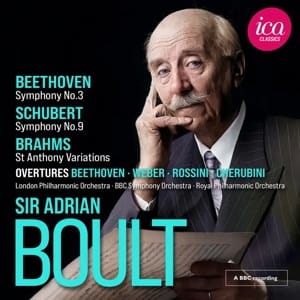
BEETHOVEN: Symphony No. 3,“Eroica”; BRAHMS: St. Anthony Variations; SCHUBERT: Symphony No. 9, “The Great” – Sir Adrian Boult – ICA Classics ICAC 5179 (2 CDs = 153:26, complete contents listed below) [Distr. by Naxos] *****:
I consistently dub British conducting maestro Sir Adrian Boult (1889-1983) “the English Toscanini,” given their predilection for textural accuracy, fast tempos, and a common, pedagogical debt to the German conductor Fritz Steinbach (1855-1916), whose repute in the music of Brahms proved influential to both interpreters. We inherit the direct benefit of this tradition on 3 October 1976, as Boult leads the BBC Symphony in the so-called “Haydn” or “St. Anthony” Variations of Brahms. We may also savor Boult’s splendid discipline with four other ensembles, each attuned to his stylistic adjustments in repertory essentially Classical and Romantic in character.
In point of fact, I began my audition with one of my favorite Beethoven creations, his 1822 occasional Overture to the Consecration of the House, written for the re-opening of the Josefstadt Theatre in Vienna. Boult’s performance of 19 June 1973 with the Welsh BBC Orchestra illustrates his sense of dramatic and lyrical continuity, firm in accent and color details. While the music begins austerely, in (Handelian) French processional style in dotted rhythm, the music soon erupts into a “learned” fugal procedure in four parts, and then into a passionate, six-beat figure that virtually explodes into the heavens. Boult does not dawdle here, urging the respective orchestral choirs to impart their throes of energy into a streamlined, polyphonic vision of unbridled power. I had to clap along with the enraptured audience.
While Boult’s association with Beethoven’s “Eroica” Symphony may be traced back to the 1920s, his recorded legacy in this piece emerges first in 1957, with a recording for the American Vanguard label. For the 10 May 1972 LPO performance captured here, Boult substituted for an indisposed Bernard Haitink. Boult was not wont to take the first movement repeat, but the Allegro con brio does suffers no diminution of dramatic girth. The emphasis on dynamic balances provides a particularly poignant aspect in Boult color accents and nuances, as the details of the conflict between rhythm and meter work themselves out, defying the urge to compromise offered by the tender wind and string melody. The pulse of the movement seems airborne, homogeneously disciplined, fixated on a pre-conceived resolution to the task of self-overcoming. The brass perorations at the coda prove heart-stopping, decisive.
Boult treats the central core of the work, the Marcia funebre: Adagio assaii more like andante, which adds a note of pained reminiscence to the memory of frustrated, naïve ideals, political and personal. The transition to the major key section, led by the woodwind choir and culminating in the brass, emerges with inflamed stoicism. The fugal development enjoys a severe, somber clarity. The opening march enters once more, only to succumb to a bitter horn orison over agitated bass figures thar soon engage in more bitter counterpoint that seeks consolation. Grudgingly, the somber mood dissipates, but the emotional catastrophe remains.
Boult takes the Scherzo in its full, bustling, energized form, including repeats. Crisp, clear attacks and palpable, controlled frenzy mark the occasion. The LPO tympani has been captured in all its insistent glory, as has been the brass trio’s “hunting” motive. The da capo, fleet and antiphonally aroused, takes us to the coda, a mere preparation for the “Promethean” final movement. Although a bit marcato to begin, the essential ground theme sets the tone for the Finale: Allegro molto series of variations that reveal a strong homogeneity of pulse. The ensuing counterpoints, as prior, ring with fleet, clarion authority, learned but dramatically urgent. The inevitable progress from Poco andante to Presto exhibits the same thoughtful control by Boult, impassioned yet artfully shaped like the culmination to an expansive, operatic scene of noble aspirations realized.
The 30th anniversary of the BBC Third Programme (3 October 1976) provides the occasion for Boult’s performance of the 1873 Brahms St. Anthony Variations, among the composer’s most genially seamless works in lyrical and contrapuntal figures. The B-flat major theme, divided into two five-bar phrases accommodates a number of character studies in various tempos, and finally a passacaglia that forecasts the same procedure in the finale of the E Minor Symphony. Boult’s touches here establish a suave, resonant patina, equally capable of grace – as in the Andante con moto Variation IV and Grazioso (siciliano) Variation VII and muscular girth – as in Variations I, the rousing Vivace Variation VI, and the marvelous Finale: Andante.
Boult’s familiarity with “The Great” Symphony of Franz Schubert dated back to 1926, and so the performance offered here, from 2 Mach 1977, confirms a long, thoughtful concept based on practiced experience, including twelve recordings. In his informative notes for this ICA set, Martin Cotton provides particular details to the respective virtues of Boult’s recorded versions of 1934, 1954, 1969, 1972, and this present document. Even without Schubert’s repeats, Boult accords a flowing, walking lyricism to the opening Andante – Allegro non troppo that, at first, reminded me of Mengelberg’s singing version, not to mention that of Toscanini. The transition to the virile Allegro, smoothly rendered, no less projects a rustic pomp. The BBC winds and brass resound alertly, their dancing resonance balanced by the tireless, steady motions of the BBC strings. The many antiphons of color rise up to form a grand arch of processional sound, intricate in its melding of competing tempos and harmonic shifts. The peroration assumes a lyrically dramatic power, brilliant and luminous.
Boult always insisted the ensuing Andante con moto not be realized too briskly, allowing the opening oboe to instill a mood of nostalgic wistfulness in A minor, asserted even more strongly in the autumnal contrasting section in F major. A wonderful, tempestuously martial eruption arises, only to relent into the sweetly consolations of the secondary motive in long lines. Boult maintains all the repeats for the third movement Scherzo, which exhibits a natural schwung and rusticity, complemented by the Austrian laendler of its Trio section. The sudden shifts of timbre and dynamics occur so artfully, we hardly feel the precisions required. Not quite attacca, the last movement, Finale: Allegro vivace, thrusts itself upon us, both transparent in texture and inexorable in momentum. Boult proffers a virtuoso reading, seamlessly unmannered in execution and direction, much in the long lines of his admired Toscanini. The BBC trumpets and tympany, hearty and robust, contribute to an elastic, eminently persuasive performance that the attending audience and we might relish for posterity.
The set concludes with Boult’s approach to three familiar overtures: Weber’s Euryanthe (22 June 1973) with the BBC Welsh Symphony exudes spirited energy and lyrical warmth. Boult had recorded the work prior, in the 1930s with the BBC. From Glasgow (4 August 1973), Boult delivers a light, streamlined version of Rossini’s Silken Ladder Overture, certainly the “patter” articulated with his idol Toscanini in mind, since The Maestro’s 1930 BBC recording had made it to Boult’s “Desert Island” list in 1960. At last, in honor of the 150th anniversary of the Royal Philharmonic Society, Boult leads Cherubini’s Anacréon Overture, which had graced the program of 1813. No less a favorite piece of Willem Mengelberg, the music shows off the resonant luster typifying the RPO strings, winds, and brass. The layered sound Boult elicits illustrates his sense of color balances, superbly rendered. An excellent addition to and extension of the Boult recorded legacy, this set comes highly recommended.
—Gary Lemco
Sir AdrianBoult
Album Contents
London Philharmonic Orchestra/
BEETHOVEN:Symphony No. 3 in E-flat Major, Op. 55 “Eroica”
BBC Welsh Orchestra
BEETHOVEN: Overture to the Consecration of the House, Op. 124;
WEBER: Euryanthe Overture;
BBC Symphony Orchestra/
BRAHMS: St. Anthony Variations, Op. 56a;
SCHUBERT: Symphony No. 9 in C Major, D. 944 “The Great”
BBC Scottish Symphony Orchestra/
ROSSINI: La scala various sections anI seta – Overture;
Royal Philharmonic Orchestra/
CHERUBINI: Anacréon Overture