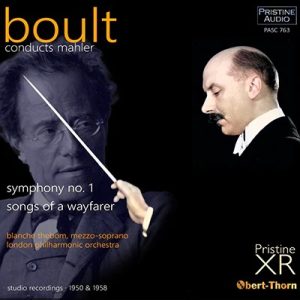
MAHLER: Symphony No. 1 in D Major; Songs of a Wayfarer – Blanche Thebom, mezzo-soprano/ London Philharmonic Orchestra/ Sir Adrian Boult – Pristine Audio PASC 763 (61:58) [www.pristineclassical.com] *****
Producers and Recording Engineers Mark Obert-Thorn and Andrew Rose have resuscitated two Mahler performances 1950 (for RCA) and 1958 (for Everest), respectively, led by Sir Adrian Boult (1889-1983) and featuring American mezzo-soprano Blanche Thebom (1915-2010) in Mahler’s 1885 lyric song-cycle, Lieder eines fahrenden gesellen. Unlike Bruno Walter’s CBS recording with Mildred Miller, this reading enjoys a lyric directedness and aerial suasion without heaviness, despite the songs’ bittersweet melancholy of unrequited love. While Bruno Walter had the direct communication with Mahler and his musical circle, Boult – much influenced by the conducting pedagogy of Fritz Steinbach – pursues a literal, unsentimental, understated approach that maintains emotional dignity and requisite passion at all points of expressiveness.
The music moves between a communion with Nature’s beauty and its simultaneous neutrality, even cruelty. The beloved’s eyes, more than any other feature, haunts the narrator, infiltrating the calls of Nature and its seductions to love, tinging the very atmosphere with a dire implacability of tragic fate. The second of the songs celebrates the tangible urge to Nature’s procreative power, the overwhelming beauty of the fields, the lust for life. The melodic tissue, pregnant to become the motif of the First Symphony, basks in its own lyric aspirations to eternal beauty. Thebom nuances her diction and timbre to allow resignation to color the last measures, just prior to real anguish of the third song, “I have a burning knife in my breast.” This powerful expression of fatal passion approaches an operatic scena, rife with aching, relentless self-reproach. The last of the songs condemns the narrator to amorous exile, at the behest of the beloved blue eyes. The funereal motif will no less appear in the third movement of the First Symphony. Here the fatal tempo accompanies a series of farewells, much in the spirit of Schubert. Harp and strings introduce a new theme, a quest for forgetfulness, some balm in Nature to quell the sense of eternal loss. The orchestral tissue seems to proclaim Nature’s indifferent judgment on such suffering.
Everest recorded the 1888 First Symphony in stereo, and the sonic impact remains transparently immediate. The inverted pedal point that marks the first movement’s pantheistic fanfare injects a sovereign mystery to the proceedings, what will become an emotional calamity in the very brightest of settings. The harp chords convey a delicate, personal anguish in the midst of an existential plenty. By the latter part of the development, the song Ging heut’ Morgen über’s Feld, has been compounded into a dire and solemn tocsin, an admixture of consolation and wrenching loss.
The A major Scherzo and Trio, based upon an Austrian Ländler, has rarely sounded so innately waltz-like, taken at a brisk, unmannered tempo. The music gains force and urgency, a momentum that would belong to Toscanini, were he inclined to lead this music. We move immediately into the D minor funeral-march parody on Bruder Jacob, the French folk song now a grotesquerie after E.T.A. Hoffmann and Callot, announced by the symphony’s double-bass. The middle section, with its klezmer motifs, sounds like circus music that anticipated Kurt Weill. Suddenly, harp and strings, as in the last of the Wayfarer cycle, intrude with the longing for forgetfulness, exuding the languor of world-weariness. The funeral march returns, more insistent, more unremitting, undercut by the black humor of self-incrimination. The high dissonances in th winds might come from a strangled Till Eulenspiegel.
Despite the chaotic, even vulgar, assaults of the F minor tempest announcing the last movement, Boult manages a sobering clarity of line, the various thematic impulses articulated with dramatic and linear force, while favoring what Obert-Thorn characterizes as “balance over excess.” The melodic counterthemes offer solace and romantic vigor, at once. The LPO battery section, along with the brass, make their presence known, the sudden shifts of texture superbly transitioned with a smoothness that likens this final, emotional construct to a Liszt one-movement symphonic poem. At just after nine minutes, the opening pedal-point returns, a call to cyclicism, pregnant with Nature’s contradictory imperatives. For Mahler, as perhaps for James Joyce in his collection Dubliners, love (in fugato) survives the irrevocable desolations, a result of the persistence of human will. Here, in Mahler’s exalted return to D major, he exerts his most Beethoven-driven energy, a martial herald of the mortal storms that lay in wait for music’s most tormented, inspired soul.
For Mahler with a distinct difference, this album comes much recommended.
—Gary Lemco