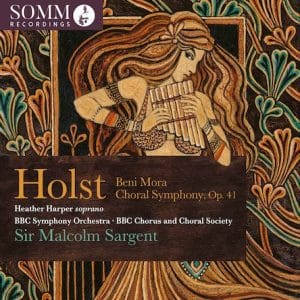
HOLST: Beni Mora – Oriental Suite for Orchestra in E Minor, Op. 29/1; Choral Symphony, Op. 41 – Heather Harper, soprano/ BBC Chorus and Choral Society/ BBC Symphony Orchestra/ Sir Malcolm Sargent – SOMM Ariadne 5040 (65:37) (4/25) [Distr. By Naxos] ****:
In 1908, Gustav Holst (1874-1934) visited – ostensibly for his health – Algiers in North Africa, courtesy of funds provided by friend and musical colleague Ralph Vaughan, Williams. Already fluent in Sanskrit and an ardent consumer of literature devoted to the East, Holst felt attuned to the indigenous folk elements of Algiers and noted a particular, eight-note phrase repeated by a local musician on a bamboo flute. The riff would find its way into the Orchestral Suite in E minor as its last movement, In the street of Ouled Naïls, the title borrowed from the Robert Hitchens novel The Garden of Allah. The urge of “exoticism” in music appealed to Holst, and he captures the street milieu of nasal tones through the English horn (in First Dance) and harp, and the hypnotic effect of hookah-induced reveries in the finale, by having that bamboo flute motif repeat 163 times in diverse colorations.
Beni Mora (1912) divides into three sections: First Dance, Second Dance, and In the street of Ouled Naïls. If First Dance establishes the mystique of the Arab world by way of effects similar to those employed by Rimsky-Korsakov and Borodin, Second Dance, utilizing bassoon, strings, and tympani, offers an even more sultry atmosphere, pulsating with erotic possibility. The mist dissolves with faint brushes from the tympani. Low strings announce the last movement, introducing the persistent motif that serves as a mantra throughout, dynamically conceived along the same lines of Ravel’s later Bolero. The tune breaks off into tributaries of sound, in various rhythms and color combinations, with tambourine, elevated strings, and tympany and brass most urgent. Most Holst scholars see the suite as a preparation for Holst’s most ambitious and successful score, The Planets. Sir Malcolm Sargent recorded Beni Mora in stereo for HMV on 29 August 1956, and SOMM’s restoration engineer Lani Spahr appears to have left well enough alone.
Sir Malclm Sargent enjoyed a natural capacity for large, choral forces, and the 1924 Choral Symphony of Holst affords him an opportunity – albeit captured off the air (22 January 1964) in monaural sound – to demonstrate his capacities for balance and dramatic emphases. One could argue that Holst’s choice of texts – a random collection of verses by John Keats (1795-1821), among the more Classical of the British Romantics – resist any attempt at coherence or aesthetic closure. The Symphony consists of a Prelude and four movements, of which the Prelude sets “Invocation to Pan,” and the last, longest movement splices diverse Keats poems, ending with orations to Apollo, “Ode to Apollo,” and another ode, “Bards of Passion and of Mirth.” The solo soprano for this performance, Heather Harper (1930-2019) gave this reviewer considerable pleasure in a 1970 performance of the Richard Strauss Four Last Songs at Carnegie Hall, the New York Philharmonic Orchestra under the direction of guest Rudolf Kempe.
The first movement of Choral Symphony, “Invocation to Pan,” proceeds solemnly, awaiting it would seem, “a touch ethereal – a new birth,” before the chorus and orchestra may swell with voluminous lyricism. The “Song and Bacchanal” (from Endymion) marks the beginning of the music’s many complexities in rhythm, here in 7/8, that stir the melancholy spirit of the solo singer (and viola) with mad dancing, “such glee,” and wine that “follows Bacchus through the earth.” The orchestral and vocal forces rush at us in timbrel and tympani, a fierce declaration of pagan power. The second movement, an adagio, derives from “Ode on a Grecia Urn,” an attempt at Attic serenity, albeit touched at the end by existential doubts. A processional mood suffuses the movement, piously aesthetic. “Heard melodies are sweet, but those unheard/Are sweeter.” Modal harmonies take us to the lover who seeks, ever, to embrace his elusive goal.
Ensues a brief, whirling Scherzo: Fancy Chorus taken from the posthumous Extracts from an Opera. “Open wide the mind’s cage-door” implores the chorus in pantheistic tribute. The tone of the long poem resembles the sentiment in Wordsworth’s “The World is Too Much with Us, Late and Soon,” in that materialism, constancy, and convention have spoiled Man’s capacity for spontaneity and unmitigated delight in Nature. Sargent keeps the rhythmic pulse moving, and the striking harmonies in concert with the epic momentum, remind us of the virtuoso choral effects created later by Carl Orff.
The nineteen-minute last movement, Finale, likely announces the weak link in this massive concept: it seems a somewhat stolid hymn to Apollo and the Nine Muses, an expansive celebration of the spirit of Art, akin to the finale in Scriabin’s First Symphony. An attempt to fuse all opposites and contradictions in human nature: “sorrows and delights,” “passions and their spites,” “their glory and their shame,” resonate as the intent of the verses. Solo Harper and Chorus invoke Homer, Milton, Spenser, Shakespeare, and Tasso as the rightful heirs to the pure, aesthetic vision, the “Tales and golden histories/Of heaven and its mysteries.” But despite our contemporary criticisms, Holst felt had had advanced as a composer by avoiding a simple reprise of the means of The Planets, declaring, “I think the work as a whole is the best thing I have written.”
—Gary Lemco