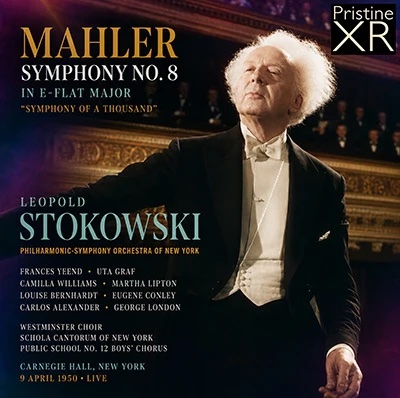
Stokowski = TCHAIKOVSKY: Symphony No. 5 in E Minor, Op. 64; Solitude, Op. 73, No. 6; Humoresque, Op. 10, No. 2; CHOPIN: Prelude in E Minor, Op. 28, No. 4; Prelude in D Minor, Op. 28, No. 24; HANDEL: Pastorale from The Messiah; IPPOLITOV-IVANOV: In a Manger; J. STRAUSS: On the Beautiful Blue Danube; Tales from the Vienna Woods (abridged versions) – Symphony Orchestra/Leopold Stokowski
Pristine Audio PASC188, 74:03 [www.pristineclassical.com] ****:
Pristine issues what would have likely constituted the Leopold Stokowski Society’s final album for Cala Records, the February 10-12, 1953 Tchaikovsky Fifth and eight selected encore pieces. The E Minor Symphony (from RCA LM 1780) has Stokowski before “His” Symphony Orchestra of New York musicians culled from the New York Philharmonic and MET orchestras, homogeneously producing the “Stokowski Sound” to produce a virile, often explosive performance in enhanced sonics, courtesy of the Pristine XR process.
Doubtless, Stokowski never played the E Minor Symphony the same way twice, so his emendations to the score would assume various guises, rife with idiosyncratic rubato and dynamic accents. The opening movement stretches broadly across some fifteen minutes of performance time, alternating its “fate” motif with any number of balletic gestures. Certainly, there are moments when one would certify that the implacable Mravinsky might be active in this fierce vision, especially in the latter two movements. The D Major Andante proves extremely lyrical and passionate, again enjoying that self-indulgent expansiveness Stokowski could bestow on his favored repertory. The Valse–whose viola playing in the middle section quite fixes our ears–and Finale move with gracious deliberation and resonant authority, respectively, the last pages of the symphony militant without having become clichéd by familiar phrasing. The ferocity of the playing and the clarity of the orchestral definition made the realization commendable even its own day; in improved audio imaging, the cumulative effect achieves an imperious authority.
The eight encore pieces are hereby assembled from a number of sources, none of which has had CD incarnation. The settings of Solitude and the Humoresque derive from RCA LM 1774 (25 February 1953) devoted to Tchaikovsky’s Aurora’s Wedding. Solitude begins with misty agonized strains we might attribute to a tragic song or elegiac melody by Grieg. Winter winds wail through the ice storm, perhaps inn evocation of Schubert’s Winterreise cycle, here ending with a tolling bell. Humoresque offers a nasal tinkling divertissement, and its charm induced Stravinsky to borrow it for The Fairy’s Kiss. More piano arrangements come in the form of two Chopin preludes (from 8 November 1950 and RCA LM 1238); the first, the E Minor that actor Jack Nicholson memorialized in Five Easy Pieces. Stokowski makes it surge and ebb in a manner Chopin would likely have called excessive. The D Minor, actually orchestrated for use in The Picture of Dorian Gray, here receives the royal treatment, the competing choirs of the orchestra–including triple-tongued trumpets–taking on the processions of the main theme as if it were Bach’s Toccata in D Minor. Over the top, yes; plumaged Stokowski, yes.
Restraint and stylistic repose, on the other hand, mark Handel’s Pastorale (27 March 1947), recorded at the same time as the Christmas carol In a Manger, orchestrated by Ippolitov-Ivanov and released on an extended-play 45 rpm. The latter piece intones and then swells in a manner typical of Russian liturgical doxology, reverent and inspired. Lastly, two “shortened” versions of Strauss waltzes, more suited to the cartoon medium than to the concert hall. The Vienna Woods recording (13 January 1955) utilizes an electric guitar to replace the zither Anton Karas might have provided. The Blue Danube moves even faster, cutting away much of the introduction that made the piece dear to Brahms. The music whirls at quick and elastic speeds, even lilting, so as to prove Stokowski could compete with Clemens Krauss if he would play the music straight. Kitsch, true; but then who could have done kitsch better?
–Gary Lemco