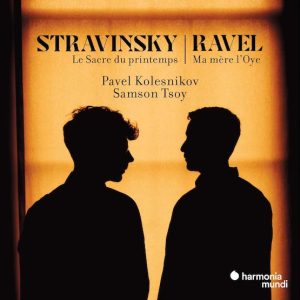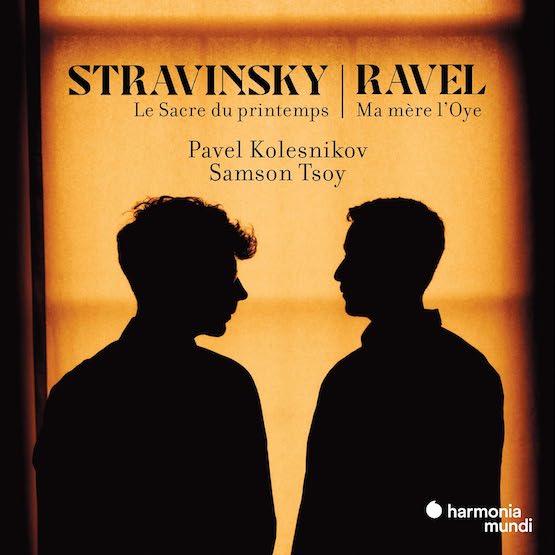
STRAVINSKY: Le Sacre du printemps; RAVEL: Ma Mere l’Oye – Pavel Kolesnikov and Samson Tsoy, piano – Harmonia Mundi HMM 902752 (49:20) (6/13/25) [Distr. by PIAS] ****:

Igor Stravinsky,
by Pablo Picasso
With the opening phrases of Stravinsky’s 1913 Le sacre du printemps on the solo keyboard, we refresh our complacent anticipations with a distilled, angular directness of expression, relatively bare and colorless, when compared to the assaulting, florid ostentation of the orchestral version. But the aesthetic of the sound context soon creates its own, self-enaclosed world, a percussively rich tapestry of vehement, primal energies. Stravinsky sought to depict – in his “Pictures of pagan Russia in Two Parts” – diverse, primitive rituals that celebrate the advent of spring, after which a young girl, serving as a sacrificial victim, dances herself to death. Stravinsky utilized traditional Russian and Lithuanian folk materials in his rhythmic complex, a potent dynamic, that combines duple and triple meters, along with harmonic innovation, to disrupt conventional notions of musical progress.
What proves astounding in this four-hand collaboration lies in the seamless continuity and momentum of a series of tableaux that shock in their cruel juxtaposition of elements. Unrelenting ferocity will break off into a disturbing calm, always before another percussive storm. The pianists’ attack in No. 4 of Part I, “Spinning Rounds,” moves from a music-box sonority to a disturbed haze of tones, some feral impulse from the depths of creation that travels upward, like thin-vapored lava, that soon erupts voluptuously. The distinction between clamor and music breaks, down, then rebuilds its idiosyncratic sense of melodic beauty, only to suffer disruption from pounding and sliding currents.
Part II, “The Sacrifice,” resets the stage with tremolo anticipations above and below a modal, primeval haze. An eerie intimacy, comprised of compound chords, invites us to a scene of potential horror. The Mystic Circle having been established, the rite imbibes the forces of the tribal ancestors to anoint the Chosen One in her simultaneous glorification and destruction. Rarely has a keyboard evoked the ecstatically punishing throes of willing, self-immolation as realized in the blistering agogics of the “Glorification” music. “The Ritual of the Ancestors” is reduced to a series of single-note, percussive beats against a hesitant parlando. The music circles to become mesmeric, the melody’s assuming a martial, lethal intent. The chant rises, a la Mussorgsky, to toll a reverberant, dark beatitude. And so we reach the culmination, the apotheosis of “purity,” in “The Sacrificial Dance.” The musical terrain becomes numbing, pulverizing, yet rife with expectant drama. The dance convulses, a virtual jazz improvisation that glories in dissonances and jarring metric asymmetries, an evil march a la totentanz. This world ends with a thud whose fermata resonates for an eternity.

Maurice Ravel, 1925
Tsoy and Kolesnikov attribute to Maurice Ravel’s 1910 Mother Goose Suite a sense of “musical magic” in his ability to capture the fairy tales from the 1695 collection of Charles Perrault, entitled Histories ou contes du temps passé. The “long ago and the far away” had its own allure for Ravel, who employed his refined sense of exotic, musical materials, like pentatonic scales and quartal harmonies built on fourths, in the manner of Scriabin. For his keyboard version of the original, orchestral score, Ravel distilled a modestly accessible, colorful arrangement that mysteriously evokes a profound innocence. For “Laideronnette, imperatrice des pagodes,” Ravel invokes Javanese impulses, the resonance of gamelan music, with pentatonic, stratified and percussive textures. In the course of “Petit Poucet,” Hop ‘o my Thumb, the weaving progress shifts from 2/4, 3/4, to 5/4, as the character loses himself amidst forest bird calls. Having deliberately “stripped my music of all ornament,” Ravel presents the poignant “Conversation between Beauty and the Beast” as a dissonant waltz rife with impulses from the opening piece, “Pavane of Beauty asleep in the woods.” The power of love magically transforms both participants. “The Fairy Garden” never fails to elicit a tear from this listener, as the ultimate homage to Paradise Lost, our childhood. For the orchestral version, none has captured the elegant mystery more than Koussevitzky. Here, the tender application of staccato and glissando piano tones beguiles us with the tapestry of a deliciously delicate pageant.
—Gary Lemco