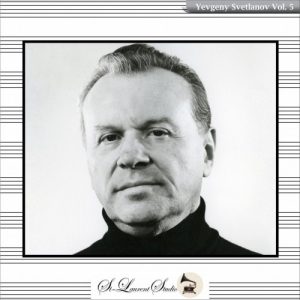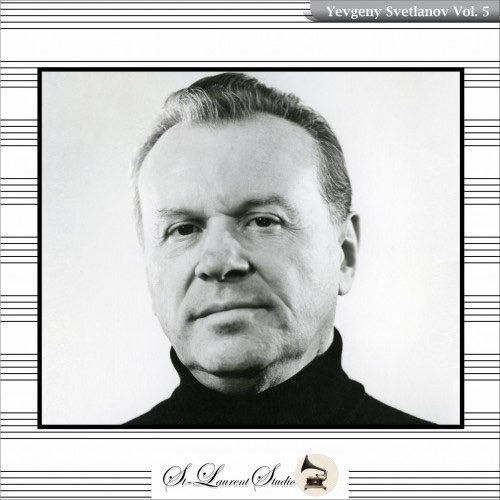
SVETLANOV VOL. 5 = GLINKA: Jota Aragonesa; FALLA: El amor brujo; El sombrero de tres picos, Suite No. 2; RODRIGO: Concierto d’Aranjuez in D major – Olga Alexandrova, alto/ Manuel Barrueco, guitar/ USSR State Symphony Orchestra/ Yevgeny Svetlanov – Yves St-Laurent YSL T-1702 (74:57) [www.78experience.com] *****:
Yves St-Laurent extends his recorded legacy for Russian maestro Yevgeny Svetlanov (1928-2002) with an all-Spanish program from Église Saint-Mattheiu de Colmar, France from 1-2 July 1994. The virtuoso temper of the selections by Glinka, Falla, and Rodrigo well suit the taste and natural flamboyance of the conductor, who literally revels in the color opportunities the scores present.
Svetlanov opens the July 1 concert with Mikhail’s Glinka’s Spanish Overture No. 1, Capriccio Brilliante “Jota Aragonesa” (1845), with its full complement of color instruments, from castanets to blaring trumpets. Glinka travelled to Spain in 1844, collecting tunes from various provinces. Glinka was often quoted, “A nation creates music – a composer merely arranges it.” In this case, Glinka captures the infectious spirit of the Spanish jota, its elastic exuberance, especially given Svetlanov’s insistence that every period should explode climactically.
From the July 2 concert, Falla’s 1915 El amor brujo, a gitaneria or danced gypsy melodrama, we recall, had been a splendid vehicle for conductor Leopold Stokowski, who left us two commercial performances – with Nan Merriman and Shirley Verrett-Carter – and one live broadcast with Gloria Lane. Svetlanov has his own ideas about tempo and sforzati, pulling back in tempo rubato and then exploding forward in caustic accents. Alexandrova contributes a nasal eroticism to her brief but passionate expressions of love and compulsion. Her Canción del fuego fatuo conveys a bitter languor of seething desire. The color elements of the score, from percussion, keyboard, and woodwinds, complement the combustion from the timpani and strings, especially in the marcato realization of the Ritual Fire Dance. The most vividly romantic episode, the Pantomima, evokes from Svetlanov his innate sympathy for Spain’s native soil, like that of Russia, aching with nostalgia. A fatal sensuality occupies the last two sections, Danza del juego de amor and Final: Las campanas del amanecer, despite the hint of wedding bells. The long courtship of love and death never relents as conceit in Mediterranean romance.
Joaquin Rodrigo’s 1939 Concierto d’Aranjuez in D major remains his most enduring composition, the guitar concerto’s having perhaps attained even more publicity by way of Miles Davis’s 1960 Sketches of Spain, which capitalized in the second movement Adagio in B minor. Cuban guitar virtuoso Manuel Barrueco (b. 1952) does the honors of the active solo part, with ample accompaniment from cor anglais, and pairs of flutes, oboes, bassoons, horns in F, trumpets, and strings. Svetlanov has no trouble realizing the Moorish and flamenco elements imbibed into this evocation of the Royal Palace of Aranjuez, its gallantry and ecstatic mystique. The intimacy of the second movement, strummed slowly and evocatively, gradually builds to its mighty crescendo, molto appassionato, with resounding force. The metric irregularities of the last movement, Allegro gentile in D, flow without any real sense that the music deviates between duple and triple time, elastic and bristling with both the dance and “the fragrance of magnolias, the singing of birds, and the gushing fountains” that inhabit the gardens of Aranjuez.
Svetlanov concludes with the most familiar excerpts from Falla’s 1919 ballet El sombrero des tres picos, its second suite, featuring the Miller’s Dance (Farruca) and the Danza final (Jota). The opening number, Los vecinos, Neighbors’ Dance (Seguidilla), provides a model of luxuriant clarity. The two remaining dances, earthy and emphatic, capture the erotic longing that motivates much of the ballet’s action. I had the good fortune to hear this music first by Dimitri Mitropoulos, who missed none of the music’s suggestiveness; nor is Svetlanov immune to the music’s festive and mesmeric energies.
The restored sound is first rate, having crossed the Pyrenees mountains successfully.
—Gary Lemco